

How to Reactivate a Dry (Dehydrated) Sourdough Starter: Easy Step-By-Step Guide
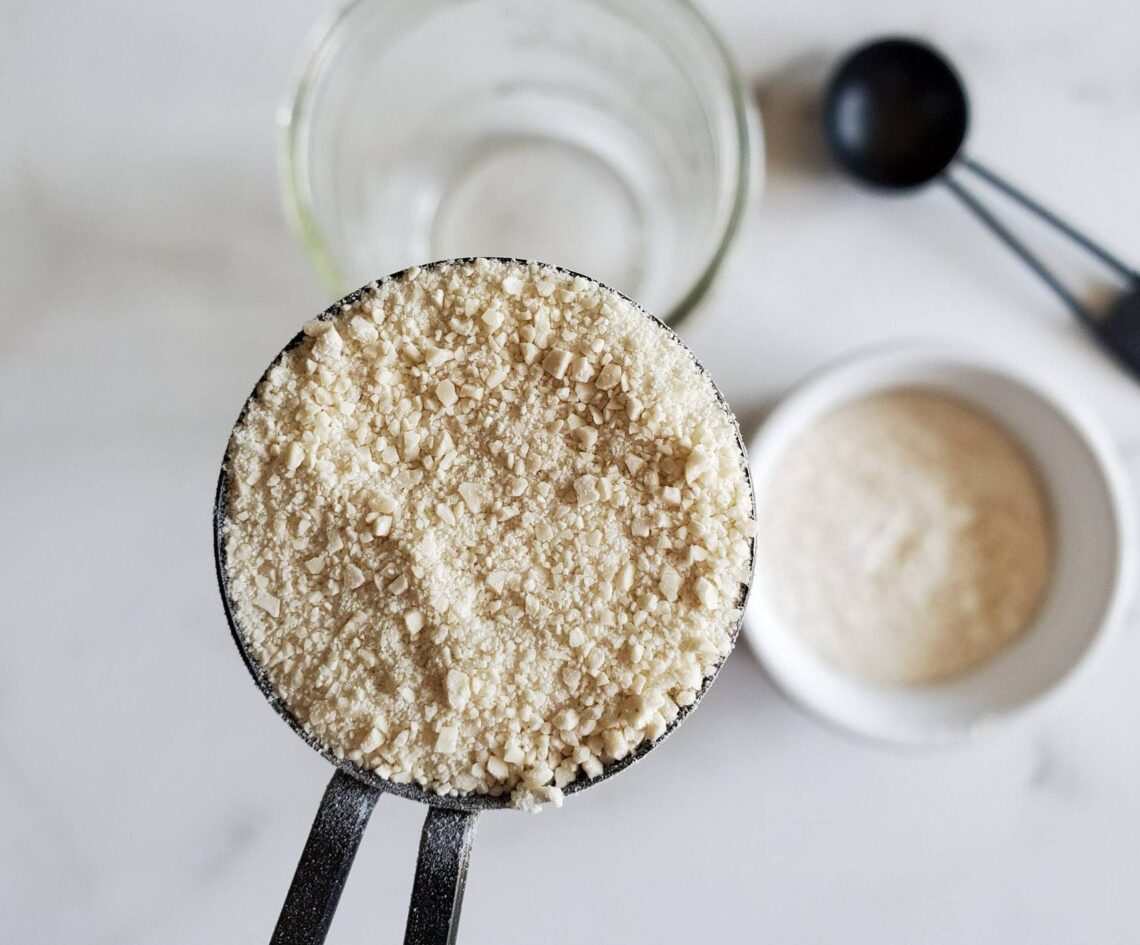
Welcome to your step-by-step guide on how to reactivate a dry sourdough starter. The process takes just under a week but is very easy to do! By the end, a small bit of dry sourdough starter will transform into a voluminous, bubbly, active starter – ready to bake with for many years to come!
If you obtained your dehydrated organic sourdough starter from us here at Homestead and Chill, thank you for your support! If not, no worries! This tutorial will work to rehydrate any dry sourdough starter (perhaps with some minor tweaks, see the “texture” tips below).
A printable summary and video are provided at the end of this article. I’ve also included some troubleshooting tips, though I don’t think you’ll have any issues. Once your starter is reactivated, head over to guide on how to feed sourdough starter for ongoing maintenance and storage tips. Don’t worry, it’s easier than you think!

Would you like to save this?
What is a dry sourdough starter?
Dry sourdough starter is made by dehydrating a portion of an active, healthy sourdough starter. We dry our organic starter using a low heat “living foods” setting in a food dehydrator. This preserves the beneficial lactic acid bacteria and wild yeasts that are responsible for making a sourdough starter bubble, and sourdough bread rise.
A dry starter is alive but is in a dormant state, and needs to be reactivated (rehydrated) over the course of a few days to slowly wake it back up. To do so, we’ll gradually add increasing amounts of flour and water each day – so you’ll have several cups of active starter by day 5.
Using a dry sourdough starter is a great way to kick-start your sourdough baking journey. It’s basically fool-proof! Rather than making sourdough starter from scratch (which is possible but can be tricky) you’re working with a strong, established culture from the start.
Supplies Needed
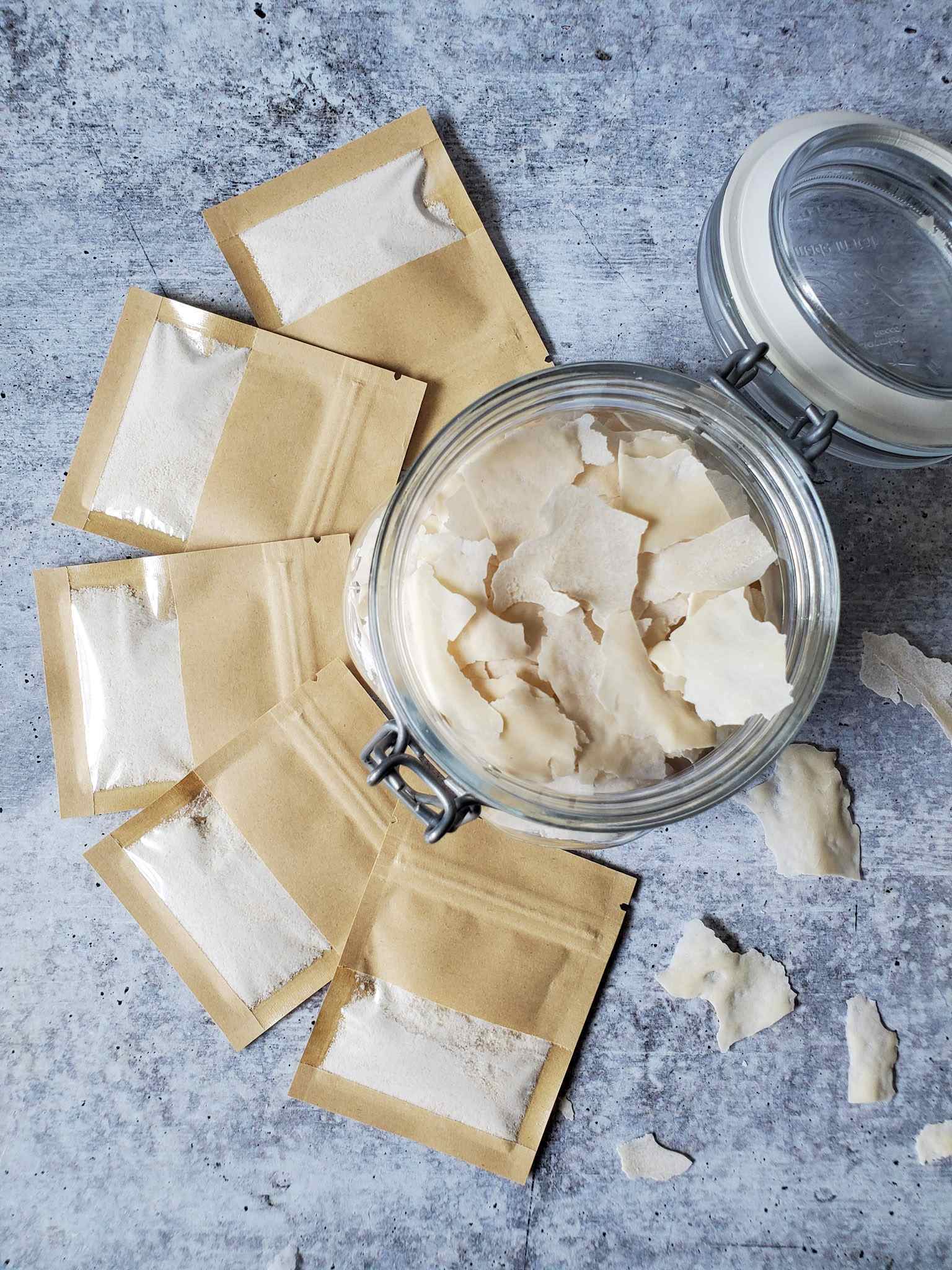
- 1 package of dry sourdough starter powder or flakes (or approximately 1 heaping half-tablespoon of ground powder)
- A pint size mason jar (or similar). Given the small volume, it’s best to start rehydrating the dry sourdough starter in an average jar, glass, or other similar size container.
- A larger glass storage container (e.g. quart, liter, or larger). On day five, we’ll transfer the active sourdough starter into a larger container – its forever home! We use a flip-top 1-liter glass container like this one. See the discussion about using bigger containers to maintain a larger volume of starter in the “Day 5” section below.
- All purpose flour or bread flour. We have experimented with reactivating a dry sourdough starter with both types of flours, and it works perfectly with both. Note that we use certified organic flour, which the microbes generally prefer but isn’t absolutely necessary. If you’d like to transition your starter to whole wheat or rye in the future, you absolutely can! However, I suggest using simple white flour when first reactivating the dry sourdough starter.
- Filtered water or spring water. Ideally, the water used to activate and maintain a sourdough starter is free of chlorine.
Key Tips Before Reactivating
- TIME: You will slowly reactivate your dry sourdough starter over 5 days, but each step only takes a few minutes per day. It’s best to do the feedings about 24 hours apart, though it doesn’t need to be exact. So, choose a time of day to start that you’re usually available, such as first thing in the morning, around dinner time, or before bed. Set an alarm if you’re forgetful!
- TEMPERATURE: Your sourdough starter will be most happy, active and balanced in a temperature range of about 70 to 75°F. Cooler conditions will lead to slower activation and a generally less vigorous starter. (Though we activated the dry sourdough starter shown in this tutorial when the house was 63-70°F without issue!) Now we use a handy starter warming plate for baking during the cooler winter months.
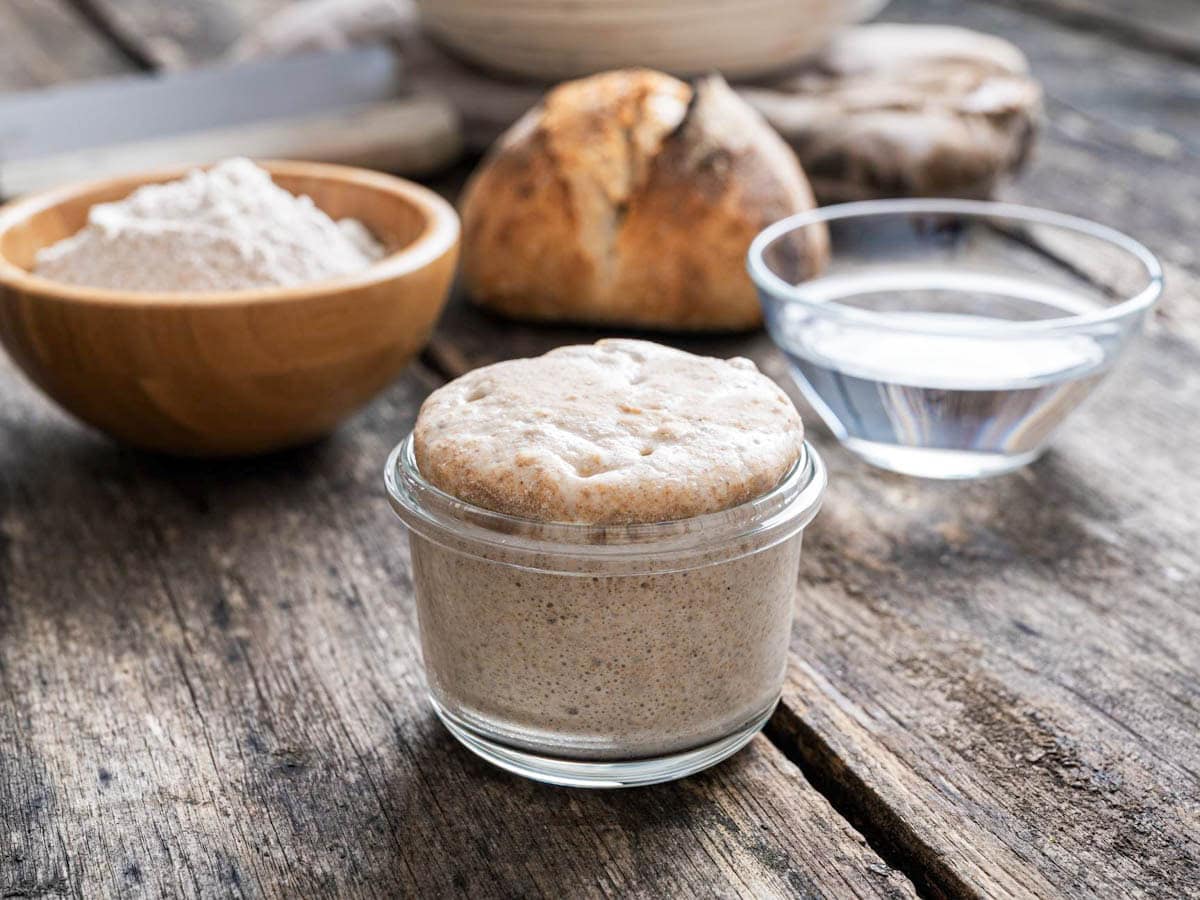
- TEXTURE: The ideal consistency for your sourdough starter is thick and gooey, kind of like marshmallow fluff. It should settle smoothly into the bottom of the container (not clump together like cookie dough) but also shouldn’t be too runny or pourable like pancake batter or it won’t rise well. So if at any time your starter seems too thick or too thin (especially a dry starter purchased elsewhere), feel free to add a sprinkle more flour or splash of water until the desired consistency is reached. Do so in small quantities, such as a teaspoon at a time (especially in the first few days).

Instructions
Day 1
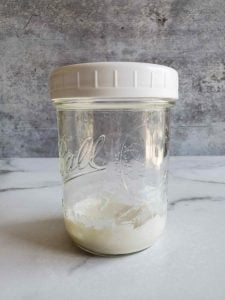
- In a clean pint-size mason jar or similar, combine one full H&C package of dry sourdough starter (approximately 1 heaping half-tablespoon) with 1.5 tablespoons of filtered lukewarm water. Avoid using cold water throughout this process, as it will slow down the activity of the starter. Allow the dry sourdough starter and water to sit for several minutes to soften and combine. Use a fork or spoon to stir it on occasion.
- Then, mix in 1 tablespoon of flour. Mix thoroughly. Try to avoid making a huge mess of the sides of your jar. Use the edge of your fork or a small spatula to clean up any major smears.
- Cover the jar with a lid. It doesn’t necessarily need to be air-tight; the purpose is to prevent it from drying out or allowing mold spores in. I only lightly screw on these BPA-free plastic jar lids. If you’re using a drinking glass or other container that doesn’t have a lid, simply set a plate on top, add plastic wrap, or a reusable beeswax wrap on top.
- Finally, set the container in a moderately warm location. Come back in about 24 hours.


Day 2
Into the same jar as yesterday, add 1 tablespoon of flour and 2 teaspoons of water to the starter. Mix well. Cover the jar or container again, and allow it to sit for another 24 hours.
Have you thought about a name for your sourdough starter yet? There is a tradition in the sourdough baking world to name your sourdough starter. In fact, it is considered bad luck if you don’t! Today sounds like a good day to pick a name. If you need any ideas, check out our list of the top 60 Punny Sourdough Starter Names.
Day 3
By day three, you may start to see fermentation bubbles in the starter! Repeat the same process as yesterday, adding 1 tablespoon of flour and 2 teaspoons of water. Mix, cover, and set aside.
During the next 24 hours, your starter may start to rise. Just for fun, mark the level of the starter on the side of the container after mixing (either with a washable glass marker or with a rubber band around the jar) and watch how much it rises.
Day 4
Today, we are going to increase the volume more than before. The growing sourdough starter should smell really nice by now, like sourdough and yeast – reminiscent of a brewery or bakery! That is an excellent sign she is getting stronger and can handle more food.
- This time, add 1/3 cup flour and 1/4 cup water.
- Mix well, until it looks like most of the flour clumps are broken up and the starter is fairly smooth.
- Cover the container, note the level of the starter on the side of the container, and set it aside again. If you’re using a pint jar, it should be about ⅓ full now.

Day 4 continued…
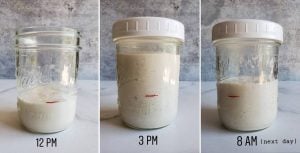
Within 12 to 24 hours, your starter should bubble, rise, and nearly double in size! If it doesn’t appear to rise at this stage, see the troubleshooting notes at the bottom of this article. You may need to adjust your consistency (e.g. make it slightly thicker), but it doesn’t mean the starter isn’t alive!
On the other hand, if your starter doubles in size and then quickly falls back down to the original starting point (a sign that it’s hungry) then you can move on to the next step sooner if you wish, instead of waiting a full 24 hours. (Smears on the side of the container are a sign that it rose and fell.)

Day 5
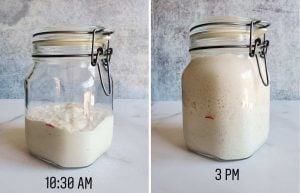
If your starter is now actively bubbling, rising and falling – congratulations! You have successfully reactivated the dry sourdough starter.
When a starter rises to double its size and then stays elevated, that is considered “peak activity”. Technically, it is ready to bake with at that point! However, at this stage in our reactivation journey, we don’t have quite enough volume for ongoing baking and maintenance. Every time you bake sourdough you must leave behind at least a half a cup of starter to feed and continue on. Therefore, we need to add more bulk to the starter, and also move it into a larger container – her forever home.
- Transfer your starter from the mason jar into a clean mixing bowl.
- Now, add 1 scant cup of fresh flour (just a hair shy of a cup!) and 1/2 cup of filtered lukewarm water. These measurements are approximately equal weights of flour and water in grams, which is the recommended flour-to-water ratio for ongoing starter maintenance.
- Mix well, and then transfer the starter into a new larger container of choice. Set it aside at room temperature once again.


Choosing a final storage container
We like to store our sourdough starter in a glass flip-top container that is at least 1 liter/quart (the very minimum) up to a 1.5 liter container. We are currently using this 1-liter glass container (34 ounces). It provides sufficient space for the starter to be fed and double in size, and it fits well in our fridge. We only ever bake one sourdough loaf or recipe at a time, and most of our sourdough recipes call for about 1/2 to 1 cup of active starter on average, so we don’t need to maintain a huge amount of starter.
However, if you plan to make several loaves of bread or other sourdough goodies at once, you’ll want to use at least a 1.5 liter to even a 2 liter container and maintain a larger volume of starter than we do. To make a larger starter, simply feed it again without discarding any.

My sourdough starter is active! Now what?
Please visit our guide on how to feed and maintain sourdough starter. There, I go over the various ways you can feed and store your starter. (“Feeding” is simply the act of adding more flour and water, and sometimes discarding a portion first.) For instance, some frequent bakers choose to leave their starter out at room temperature – but then it will need to be fed daily. Rather, most folks store their starter in the refrigerator, where it only needs to be fed once every week or two, or as little as once a month.
If you get to the final step and aren’t sure how to proceed, simply put the active starter in the refrigerator for now.
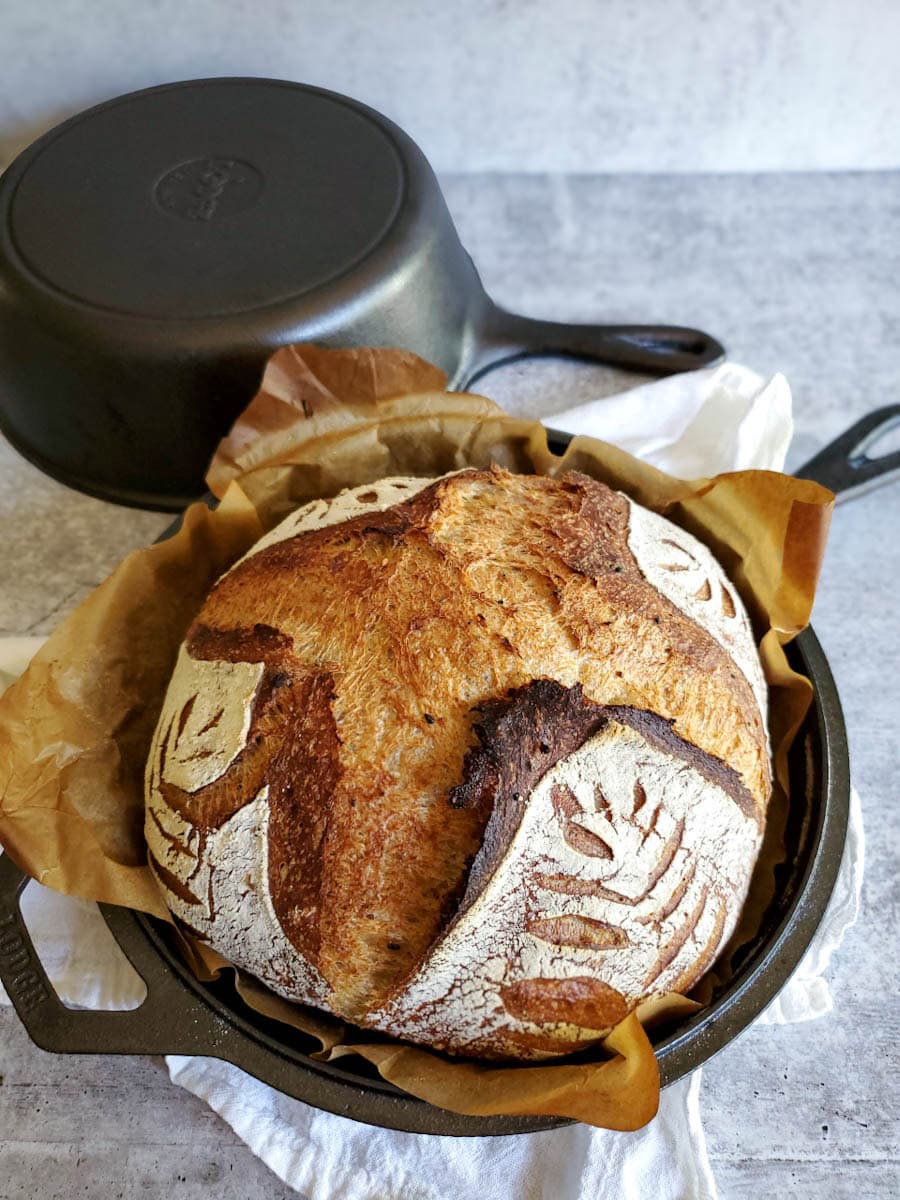
If you’re feeling ready to bake, pop over to our simple sourdough bread recipe – or give our easy sourdough focaccia recipe a try (which is even more beginner-friendly). Also feel free to browse this list of our favorite sourdough supplies including the cast iron combo cooker we bake bread in (it’s like an upside down Dutch oven).
Transitioning sourdough starter to a different kind of flour
If you want to feed your sourdough starter whole wheat, rye, or another type of flour, feel free to do so! In fact, many starters become even more vigorously active with wheat and rye flour. I suggest easing the starter into the change, by gradually adding the new flour type mixed with the original flour that it is accustomed to eating.
For example, if you’re currently feeding your starter all-purpose flour, try using 3/4 cup AP and 1/4 cup whole wheat for the first feeding, see how it responds, then increase to half and half, and so on with subsequent feedings. We often feed our personal starter half bread flour and either half whole wheat or half rye.

Troubleshooting Tips
If your starter isn’t rising, consider the following factors that may be causing issues. Or, learn even more in this guide: 9 Ways to Make Sluggish Sourdough Starter More Active.
- When a sourdough starter is too wet or runny, the fermentation bubbles will rise right through and out of the mixture, rather than being trapped inside and creating rise. So if your starter is easily pourable (like thin pancake batter), stir in more flour to stiffen it up. Add just a tablespoon or two at a time until it becomes more thick and gooey, but not a solid ball of dough.
- Cold temperatures lead to decreased starter activity. If your house in on the cool side, try to find a warmer spot to store your starter such as near or on top of a warm appliance. You could also use a handy starter warming plate – made specifically for this task! Another trick is to place the starter inside the oven – with the oven OFF, but the oven light ON. (But use caution not to accidentally pre-heat and cook your starter!)
- Your starter may simply be hungry. Once it rises and falls, it will not rise again until it’s fed more fresh flour and water. So, if it has been sitting out for a few days and it hasn’t risen yet, it won’t magically start doing so! Try discarding half of the contents in the container and then feeding it with a scant 1 cup of fresh flour plus 1/2 cup of lukewarm filtered water. It should perk back up!
What is that dark liquid on the top of my sourdough starter?
When a sourdough starter has run out of food, it produces a thin dark layer of alcohol-like liquid on top called “hooch” – a natural byproduct of yeast fermentation. Hooch is normal and harmless; it simply means your starter is hungry and needs more flour and water. You can either pour the hooch off the top, or mix it back in (which will make it more sour-tasting, some folks like that) and then discard and feed as usual.
RELATED: If you’re ever unsure about the looks of your starter, or, if you ever go many months without feeding your starter and it has a lot of hooch, please visit this guide: Is My Sourdough Starter Bad? How to Revive Old Inactive Starter.

And that is how you rehydrate a dry sourdough starter.
Please, do not be intimated by the process. It is incredibly easy! By starting with an established healthy colony of lactic acid bacteria and yeast, you’re already miles ahead of the game. You’ll be baking your first loaf of sourdough bread in no time.
Once your starter is active and ready, try some of our favorite sourdough recipes:
- Simple No-Knead Sourdough Bread Recipe
- Sourdough Discard Crackers Recipe
- Simple Sourdough Focaccia Bread Recipe
- Sourdough Granola Recipe (Discard or Active Starter) with Fermented Option
- Healthy Sourdough Spiced Pumpkin Bread (or muffins)
- Delicious Sourdough Zucchini Bread (or muffins) with optional nuts, seeds, chocolate or dried fruit
- Sourdough Chocolate Chip Cookies: Cinnamon Spiced & Salted
- Sourdough Ginger Molasses Cookies (Soft and Chewy)
Please let me know if you have any questions. We’d also love to hear your success stories with a review or comment. Thanks for tuning in, and happy baking!

How to Reactivate a Dry (Dehydrated) Sourdough Starter
Equipment
- Pint-size glass mason jar and lid or similar (for initial activation)
- Larger glass container, such as a 1 to 2 liter glass flip-top container (for ongoing starter storage)
Ingredients
- 1/2 Tbsp dried sourdough starter culture
- white bread flour or all-purpose flour (amount varies with each step)
- filtered lukewarm water (non-chlorinated, avoid using cold water)
Instructions
Day 1
- In a clean pint-size mason jar (or similar) combine 1/2 Tbsp of dried sourdough starter powder or flakes (one H&C package) with 1.5 Tbsp of filtered lukewarm water. Allow the dry sourdough starter and water to sit for several minutes to soften and combine. Use a fork or spoon to stir it on occasion.
- Add 1 Tbsp of flour. Mix thoroughly. (See consistency notes below)
- Cover the jar with a lid, beeswax wrap, plate, or other cover to prevent it from drying out. Set the container in a moderately warm location (70 to 75F is ideal). Come back in about 24 hours.
Day 2
- Into the same jar as yesterday, add 1 Tbsp of flour and 2 teaspoons of water to the starter. Mix well.
- Cover the jar or container again, and allow it to sit for another 24 hours.
Day 3
- Repeat the same feeding process as Day 2 (1 Tbsp flour and 2 teaspoons water).

Day 4
- This time, add 1/3 cup flour and 1/4 cup water to the starter. Mix well.
- Cover the container and set aside once again. Consider marking the level of the starter after feeding. It should rise quite a bit by this time!
Day 5
- Transfer your starter from the mason jar into a clean mixing bowl.
- Add 1 scant cup of fresh flour (just a hair shy of a cup!) and 1/2 cup of water. Mix thoroughly.
- Transfer the starter into a new larger container of choice (such as a 1 to 2 liter glass flip-top jar). This will be the starters "forever home". Set it aside at room temperature once again.
- If your starter is now actively bubbling, rising and falling – congratulations! You have successfully reactivated the dry sourdough starter. When a starter rises to double its size and then stays elevated, that is considered “peak activity” and is ready to bake with. It will deflate after a few hours and need to be fed or refrigerated.
Notes


133 Comments
Jill
Bought your dehydrated starter and used your instructions on rehydrating. They were so easy to follow and not hard to do. Love how simple you made this process of joining in on becoming sourdough bakers! So happy! Thank you so much for great product and well written and thought out steps and videos!
Aaron (Mr. DeannaCat)
Hi Jill, so great to hear activating the starter was so simple for you and thank you for your order, have fun baking with sourdough!
Lyndsey
Hello 🙂
Looking at different options for rehydrating starters and notice that you don’t do a discard… can you help explain? I am new to this and would love to learn. This seems much simpler and would provide you with more for baking so I’m confused what the discard is for?
Thanks!!!
Aaron (Mr. DeannaCat)
Hi Lyndsey, when it comes to baking with sourdough we definitely discard, however, when it comes to rehydrating a dry sourdough starter, we don’t discard while we are building the healthy bacteria to eventually end up with a healthy sourdough starter that can be used in baking. Once you have an active sourdough starter, you need to discard some of the old sourdough starter to make room for the feeding of fresh flour and water to continue to grow and populate the healthy population of bacteria. We have many more articles on sourdough and sourdough baking recipes in general that you may find helpful:
6 Ways to Use Sourdough Starter Discard – not just baking!
How to Make Sourdough Bread More Sour Tasting
Simple Sourdough Focaccia Bread Recipe
Simple No-Knead Sourdough Bread Recipe
Thea
Hi Deanna!
I forgot day 4 😭 ugh!!
48 hours later I just did the 1/3 cup and 1/4 cup. Any advice?
It was pretty runny and maybe a little bubbley when I stirred it before adding. I’m scared I killed it!
Aaron (Mr. DeannaCat)
Hi Thea, you will be just fine! The process is really forgiving, it seems you just did the day 4 feeding now so I would just continue with the steps as instructed in the article. If your starter was bubbly, that is a good thing, the texture of the starter before you feed isn’t that big of a deal as that can fluctuate depending on how much flour or water is added. You should have a healthy and active sourdough starter here within the next few days, hope that helps and good luck!
Mary W
Learned something new – thanks. I always thought starter had to breathe so used a coffee filter/rubber band covering. I kept a ‘spare’ starter in the fridge and took it out to ‘breathe’ every few days. I’ve kept mine alive for almost 2 years and adore the smell of starter and things to cook – pancakes! Just don’t care for bread. Now I don’t have to worry about the breathing nor the liquid ratio. I reduced mine to more in line with what you have shown since mine was sluggish and not full on bubbly. It rose and behaved fine but wasn’t like I see in others. Once I reduced the liquid (Florida is so humid) it all fell in line. I’m going to try your weekly refrigerator method. THANKS
Aaron (Mr. DeannaCat)
That’s great to hear Mary, we really follow a simple approach in regards to feeding our starter, just cup measurements and “eyeballing” the amount of discard so we generally start off with close to the same amount of starter in the jar before feeding (usually an inch or so in the bottom of a quart mason jar). Don’t have to mess with weighing starter, flour, or water to have a successfully active starter, especially once you get it down. Have fun baking!
suzi
I moved recently and dried my starter on parchment paper then broke it up into potato chip size pieces for travel. I have a generous amount. how to I follow your instructions working with the chips ? I assumed I would be rehydrated the whole shebang but… is there a volume advantage to rehydrating a larger amount to start? i’ve kept my starter in the fridge in the past making only one loaf every month or more. thank you.
Aaron (Mr. DeannaCat)
Hi Suzi, if you have a blender, just blend up your starter pieces into more or less of a powder, from there, it will be easier to follow our reactivation instructions. I don’t think there is too much advantage to using a large amount of dried starter at once, even using a small amount, you typically have close to a quart of starter once it is fully active on the 5th day from starting the activation. Hope that helps and have fun baking!
Elly
I started my sourdough starter last night at 6pm. Left it in a warm place with loose lid. This morning there’s already bubbles is that bad? Should I feed it more often?
Aaron (Mr. DeannaCat)
Hi Elly, bubbles are not bad, that is a sign of life and activation. Stick to the steps we have outlined in the article and you should have a healthy and active sourdough starter to use for baking within 5 days or so. Hope that helps and have fun!
Lacey
I have had my own starter for almost 4 years but it has just never produced a strongly risen dough/loaf. I have tried all the recommendations I could find online to revitalize my starter and make it stronger but to no avail. I bought some of your starter in the hopes that it will perform better than mine. Is there any method I could use to activate/combine your dried starter with my already existing (albeit somewhat weak) starter? Even though mine hasn’t performed great I feel attached to it and don’t want to abandon her totally if I can help it 😂
Aaron (Mr. DeannaCat)
Hi Lacey, first, thank you for your order of our sourdough starter! Second, I would probably just stick to our activation instructions and keep the sourdough starter separate from your original. Once it’s fully activate, you can always combine some of the new starter with your old starter and see if it revitalizes itself some, then you still have some of the new starter to fall back on if you can’t get your old one moving. Hope that helps and have fun baking!
Mac
Hi!
Thank you for the detailed guide, it’s a huge help!
I’ve been following this process to revive some old starter I was gifted (I don’t know how long it’s been dehydrated, but I can safely say I’ve had it least 2 and a half years in the cupboard).
It actually seems responsive, and it did grow following the steps above for the first week.. bubbles appearing from day 2.
My issue is that it’s never fully doubled. My understanding is, when people say “doubled”, that can mean way more but not really less? Yours clearly went past 2x the initial amount.
I’m on the second week now, aiming for 1:1:1 feedings. I am starting with 30-50g of starter. I keep it in the living room where the temperature averages about 75F. The kitchen is colder, low 60s maybe.
I have split it off, feeding different samples of it spelt, whole wheat, and white flour.
The white flour reacts the poorest, hardly rising at all. Bubbles were rising through it so I’ve tried increasing the ratios of flour/water but that didn’t help (one offshoot started smelling like bananas?). I suspect it’s linked to flour quality so I’ve ordered better flour.
The Spelt and Whole Wheat respectively have both got very close to doubling, but nothing like the gorgeous overflow I am seeing online. The starters do show lots of air bubbles throughout, so I know something is active. At the highest peak I’ve seen, they’re still about 1-1.5 cm off of doubled.
I see info online about starters being sluggish while they’re young, but I don’t know if that applies to revived starters or just new ones.. The smell is definitely acetone, and I dared making crackers (thanks for the awesome recipe!) with the discard once, and they were tangy and great! But it fails any float tests, the most one plop floated was for about 5 seconds. And the doubling still seems off.
If you have any thoughts or insight, it would be greatly appreciated! Until then, I’ll keep serving the starter as diligently as I can 🙂
Aaron (Mr. DeannaCat)
Hi Mac, it seems like everything is going well as you are seeing activity in your starter accompanied with the fermented aromas, even if it hasn’t exactly doubled in size, it looks like you are on the right track. We don’t weigh the flour or water when we feed our starter now, we discard the quart or liter sized jar down to about an inch or so of starter left, then we feed it a scant cup flour and 1/2 cup water (although we typically add a little more water to get the right consistency). The more you become familiar with the process and what the texture of the starter should be, you will likely start seeing a more active starter. And I wouldn’t worry too much about the float test either, it seems your starter is active so it should only continue to build from there.
Also, are you leaving your starter on the counter and feeding it everyday? Maybe try and store it in the fridge for a few days to a week before you decide to take it out and feed it again to see if that doesn’t change things up slightly for your. We typically leave ours in the fridge and take it out the night before we want to feed the starter for use in a recipe. Hope that helps and good luck on your sourdough baking journey.
Monica
On day 3 of reactiving and so far so good! Thank you for your detailed instructions and advice. Question, please. About how much starter will be available for using in a recipe? I’m a little confused on how much to discard once it’s ready (I know it will depend some on the recipe I want to use it in), but how much starter minimum should be left in the home to feed and grow again? Thank you again!
Aaron (Mr. DeannaCat)
Hi Monica, glad to hear your activation process is moving along well. The amount of starter that you have on hand can vary depending on how large your jar(s) is/are and how much you feed it. For our purposes, we keep our starter in a quart sized mason jar. We typically discard to around an inch of starter left in the jar before feeding it a scant cup flour and 1/2 cup water (sometimes we add a tad extra water depending on the consistency of the starter once its mixed). This usually fills the jar close to half full, once the starter is fully active, it is close to the top of the jar and will spill out of the top if you don’t get to it in time. This is more than enough starter to make a loaf or even two loaves of our basic sourdough bread recipe. Our focaccia recipe uses a bit more active starter so you aren’t left with as much but the jar usually gets nowhere close to being back to the 1 inch mark unless we are discarding and going to feed it again. Hope that helps and have fun baking.
Maddy Fields
These instructions are so helpful & my sourdough starter seems to be thriving so far (maybe too much)? I have one question.. I’m at the end of day two (fed about 7 hours ago) and I’m noticing that my starter already rose and fell. My thermometer in my oven with it off/light on is 84 so quite warm. Am I okay to skip day 3 instructions and go to the bulked up feeding on day 4?
Aaron (Mr. DeannaCat)
Hi Maddy, I wouldn’t skip day 3 and I would remove the starter from the oven as 84 degrees is a bit warm and just leave it on your counter, 70-75 is the optimal temperature for a starter. Hope that helps and good luck!
Jess
Hi I bought a dry starter and followed the one instruction it had on there – add 80ml of water and 90ml of flour and wait 24-48hours. Stupidly I did that.
What do I do now? I came across your instructions a tiny bit too late and am wondering now what to do?
Do I add the same amount daily for a week, add less ? Please help me revive Helmut properly!
Thank you.
Aaron (Mr. DeannaCat)
Hi Jess, it’s hard for me to say as I don’t know how much dried starter you initially started with? Was that the entirety of the instructions that were given with your starter? I would wait the two days, discard half of the starter and then feed the same amount that you initially did. Hopefully after that time you will see some activity in your starter. Essentially you are trying to build an active starter, so feeding it some, letting it consume the food for 24 to possible 48 hours which helps it grow before discarding some and feeding again. Hope that helps and good luck!
Jess
Yes, I used the entire sashet that was in the packet. Those were the only instructions. Add and then wait 24-48 hours and once you see bubbles, you are ready to make bread. That’s it.
Thank you very much! Should I repeat that for a week then?
Aaron (Mr. DeannaCat)
Yeah those weren’t very good directions at all and it takes a little more than that to get active sourdough starter. Anyway, I would just repeat every day or so depending on the type of activity you see, it likely should only take 3 days or so with what you are starting out with. We keep our mature starter in a liter sized jar, after we feed it, it gets to the top of the jar before we consider it active. Check out our article on How to Feed Your Sourdough Starter + Storage & Care Tips. Good luck!
Jess
Thank you very much for your help! He doesn’t look ‘active’ at all yet. Off to feed again.
I appreciate all your help
Chuck
I got some dehydrated starter, but it didn’t come with instructions. I used your instructions and it worked great. Mine did not seem super active on day 4, so I did another day of 1 Tbsp flour, then on day 5 did the 1/3 cup; it doubled in size in just a couple hours and now it’s most of the way back down. Thank you for the excellent instructions. My plan is to put it in a bigger jar and add the 1 cup flour before I go to bed and I’m going to try your basic recipe tomorrow.