

How to Fill Raised Garden Beds with Organic Soil
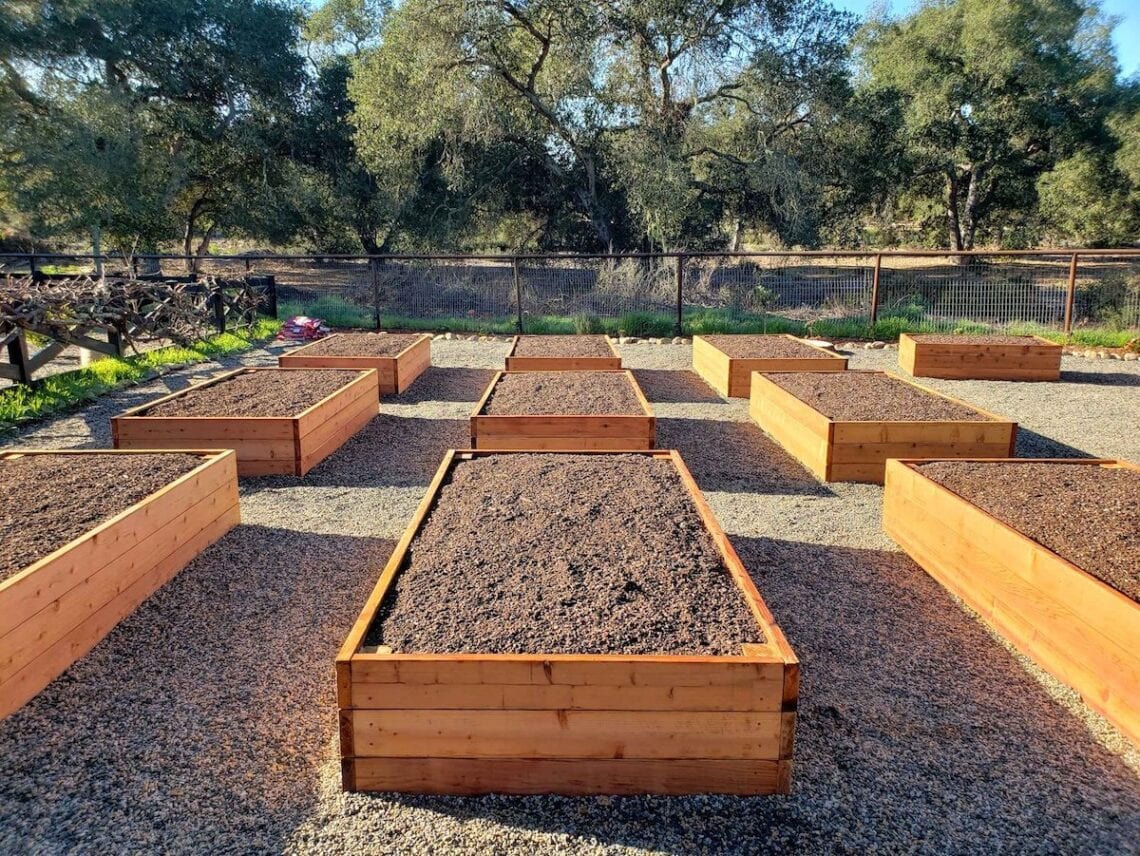
Do you have new planter boxes that need filling? Read along and learn how to fill raised garden beds with quality organic soil that is well-balanced, nutrient-rich, and microbially-active to help your plants thrive. After all, soil health is KEY to the overall health and productivity of your garden! It’s something you want to “get right” from the start.
In this article I will share our raised bed soil recipe – with options for using bagged or bulk soil, compost, and our favorite organic fertilizers or other amendments. Learn how to calculate bed volume and soil needs, the importance of mulch, and explore the hugelkultur method to fill raised garden beds. Last but not least, I’ve included tips on how to improve existing soil if your garden beds are already full but underperforming.
Would you like to save this?
Disclosure: Homestead and Chill is reader-supported. When you purchase through links on our site, we may earn an affiliate commission.
Getting Started with Raised Beds
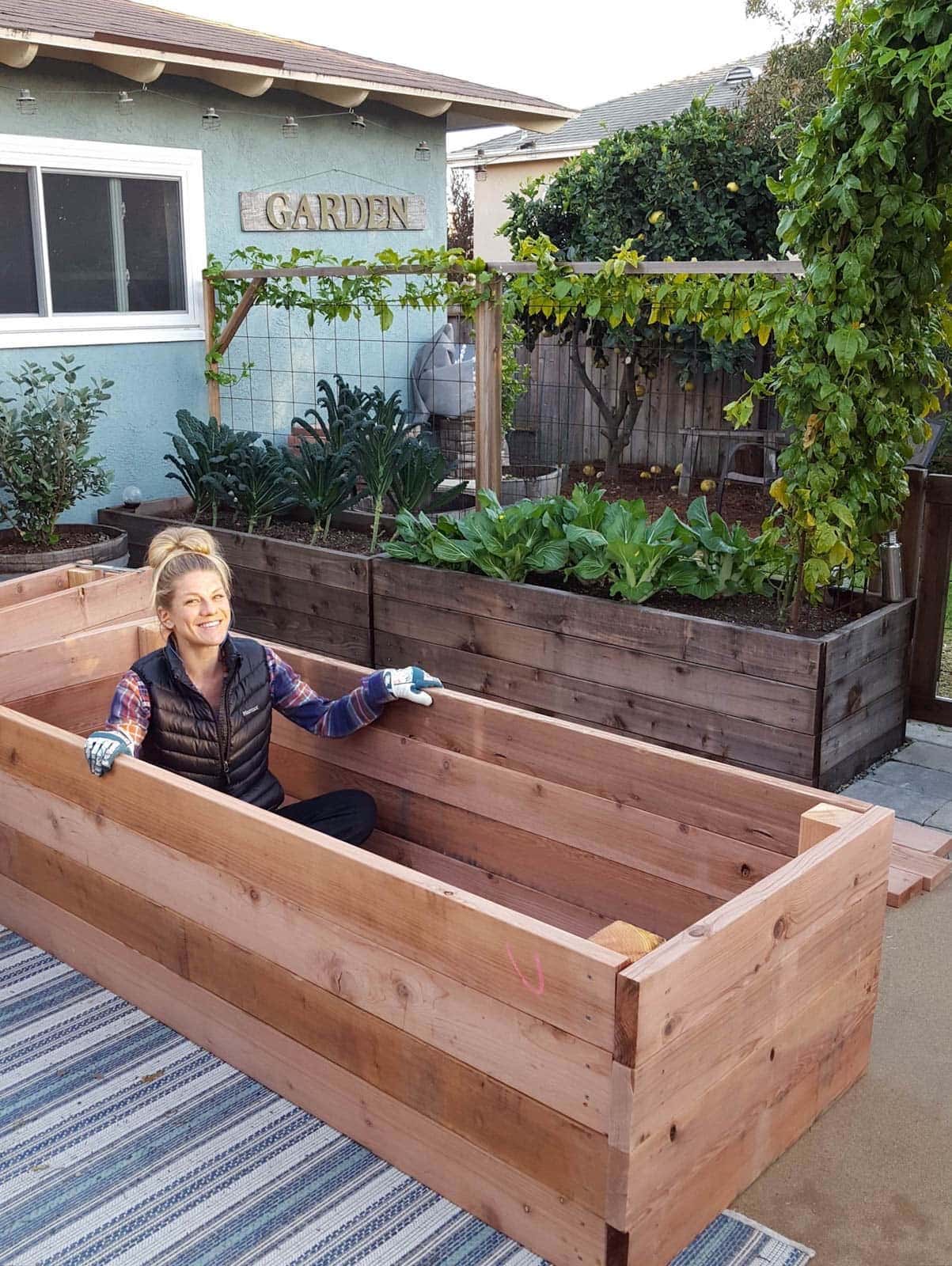
Don’t miss our guide on how to build a durable DIY raised garden bed! The tutorial includes a step-by-step video and explores wood choices, bed sizing, location and layout best practices, tips for gopher-proofing beds, non-toxic sealer, and other ways to make wood raised beds last longer.
Don’t want to build your own? Check out the high-quality, long-lasting, galvanized metal Birdies raised beds from Epic Gardening – code “deannacat3” will save 5%! We love our Birdies too.
Once you have your beds in place, it’s time to fill ’em up.
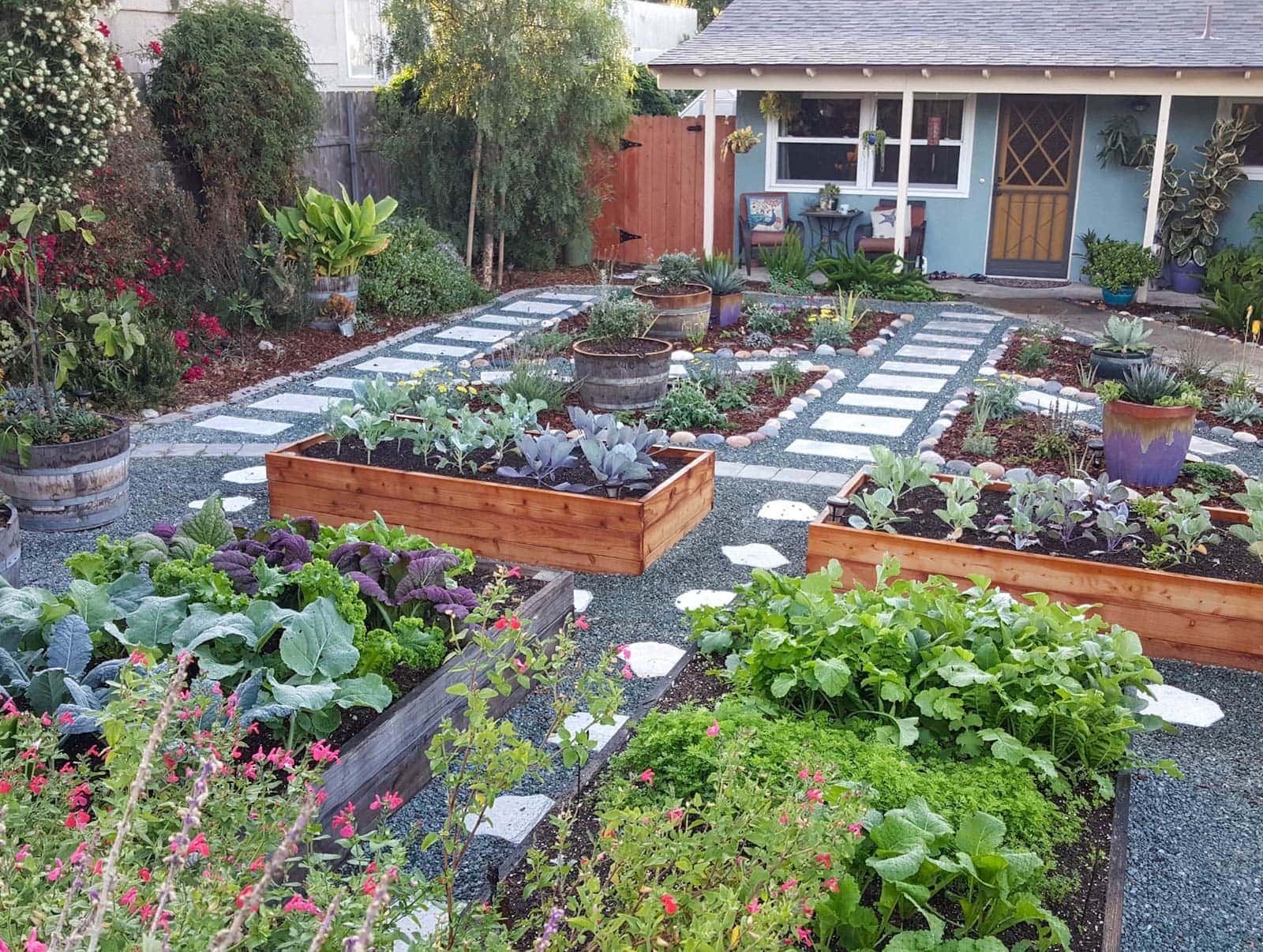
Investing in quality raised bed soil
Let’s set the record straight: “Dirt” is not soil! Soil is rich, full of nutrients, critters, microorganisms, and is biologically active! In contrast, dirt is usually devoid of all these things. Soil improves with time and age, as the soil food web blossoms. It is a living, breathing, dynamic ecosystem of its own.
No matter how much love, energy, or money you invest into your garden, if you have crummy soil, the result will be crummy plants. If you’ve gone through the effort to build or buy yourself some awesome raised garden beds, why skimp on the soil? However, the answer isn’t as simple as “go grab X brand of soil”. In my experience, not one soil is going to be perfect for growing vegetables on its own – bulk or bagged.
If you’re blessed with decent native soil, you can use some of that to fill your raised beds to offset cost (explored below).

The Best Soil for Raised Beds
Confined to a large container, raised bed soil needs are unique and slightly different than in-ground gardens. The goal is to fill raised beds with soil that’s fertile, rich in organic matter, holds moisture, but also has good drainage and plenty of air pockets using a combination of quality organic soil (bagged and/or bulk), compost, and an aeration additive.
Our raised bed soil recipe
- 40% soil (topsoil, loam, native soil, etc)
- 40% well-aged compost
- 20% aeration (e.g. sand, lava fines, perlite, pumice, coco coir, peat moss, and/or rice hulls)
- Other amendments such as worm castings and gentle, slow-release organic fertilizers
We’ll talk about each of these components in more detail below. Note that the ratios are approximate; they don’t need to be exact. Also note that the ratios will change if you primarily use bagged soil, which usually already includes compost and aeration (perlite) – such as 80% bagged potting soil and 20% compost.
Calculating Soil Volume
Before soil shopping, you’ll need first to calculate the internal volume of your bed(s). Bags of soil come in measurements of cubic feet, usually in a range of 1 to 3 cubic-foot bags. Bulk soil purchased from a local landscape supply company will be in cubic yards.
To calculate how much soil you need to fill a raised garden bed, begin by determining the volume of your bed in cubic feet. To do this, simply multiply the width by length by depth in feet (For example: 4’ x 8’ x 1.5′ = 48 cubic feet).
Now you have your total cubic feet, and can figure out how much bagged soil it would take to fill the bed. If you’re using bulk soil or compost too, you’ll need to calculate volume in cubic yards. To convert to cubic yards, simply multiply cubic feet by 0.037037 (or use this converter). Given the example of a 4×8′ by 1.5-foot deep bed used above, 48 x 0.037037 = 1.7 cubic yards of soil is needed to fill it.
If math isn’t your strong suit (or you’re just feeling lazy…. no shame!) here is a raised bed soil calculator that will do it all for you, in both cubic feet or yards.
40% SOIL
Using Bulk vs Bagged Soil (or compost)
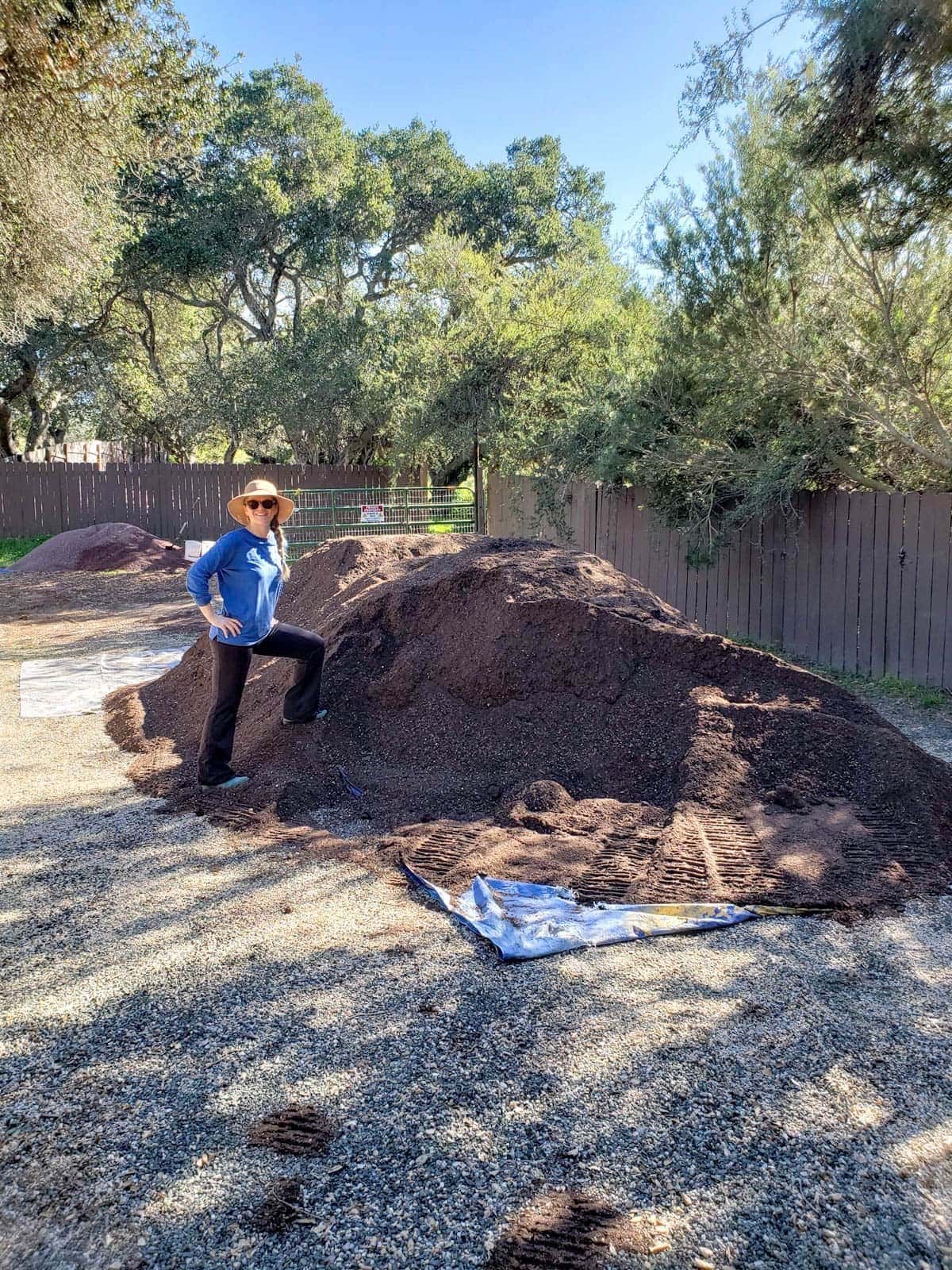
If you calculated that you need several yards of soil to fill your raised garden beds, you are not going to want to rely on bagged soil alone. The cost will add up quick! Look up local landscape supply companies and see what they offer in bulk – either for delivery or for pick-up, if you have a truck.
On the other hand, if you need to fill only one or two modest raised beds, purchasing bagged soil could be the way to go.
We often get bulk soil and compost delivered from Central Coast Landscaping or Mier Brothers here on the California Central Coast.
Bulk Soil Options
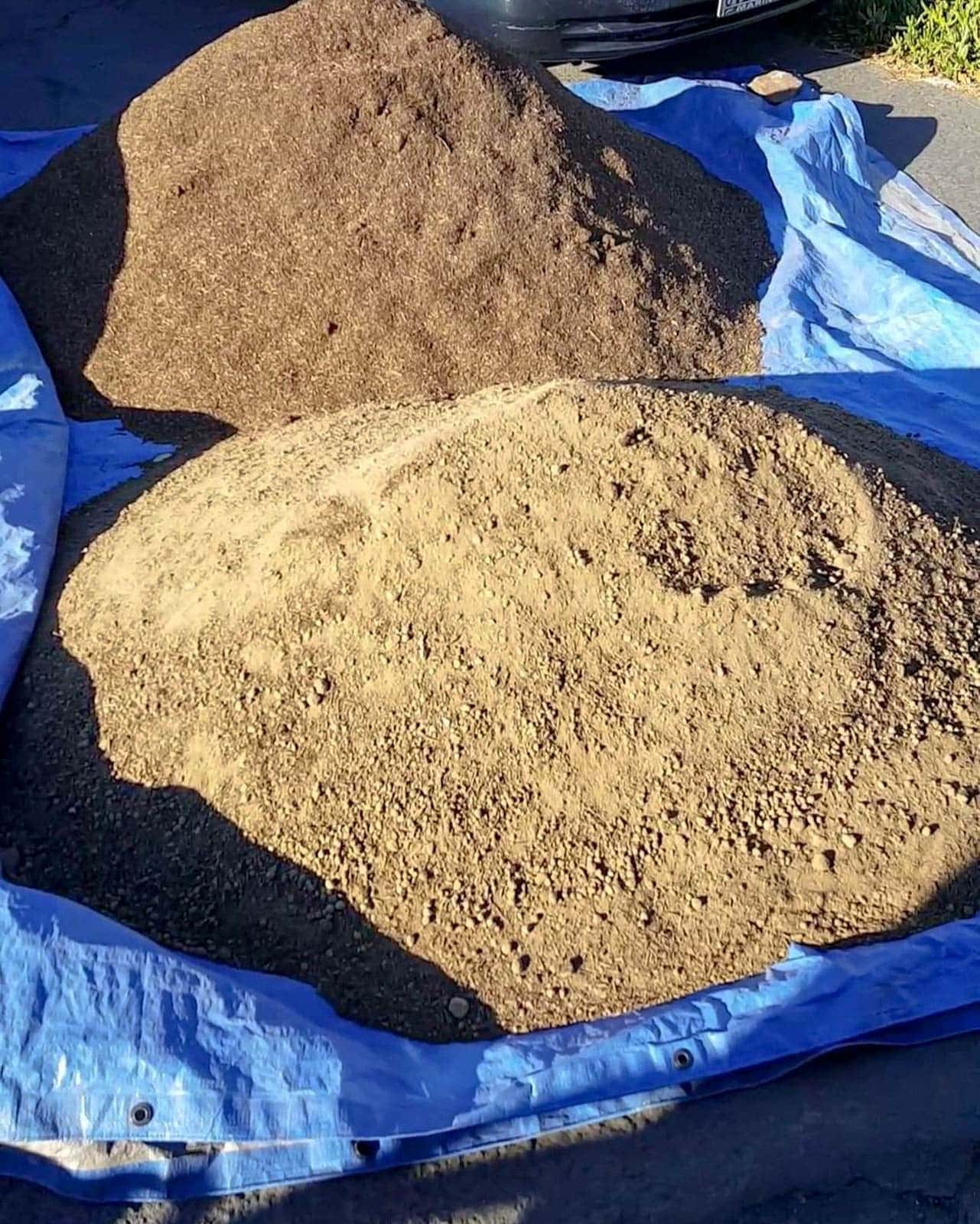
Bulk soil quality, composition and type will vary depending on your location. In our area, we’ve found varying grades of bulk soil including basic topsoil or “fill”, some premium container blends (similar to bagged soil), and a middle-of-the-road “planters mix” that is 2 parts top soil, 1 part compost and 1 part soil conditioner.
The composition of bulk soil will influence how much/what else to mix with it. For instance, if you all you can find is basic fill or topsoil, then you’ll want to follow the full raised bed soil recipe of 40% topsoil, 40% compost and 20% aeration to create a nice well-balanced soil. Or, use mediocre bulk soil as a “filler” at the bottom of deep raised beds, with a better soil on top.
Yet if you’re able to find premium raised bed soil in bulk, then it likely already contains a good amount of compost and aeration (sand, perlite, etc) so you can therefore scale back on those component of the recipe respectively. The landscape supplier should be able to provide details of the ingredients and make-up of the soils they offer!
Bagged Soil Options
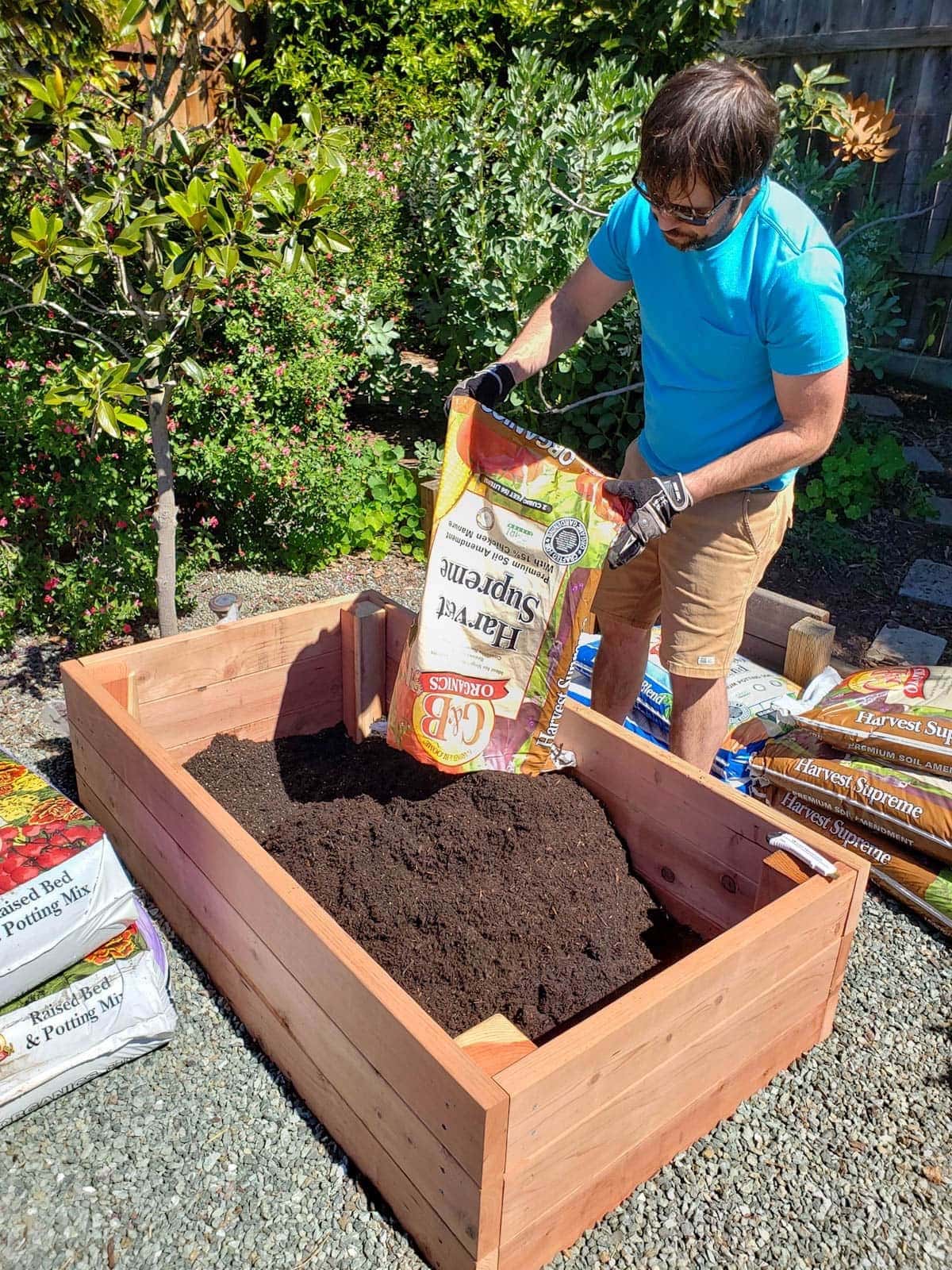
Even if we use good bulk soil to fill the majority of our raised beds, we always add at least a few bags of high-quality organic bagged soil near the top. We’ve used a wide variety of bagged soils over the years, but tend to prefer the selections offered at our local garden centers and nurseries over big box stores. “Hydro” grow shops (those geared towards hemp growers) usually have a great selection of premium soils too.
A few good options include E.B. Stone, Aurora/Roots Organics, Gardener & Bloom (G&B), Dr. Earth’s, and Fox Farms. Other cheaper or generic bagged soil can be used as filler towards the bottom of the bed, especially if you’re filling raised beds with bagged soil alone.
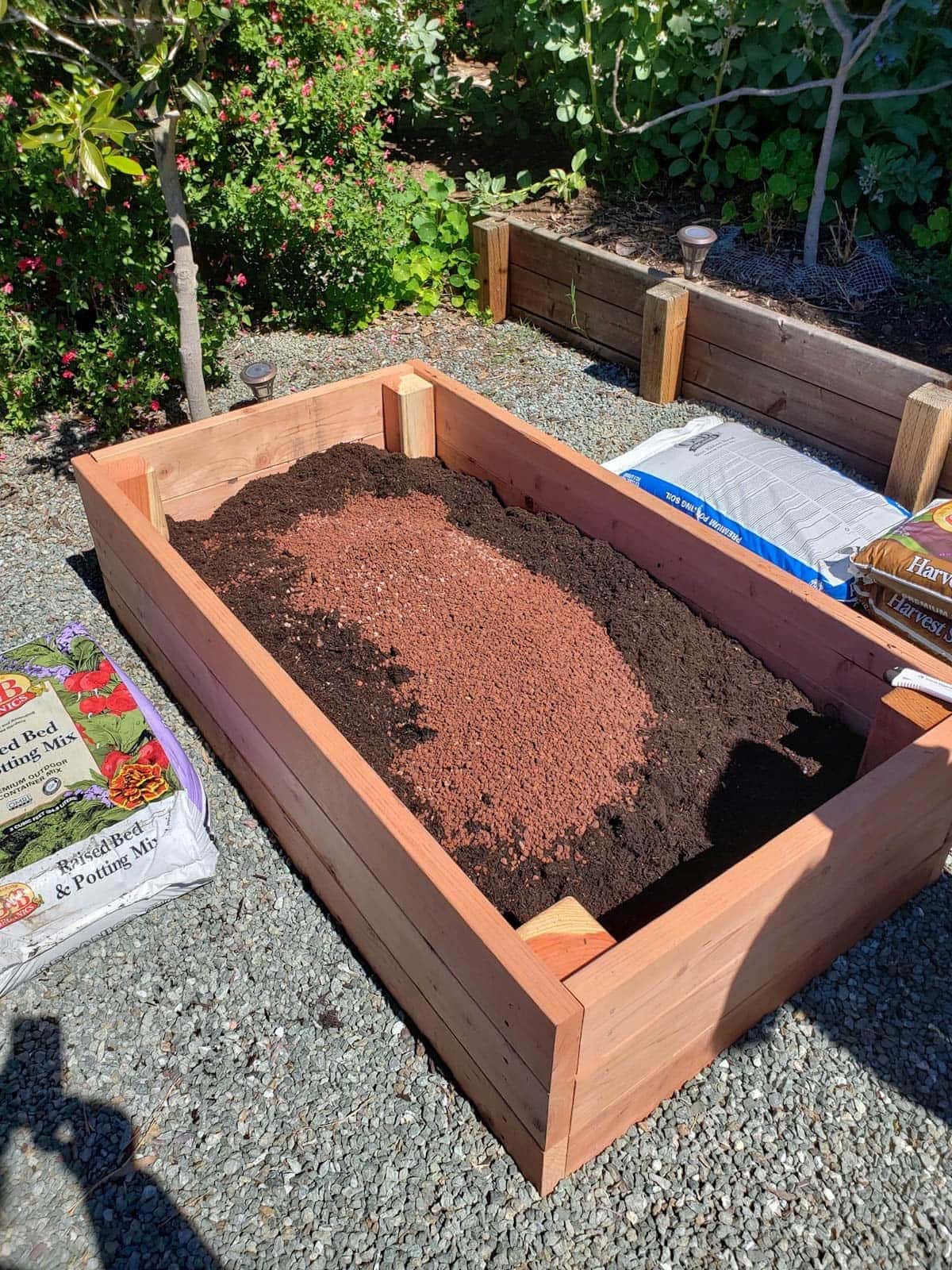
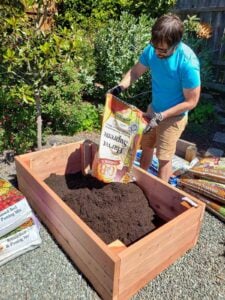
If possible, choose a few different types of bagged soil. Do not use “potting soil” only. It is light, fluffy, and will dry out quickly. In the photo below, you can see that we mix various types of bagged soil and conditioners. By combining a few different things, you’re getting a nice variety of composition and texture. Some are a little more woody, some more fluffy, some with perlite or pumice, some with or without added fertilizers.
40% COMPOST
Compost is organic matter that has been thoroughly broken down and decomposed into rich nutrient-dense plant food. It is a phenomenal soil conditioner, boosts the soil food web, and will make your garden shine!
We add plenty of homemade compost from our worm bin, larger compost piles, and aged/composted manure from our mini donkeys, but usually cannot make quite enough to meet all of our needs – especially for large projects like filling new raised garden beds with soil. So we do end up supplementing with organic bagged compost or bulk compost too.
Keep in mind that most bagged soils usually already have compost in them. So unless you’re using plain topsoil in your raised bed soil recipe, feel free to scale the “compost” ratio down to 10-30% (depending on the soil you’re using).
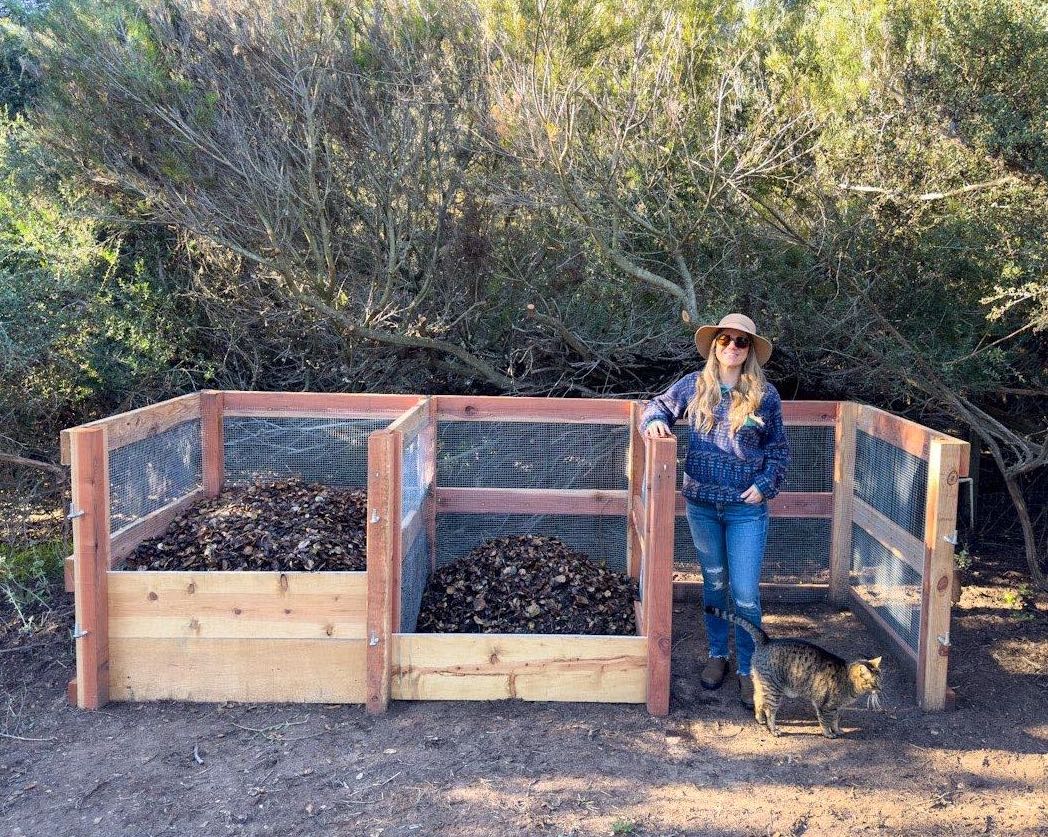
RELATED: See this guide to learn 6 ways to compost at home or this tutorial to learn how to build a DIY compost bin!
Compost Options
Many popular soil companies offer bagged compost products too. Again, these can be found at your local garden center or hydroponics grow shops. You should also be able to find compost locally in bulk, which is usually derived from green waste or possibly composted food waste. The bulk compost we purchase is made from local green waste and is OMRI-certified for organic gardening.
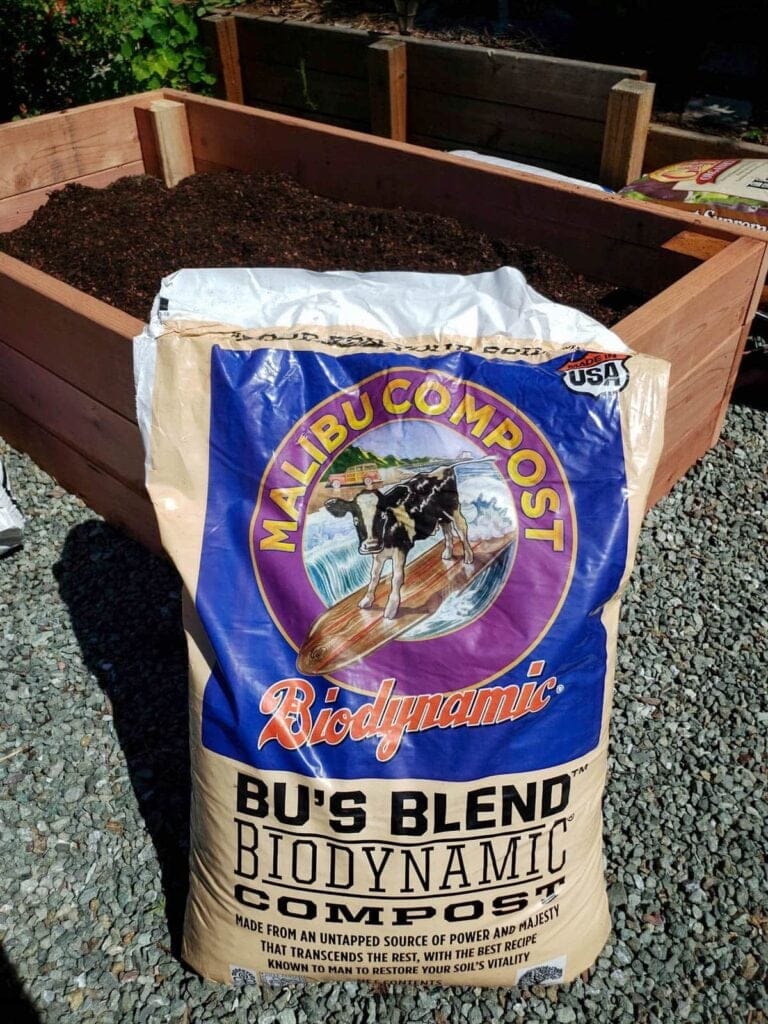
Our favorite bagged compost is Malibu Compost Biodynamic Blend. It is made from aged, composted cow manure from certified-organic, biodynamic dairy farms. However, please note that Bu’s compost is quite rich, so they recommend mixing only 25% of their compost to your soil blend.
Unfortunately, Bu’s is primarily available on the West Coast. If you live in the Northeast, Coast of Maine makes a similar product. I’m sure there are many more companies out there, all over the U.S. Leave a comment if you are aware of a good local product like this in your area!
Worm Castings
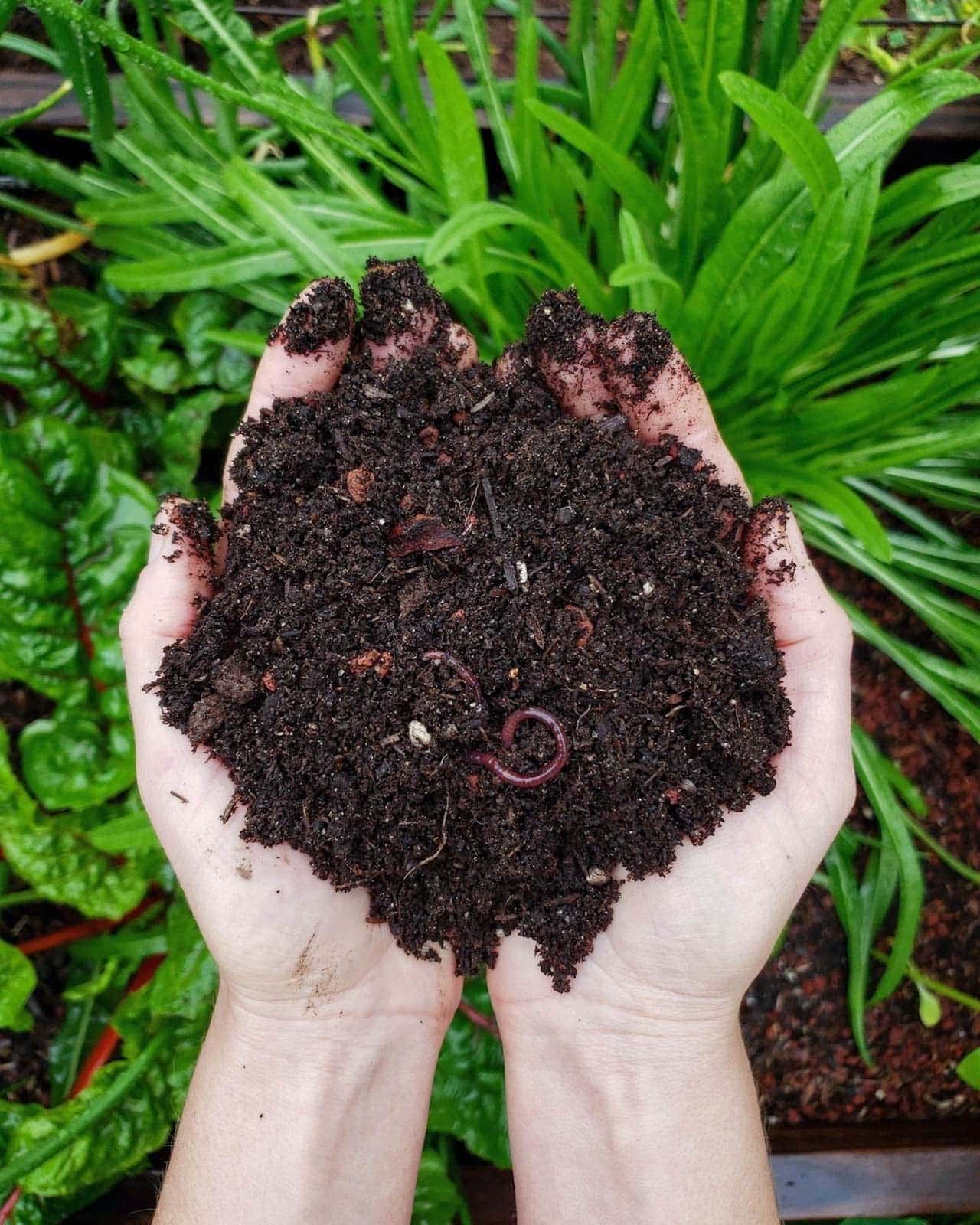
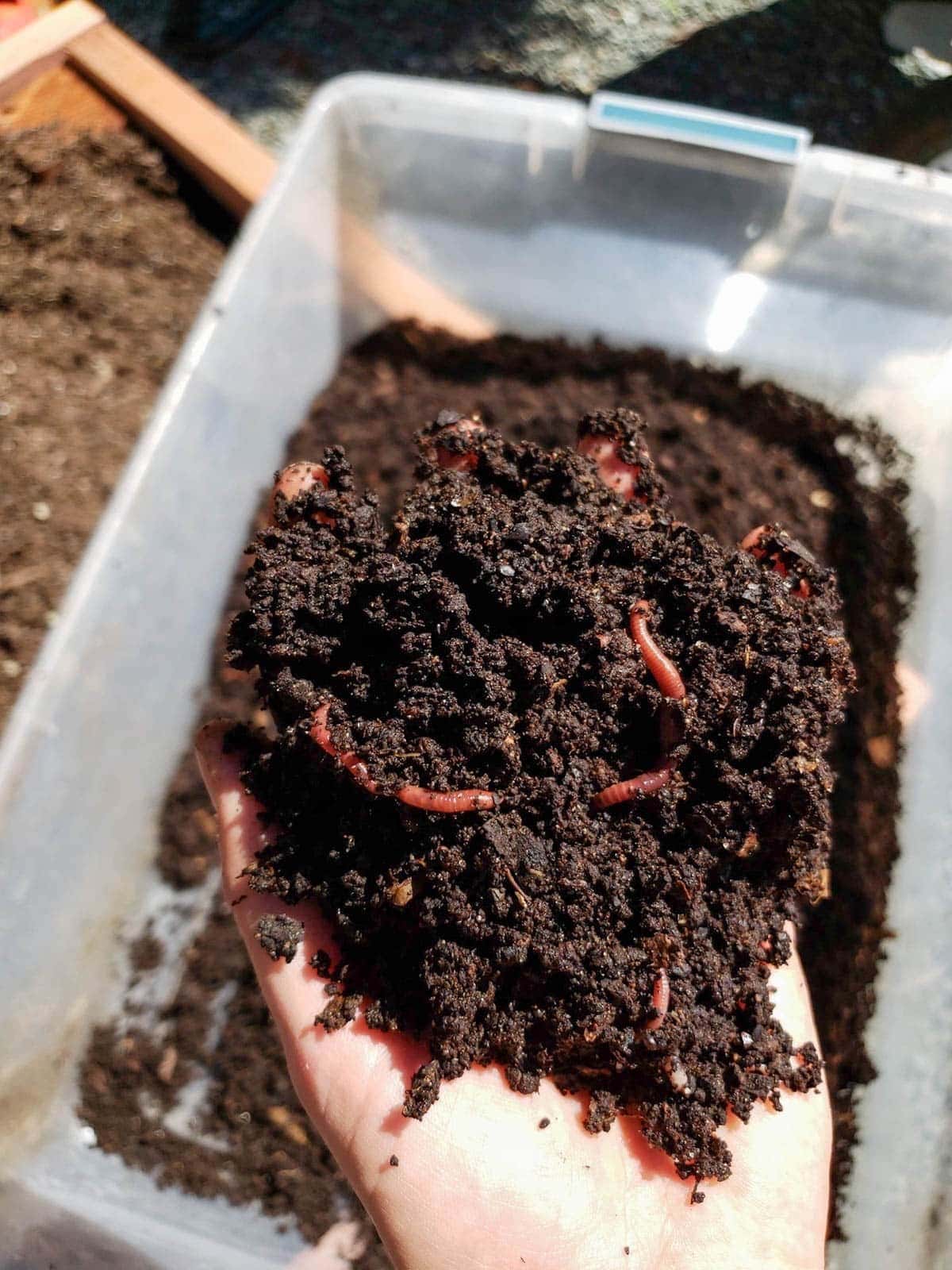
Last but certainly not least, worm castings (aka worm poop!) are compost too. Worm castings are so good for your plants, they’re referred to as “black gold”. Worm castings offer gentle, slow-release fertilizer as well as improve soil structure, microbe activity, water retention, and drainage.
I highly recommend keeping a worm bin at home! It is a terrific way to divert food waste from the landfill, and up-cycle that “waste” into an incredibly valuable product for your garden or house plants. Worm bins are inexpensive and easy to maintain. Learn how to make a DIY worm bin here!
If you aren’t up for keeping your own worm bin, you could purchase finished worm castings and add at least a small mount to each bed. We can usually find bags of G&B Organics Worm Gro locally, or you could pick up some worm castings online here or from Uncle Jim’s Worm Farm.
20% AERATION
An aeration addition is also key to healthy, effective soil. This could include lava rock, pumice, or perlite. Coarse sand also promotes aeration and drainage, but not quite as effectively as the others.
A lot of bagged soil mixes already contain aeration additives, which also includes things like peat moss or rice hulls. So if you use primarily bagged soil, read the ingredient list and adjust accordingly. You can likely go lighter on additional aeration (e.g. perhaps only 5-10% extra, if any).
Benefits of Soil Aeration
All the beneficial organisms found in soil need air to survive, including microbes, nematodes, worms, protozoa, fungi, and more. Even more, plant roots need air to thrive too! Plants breathe through their roots just as much as they do through leaves. That’s why it’s important to not overwater, and always provide drainage holes in pots. Otherwise, plants will drown!
An aeration additive also helps the soil achieve a ideal moisture balance. They create air pockets, promote good drainage, and prevent the soil from over-compacting. At the same time, they also increase moisture retention by absorbing water like a sponge, which helps the soil stay evenly moist for a longer period of time between watering.
Our Choice: Lava Rock
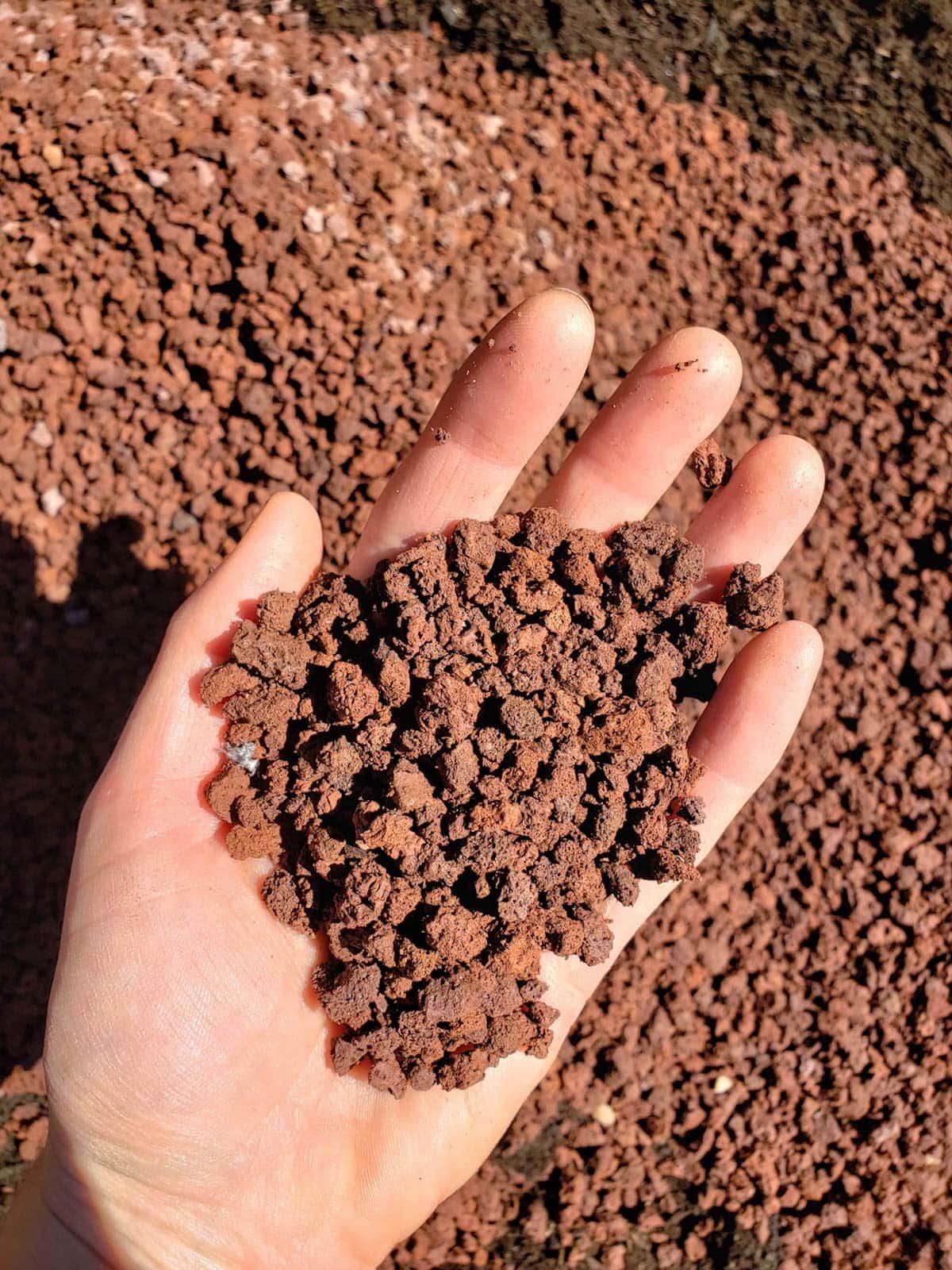
For the aeration portion of our raised bed soil recipe, we have come to love volcanic rock. It is also called “lava cinders” and is frequently used in aquaponics. Use the small 3/8 inch to quarter-inch size, not larger chunks! Lava rock is full of pores, that not only promote aeration and drainage, but are also the perfect habitat for beneficial microbes to grow. They don’t float to the soil surface like white bits of perlite do, and are generally more affordable than pumice.
Our local landscape supply company carries volcanic rock both in bulk and in half cubic-foot bags. If you can’t find volcanic rock, use small perlite or pumice. Availability of all these products will vary depending on your location.
How to Fill a Raised Garden Bed
Now that you have our raised bed soil recipe, it is time to fill them up!
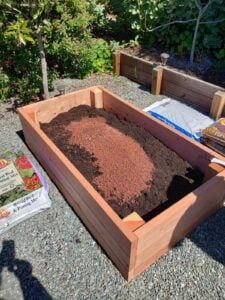
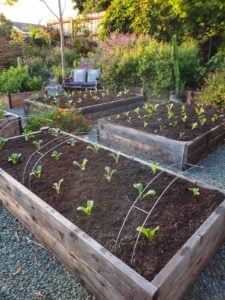
We prefer to fill our garden beds 100% full of soil and compost. Aside from sometimes adding lesser-quality bulk soil to the bottom of our deepest beds, there’s no other “fillers” at the bottom. See notes about fertilizer additions or using hugelkultur (adding leaves or sticks to the bottom of beds) in the sections to follow.
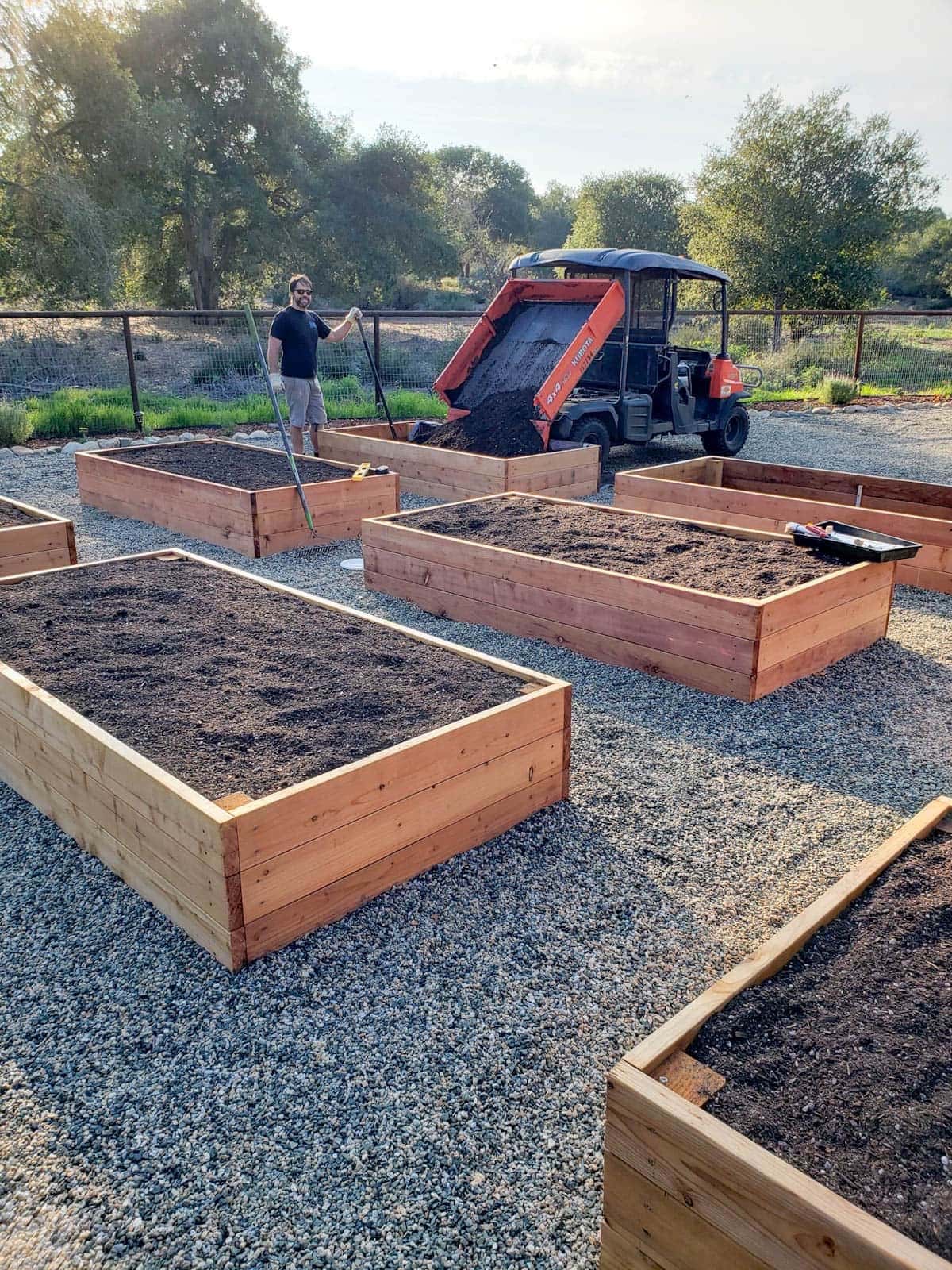
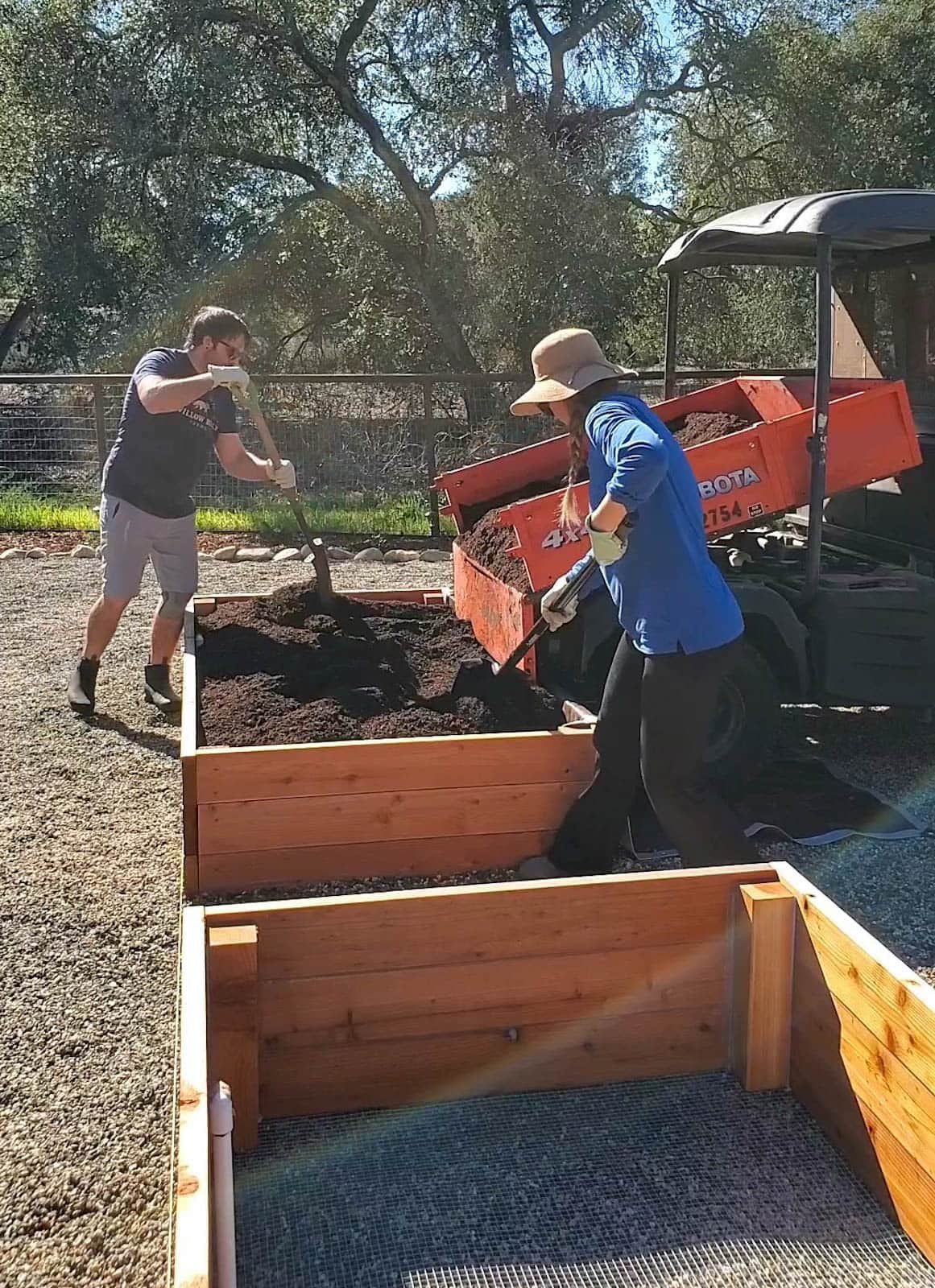
As you fill the beds, try to mix all of the various ingredients as evenly as possible. We’ll generally add them in “lasagna layers”, mixing as we go. For example, add several inches of bulk soil or bagged soil, a good layer of compost, a couple inches of volcanic rock, and mix. With that, the bed may only be about quarter full. Repeat with more layers of each, mix. Continue this process until the bed is full.
Also, it’s best to fill garden beds with soil all the way to the top – giving the roots as much depth to grow in as possible. When you first water a new bed it will compact and sink down a little too. Depending on how much it sinks, you may want to top it off with another layer of compost or soil.
What About Hugelkultur?
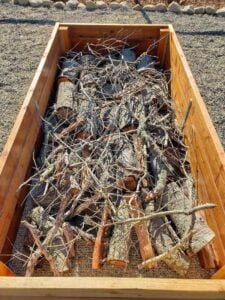
When filling a deep raised garden bed with soil, you can offset some of the cost by adding small logs, branches, leaves, mulch, pine needles, or other natural woody organic matter to the very bottom of the bed, and then add at least a foot of good soil and compost on top. The woody debris eventually breaks down to feed the soil as a carbon source over time.
This practice is called Hugelkultur. Learn hugelkultur pros and cons, best practices and materials to use, and how to make a hugelkultur garden bed here.
However, I do not recommend adding non-organic matter such as rocks, plastic bottles, styrofoam, or other random materials to take up space in your bed. I also don’t recommend using hugelkultur in shallow raised garden beds that are less than 12 to 15 inches deep.

Adding Fertilizer to New Raised Beds
Most “virgin” soil (especially plain topsoil) should be amended with natural fertilizer to keep plants healthy, happy, and productive!
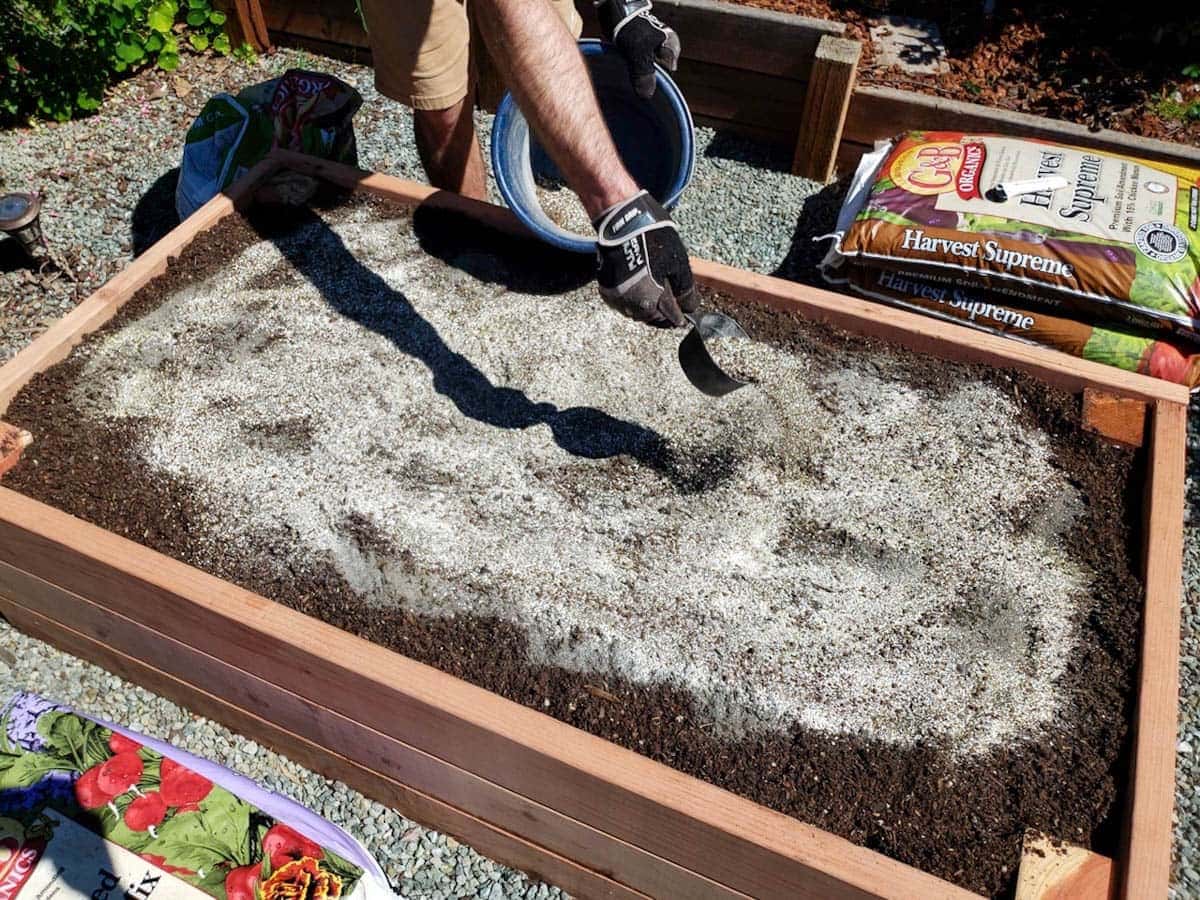
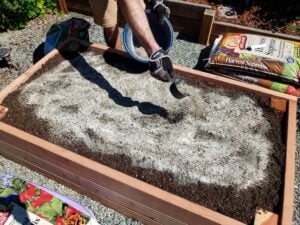
We prefer to use well-balanced, gentle, slow-release organic fertilizer like this one, lightly sprinkled and scratched into the top of the soil a couple times per year. When filling new beds, we also like to add a little Azomite rock dust for important trace minerals, which offer a vast array of benefits for plant growth!
If you fill raised garden beds primarily with high-quality organic bagged soils and compost, you can go pretty light on the fertilizer for the first growing season since the bags often contain amendments already. I always suggest using less than the manufacturer’s instructions in general. You don’t want to accidentally “burn” the plants!
On the other hand, if you started with mostly bulk soil and compost from a local landscape company, you’ll most definitely want to add fertilizer from the start. (That is, unless they say that it’s already amended, but I don’t think that’s common practice for most bulk material.)
Plants use up nutrients in the soil as they grow, so you’ll also want to implement a regular fertilizer routine for your raised garden beds going forward. In addition to adding slow-release fertilizer, we top off our raised beds with fresh compost and water with compost tea a couple times per year.
The Importance of Mulch
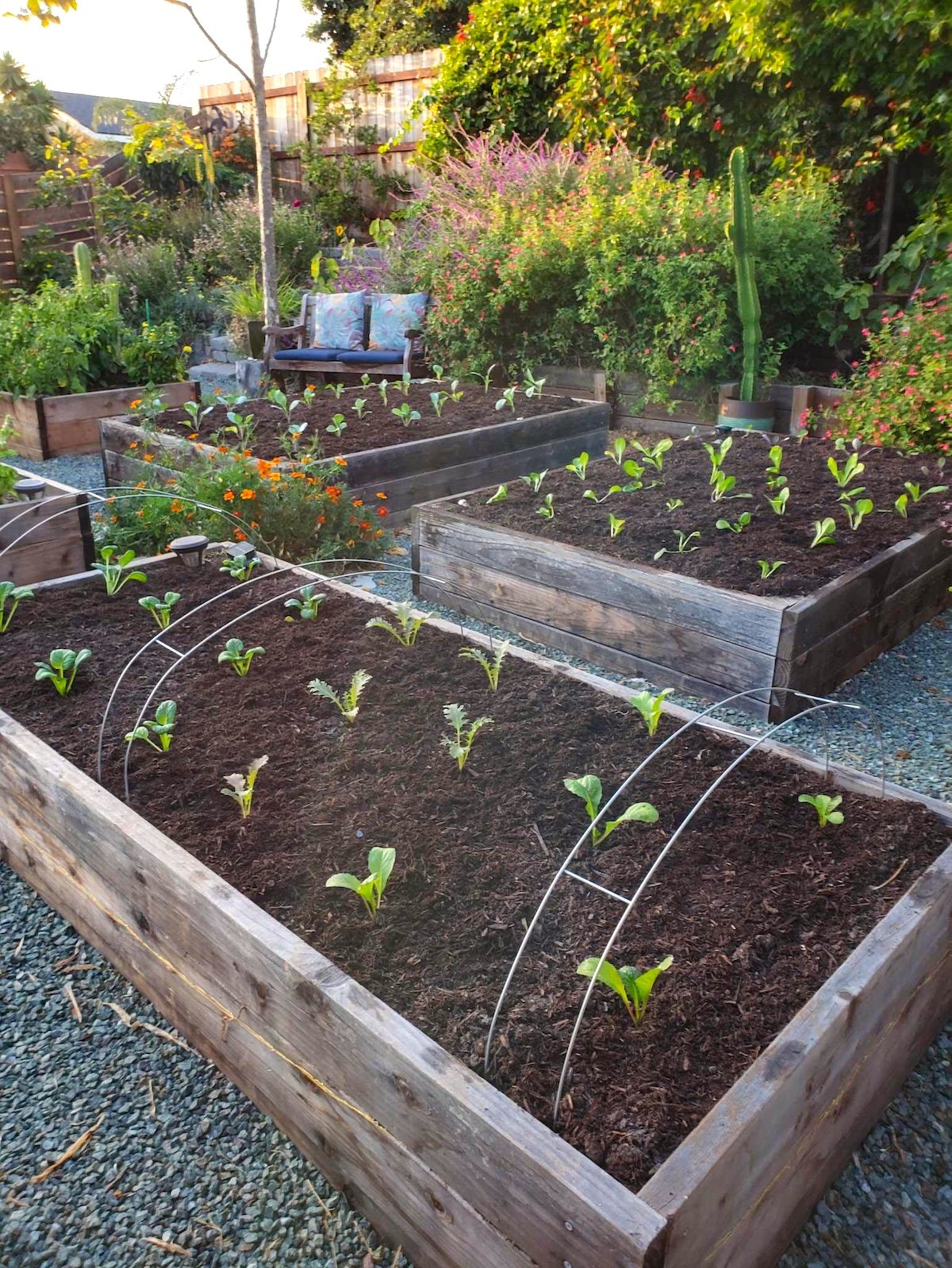
Last but certainly not least, don’t forget to cover the soil with a couple inches of mulch. Mulch protects and improves raised bed soil by reducing evaporation, suppressing weeds, and buffering the soil (and plant roots) from temperature swings. We typically use a woody compost as mulch. Learn more about mulching best practices and pros and cons of 8 popular mulch options here, including bark or wood chips, straw, compost, and more.
How to Improve Existing Raised Bed Soil
Do you have raised beds that are already full of soil that might not be the best quality, is having drainage issues, or the plants don’t seem to be growing very well? Don’t worry, it’s happened to us before too. But don’t feel the need to go dig out all your soil and start over. There is hope!
Before you consider replacing your raised bed soil, try amending it first using some of the materials we’ve discussed already, including compost, fertilizer, and more.
If your plants are sad and small, have you been fertilizing them adequately? Is your soil too compact? Try to loosen it up and mix in some aeration additions. Does it seem like the soil drains too quickly, or dries out too quickly? Add compost and worm castings! That, along with watering with aerated compost tea, will increase the microbial life in your soil. For better moisture retention, drainage, and “fluff”, peat moss or coco coir could also be mixed in. Note that coco coir is the more sustainable option of the two.
First, try those measures for a season and see if there is noticeable improvement. I really think there should be. If not? Next, consider taking out at least a portion of the old soil and replacing with the types of things discussed in this post.
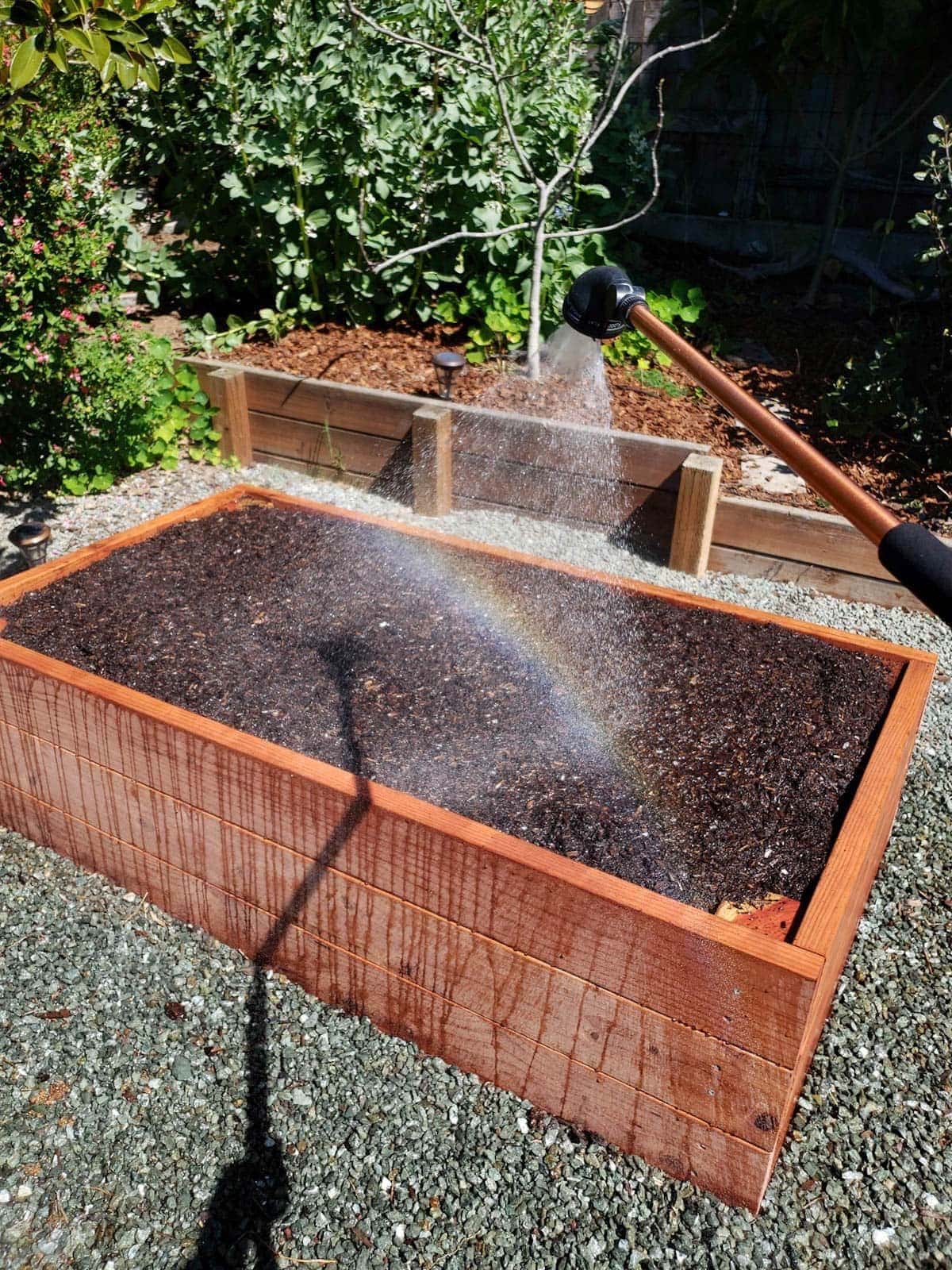
And that’s how we fill new raised garden beds with soil.
I hope that was helpful! If so, please consider leaving a review or comment below – and feel free to ask any questions! Now it’s time to put your new garden beds to good use. Don’t miss our guide on starting seeds indoors, tips for transplanting seedlings outside, or the best easy companion flowers to grow for pollinators!
You may also like:
- How to Install Drip Irrigation in Raised Beds (Drip Tape)
- 7 Ways to Make Wood Raised Beds Last Longer: Non-toxic sealer and more
- How to Make a Sturdy and Inexpensive DIY Trellis
- 9 Ways to Add Whimsy and Interest to Your Garden
How to Fill Raised Garden Beds with Organic Soil
Ingredients
- 40% soil (topsoil, loam, native soil, etc)
- 40% well-aged compost
- 20% aeration addition (e.g. sand, lava fines, perlite, pumice, coco coir, peat moss, and/or rice hulls) to improve texture, drainage, and moisture retention
- other amendments such as worm castings, rock dust, and gentle, slow-release organic fertilizers
Instructions
General Info
- Note that the soil recipe is approximate and flexible, depending on the type of base soil you use. For example, quality bagged soils usually already contain some compost and aeration additives, so you're using mostly bagged soil, you may only need about half the called-for compost and aeration.
- To fill just one or two modest raised beds, using bagged soil and compost alone may work. Yet if you're filling several raised beds, look into getting bulk soil/compost delivered from a local landscape supply company. It will be far more cost effective!

- If using mostly bagged products, do not use "potting soil" alone. Choose a mix of a few different types/brands of potting mixes, raised bed soil, and soil conditioners along with some added compost. See main post for more details and brand recommendations.
Calculating Bed Size and Soil Volume
- To calculate how much soil you need to fill a raised garden bed, begin by determining the volume of your bed in cubic feet. To do this, simply multiply the width by length by depth in feet (For example: 4’ x 8’ x 1.5′ = 48 cubic feet). Bagged soil usually comes in cubic feet.
- If you’re using bulk soil or compost too, you’ll need to calculate volume in cubic yards. To convert to cubic yards, multiply cubic feet by 0.037037 (or use this converter). Given the example of a 4×8′ by 1.5-foot deep bed used above, 48 x 0.037037 = 1.7 cubic yards of soil is needed to fill it.
How to Fill a Raised Bed
- Add the soil, compost, and aeration addition of choice in layers and mix as you go, so all of the ingredients and final soil will be as evenly mixed as possible. We also like to add worm castings mixed into the top 6 inches of the bed.
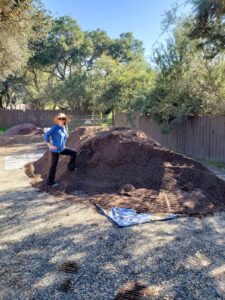
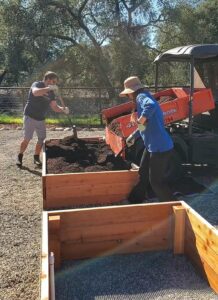
- For smaller projects, we simply used wheelbarrow and shovels. For larger projects, we used a skid steer to load into a UTV to dump into each bed.

- It's best to fill garden beds with soil all the way to the top – giving the roots as much depth to grow in as possible. When you first water a new bed it will compact and sink down a little too. Depending on how much it sinks, you may want to top it off with another layer of compost or soil.
- For extra-deep beds (over 18" tall) you can offset some of the cost by adding small logs, branches, leaves, mulch, pine needles, or other natural woody organic matter to the very bottom of the bed, and then add at least a foot of good soil and compost on top. I don't recommend this method (hugelkultur) for shallower beds.
- After filling the bed, sprinkle on some well-balanced, slow-release organic fertilizer and azomite rock dust (recommended) over the top, lightly scratch it into the soil surface, and then water the bed well.

- Don’t forget to cover the soil with a couple inches of mulch. Mulch protects and improves raised bed soil by reducing evaporation, suppressing weeds, and buffering the soil (and plant roots) from temperature swings. We typically use a woody compost as mulch, though straw and leaves are also popular options.


141 Comments
Stephanie
This information is amazing!!!! I’m adding some raised gardens this year and found your website so helpful!!! Thank you for sharing this information. I want to plant a few fruit trees and our soil (dirt really) is awful (like cement almost). Would you recommend working the soil this year and adding nutrients, and the suggestions above, and hold off planting one more year? I don’t want to lose a good tree ya know?! Thanks again!!
DeannaCat
Funny, we are planting an avocado tree this weekend and I JUST thought “I need to do a post on tree planting”… Even in our sandy soil, we always dig a pretty large hole, about 3x the size of the container or root ball, and give it plenty of good fresh organic soil and compost mixed with some of the native soil in its planting hole. For your situation, you could do the same and also add some European nightcrawlers (we get ours from Uncle Jims Worm Farm) to the planting hole. They dive deeper than compost worms and will loosen and enrich the soil in that area for you. In the meantime before I write that tree planting post, we did make a video for YouTube about it (which is a tad long, sorry, it my first YouTube video ever… but it also included how to make a DIY gopher basket to plant it in, since that is a huge issue here) Here is the link! I hope this helps!
Hillary
Hi and thanks for the article. I didn’t see any recommendations on high the bed should be filled. I have seen some people fill the bed up to the top and others will leave about 6 inches unfilled from the top. What is your recommendation?
Thank you!
DeannaCat
We always try to fill them as much as possible! More soil equals more root space and moisture retention. Beds will usually sink a bit with time (especially newly filled beds), so they can be topped off with fresh compost and soil between seasons.
Sagun
First, I would like to thank you for sharing your knowledge with us. Not many people are willing to share what they learn the hard way.
Second, is coconut coir or peat moss considered aeration? If so, can I use them in conjunction with perlite or pumice? I don’t like the way perlite looks on my pots or raised bed, they stand out like a sore thumb.
DeannaCat
Hey there! Yes, in a way. In our beds, we wouldn’t exactly consider them as the only source of aeration that we’d want – because we like the added surface area for microorganisms via the small volcanic rock. But they do add fluff to dense soil, and don’t compact with time, so in a way they are! Yes you could do both.
Jordan
Love your blog and all your well curated information! It’s real, it’s to the point and it’s amazing. As a flower farmer and plant nerd who has always shied away from containers and raised beds, I’m so happy to have a raised bed guru I can trust. Also I’m from the central coast and could tell from your style and plants that you had to be close to SAn Luis – right on! Cheers and thank you!
DeannaCat
Awesome! Thanks for the feedback. I am glad you found it helpful, neighbor! 🙂 Cheers right back at you.
Erica Magda
Thanks for the great post! I’m building an addition on my garden that will require about 15 cubic yards of material overall. I’m in the Chicago area. A couple questions:
1) Lava rock is the best for aeration in the midwest? Is 3/4″ too big for the lava rock? Or could that work?
2) Bulk top soil: It’s a challenge to find top soil I feel comfortable using due it where it’s sourced from. Have you ever used chemical, pesticide or NPK testing on your soil? Would you only buy bulk soil from those who do testing on the soil? If not, what questions would you ask, or what would give you a comfort level. One place I found got their top soil from a corn field (yuck!). Lots of the top soil I found comes from grass or fields torn up for subdivision building. It doesn’t seem ideal.
DeannaCat
Hi Erica! Lava rock is excellent no matter where you are, but it’s not always easy to find depending on location… I do think 3/4″ is a big large. If you have access to pumice or perlite, or are using some bagged mixes that have those in them, that would work better. In regards to your soil question – it is tricky one. Again that will vary so widely for folks in different places. Bulk stuff makes me a little nervous too. Do they have a more premium option than the top soil? One thing I try to keep in mind with all of this is that perfection isn’t possible. It would be damn hard to source something that is 100% pure and organic, be it in bags or bulk. We are all doing our best to grow our own food, but still have so much out of our sphere of control. Compost reduces toxicity in soil. Worms also reduce toxicity in soil. Time reduces any potential residual pesticides or herbicides. So once you get the stuff home, if you keep up with the organic practices and continually love on your soil, it will improve with time. We run into this dilemma when trying to source straw for our hot compost. Ask questions and do what you can, but know that it’s still better than most grocery store food! 🙂
Lacey Daniels
Looking forward to the worm bin post! I definitely want to get that started this year!
Mamma G
I can’t thank you enough for this and all the other great information you share. You’ve re-ignited my love of gardening. This blog and your IG page are my favorites. Thank you!
I like the way you have gravel between your raised beds instead of grass. Is there a blog or IG post about that? I might have missed it. Thank you again so much for all of this.
DeannaCat
Hi there! Check out the post about Building Raised Beds, or the “15 Mistakes to Avoid in the Garden” and you’ll see how we made some big mistakes with this at first, and then corrected it by removing the grass, laying down paper and landscape fabric (all under the beds too!), and then the gravel between 😉
BreezeGardener
This post couldn’t have come at a better time 😊 as I’m about to fill up my raised beds. I’m over here taking notes so I can go “soil shopping” tomorrow. 😁 This post saved me from standing in front of those bags and bags of soil and amendments in the store lookin confused trying to figure out what I really need. Now that I have all this info, I can do the planning from home and just go pick up what I need.
You were probably asked this before but I must have missed it. Do you plant outside of raised beds too? I know you have some trees planted in the yard. Do you lay down any kind of protection for them? Do you use the same kind of soil for raised beds and ground planting?
Thank you so much for your posts, for inspiring us and helping us become better gardeners. 💚
DeannaCat
Hey there! So we do a similar mixture for trees too. For protection, we build them them large gopher baskets from hardware cloth. We do the same for artichoke plants or other valuable edible shrubs. Thankfully the gophers leave the other perennials like lavender, salvia, etc alone. They also aren’t as picky about soil so just lightly amend the native soil, and introduce worms. I haven’t done a post about this stuff yet, but did make a YouTube video about planting trees in homemade gopher baskets! If you want to check it out, here it is.
Rebecca
Hi! I have been following you for a while and love your garden. I inherited some garden beds whose soil has been pretty lackluster the past few years. I was curious if you know any labs to get my soil tested in the area? I live in Oakland. Thank you!
DeannaCat
Hey Rebecca – Sorry, I don’t know of anything off hand! Sounds like a good ole’ google search 🙂 Thank you for being here!
Parisa Heydarifar
Really enjoy your blog and instagram! We’re setting up some gardens, and your’s is my favorite inspiration!
We’ve purchased a bunch of soil mixes as you referenced above, but for the compost ended up purchasing an all natural, but non-organic deodorized cow manure that’s fully composted. How big of a deal do you think having the non-organic cow manure compost could be versus some of the organic compost you mentioned? We did purchase organic potting mixes and soil amendments.
Also, do you think some of the lava rock use could be replaced with peat moss?
Thank you for the insight!
DeannaCat
That’s totally a personal decision… I’ll put it this way: Do you eat meat? Do you eat inorganic meat? If yes, then you’re not really straying too far from those things by using inorganic cow manure. We don’t eat meat and only eat certified organic food – to avoid the hormones, antibiotics, bioaccumulated toxins, etc, so that is how we try to also treat our garden. Many many great organic gardeners do not have such strict standards as we do! Again, that just our preference 🙂
Parisa Heydarifar
Thank you! That is so very helpful!
In follow up, would it be a total waste to then in these beds or existing containers that were not fully organic to use only organize materials moving forward for example for fertilizer and amendments, etc? Or can you make the switch and still reap benefits?
Lara
Instead of buying the seaweed extract, could I also mix kelp powder with water myself?
Also thanks for all your work you put in this blog 🙂 it’s the only blog I follow
DeannaCat
Yep! That would work! I suggest mixing it all together, and letting it sit to “get happy” together as a tea for about 24 hours prior to watering with it. It helps the nutrients get more evenly distributed and effective.
Anne Frolov
Would you consider a 12″ bed a deep bed that you would use bulk soil at the bottom as filler? Or only taller ones like the 2′ you mentioned?
I’m working on (9) 12″ boxes (various size squares and rectangles) but using the garden bed calculator it gave me a total of 4.2 cubic yards. I was thinking to use 1 yard bulk filler, and the other .68 from nicer bagged soils to = the recommended 40%. Does that sound like it would work OK?
I want to have quality beds, but also don’t think I can afford to do too much of the bagged variety!
DeannaCat
Hi Anne! I think that sounds totally reasonable! I don’t considered 12″ all that deep, but in making that recommendation I sort of meant for filling deep beds, OR when we have large projects. 9 beds is a big project! So yes, do whatever is in your budget 🙂