

How to Make a Gluten-Free Sourdough Starter from Scratch

Do you dream fresh homemade sourdough bread, but can’t eat gluten? I’m here to tell you that dreams can come true! Come learn how to make your own gluten-free sourdough starter from scratch with this easy step-by-step guide, using only three ingredients.
The process takes about a week, but requires minimal time or effort each day. By the end you’ll have an active homemade gluten-free sourdough starter – ready to use recipes like our gluten free sourdough bread, delicious gluten free sourdough crackers, or any others you desire.
Note: This post was originally published in March 2020 but has been significantly updated since.

Want to save this?
Before we dive in, I’ll share a few tips, facts, and gluten-free flour options. I’ve also included a handy demonstration video at the end (where I make a wheat starter from scratch, but it’s basically the same process).
Quick Sourdough Facts
- Rather than using instant dry yeast, sourdough relies on fermentation via a starter – a living culture of beneficial bacteria and natural yeasts – to make the bread rise.
- The natural fermentation process and added probiotics makes sourdough bread more gut-healthy, nutrient-dense and easier to digest.
- Once established, a starter must be nurtured with routine feedings to keep it alive. But don’t worry, it’s easier to do than most folks imagine. I store my starter in the fridge and only feed it (add fresh flour and water) once every few weeks… or sometimes as little as once every few months!
- Contrary to popular belief, most homemade sourdough doesn’t taste super sour at all (it’s only called “sour” since it’s made with fermentation). Rather, commercially-made sourdough often includes additives to boost sour notes.

RELATED: Browse my favorite sourdough baking supplies and learn how to store, maintain and feed sourdough starter here.
Gluten-Free Sourdough Flour Options
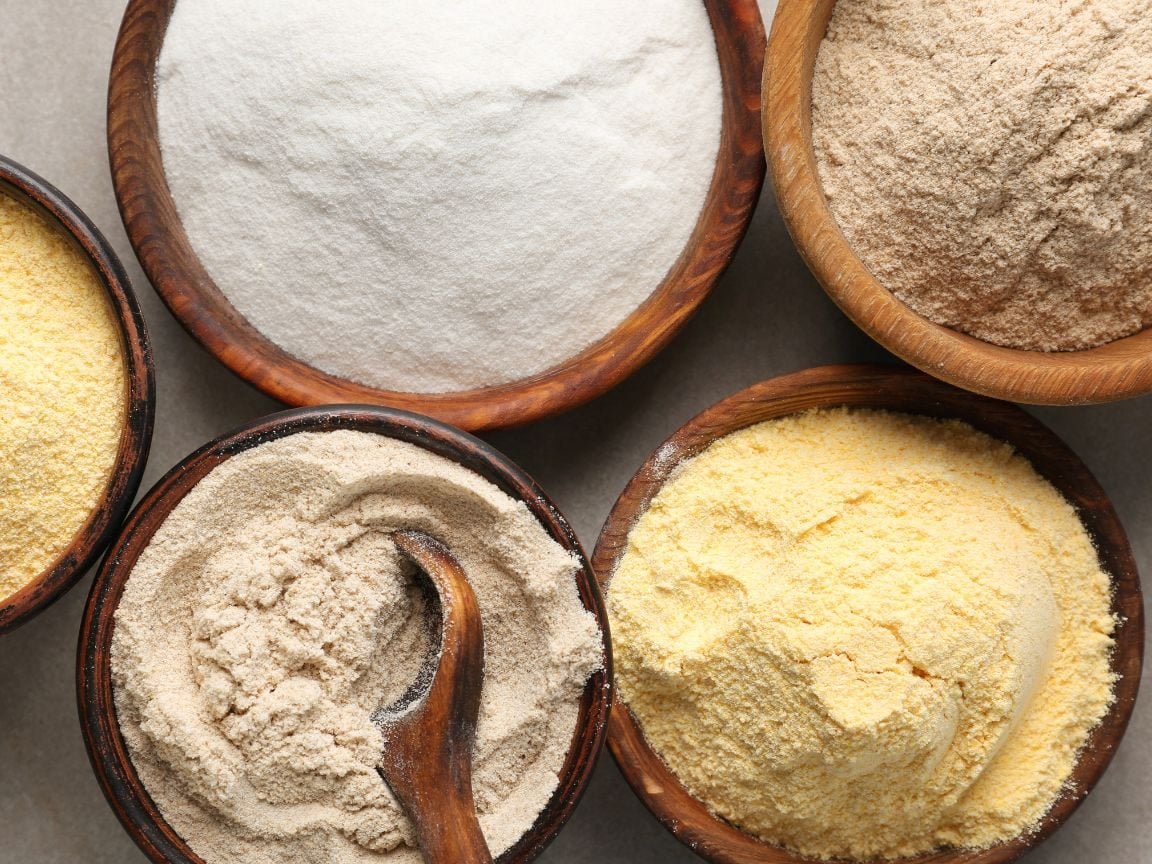
When it comes to baking gluten-free sourdough bread, there are dozens of GF flour types to choose from! Millet, potato, rice, buckwheat, tapioca, sorghum… the list goes on.
- Most gluten-free sourdough bread recipes call for a combination of several types of GF flours, along with the addition of psyllium husk and/or xanthan gum to help everything bind well in the absence of gluten.
- To make a gluten-free sourdough starter, I’ve found it’s best to simply use brown rice flour or buckwheat flour (or half and half.) I used brown rice for this tutorial, which has a more mild, subtle flavored compared to buckwheat. You can also use white rice flour, albeit less nutritious than brown rice or buckwheat.
- Once your starter is established, you can experiment with feeding (maintaining) it a variety of these flours, or even sweet rice flour. Sweet rice flour is less gritty and more sticky than other rice flours, which I’ve found can be helpful as a binding agent.
- Finally, I do not recommend using an all-purpose 1:1 GF flour for this recipe due to the extra additives and gums it contains. I tried to make a gluten-free sourdough starter with a 1-1 GF flour once – it technically worked (rose and got active) but smelled absolutely disgusting.
Supplies Needed
- A large air-tight glass container. I like to use this 2-liter flip-top container (about a half-gallon). A smaller container container will limit the space your starter has to rise. The container should be large enough to allow for the flour/water mixture inside to at least double in size.
- A digital kitchen scale. For the most consistent results, it’s best to weigh sourdough ingredients since various flours have different densities and weights. For example, this recipe calls for 500 grams of flour to start. 500 grams of Arrowhead Mills brown rice flour equates to 3.25 cups, yet 500 grams of their buckwheat is 4 full cups.
- Mixing bowl
- Box cheese grater (to shred the apple)
- Liquid measuring cup
- A moderately warm location
- Recommended: an ambient thermometer or sticky strip thermometer
Ingredients
- Brown rice flour or buckwheat flour (or a mix of both). You’ll use about 750 grams of flour (or 1.7 pounds) total for the entire process. I like to use this organic brown rice flour.
- One organic apple. The apple is what inoculates the starter with natural yeast and beneficial lactobacillus, so I highly recommend going organic for the best results. Non-organic produce may lack the good bacteria needed, and contain chemicals that interfere with healthy fermentation. I prefer use a Fuji, Pink Lady, or Gala apple.
- Un-chlorinated or filtered water. Avoiding chlorine is important when it comes to any fermentation process, including making sourdough. A basic carbon filter is enough to remove most of the chlorine from city tap water. You can use bottled water in a pinch, but don’t use distilled water! It’s too sterile and “stripped down” to support a healthy sourdough culture.

Instructions
Day 1: Mix Flour, Water and Apple
- Start by washing the apple well under hot running water, but don’t use soap or another vegetable wash. Then use a clean cheese grater to shred the apple, including the skin.
- In a large clean mixing bowl, combine 500 grams of brown rice or buckwheat flour, one grated organic apple, and 360 mL of lukewarm filtered water (about 1.5 cups). Mix thoroughly. The texture should be like thick sloppy dough – not dry and crumbly, but not soupy wet*.
- Transfer the mixture into a large, clean glass container with a lid. Mash down the wet dough to remove any air pockets. If possible, try to avoid getting gunk all over the sides of your container (which is more likely to grow mold). Use a silicone spatula to clean up the sides if needed.
- Mark the level of the mixture on the side of the container using a glass pen or rubber band so you can easily monitor the starters’ growth.
*PRO TIP: Throughout this process, if your starter ever seems too dry or far too wet, feel free to add a splash more water or flour until the desired consistency is reached as described. The amounts I’m providing are a general guide since different flour types and brands will have slightly varying weights.

Days 2-3: Rest and Wait
- Now tuck the container in a moderately warm location and let it sit for 72 hours.
- The ideal fermentation temperature for starter is around 70-75°F (23°C). Cooler temperatures will slow the activation process and increase the chances of mold, so if your home in the cold side, see tips on how to keep sourdough starter warm below. Use a simple stick-on thermometer to easily monitor the temperature.
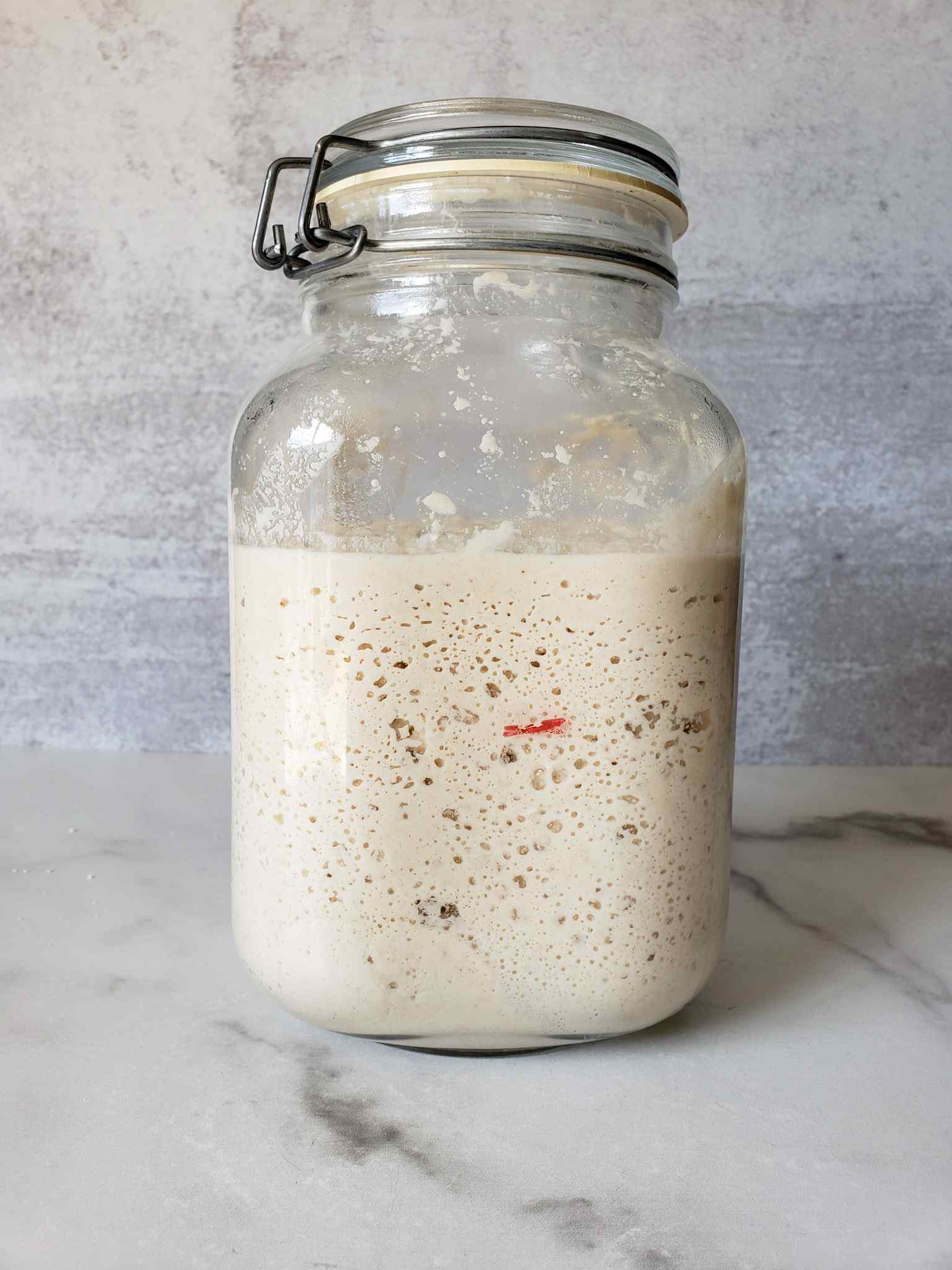
- Over the next three days, your starter should start to get active, bubbly, and rise. It may even rise and then fall back down again, which is a sign that it needs to be fed soon (step 3). The starter will also start to smell a little funky, malty, and semi-sweet – reminiscent of apple cider vinegar.
Ways to keep sourdough starter warm:
- Find a warm spot in your house, such as next to or on top of a warm appliance. For example, my kitchen has under-cabinet lights that put off heat when they’re on, making the cabinets above quite warm and cozy.
- Use a starter heating pad. I love and use this handy warming plate to keep my starter warm AND under the bowl of proofing dough later. I’ve also found that using warm water in the starter and dough will help boost activity.
- Oven light trick. Most oven light bulbs emit warmth, so turning on the oven light (but keeping the oven itself OFF) can create a nice warm spot in the back of the oven for your starter or proofing dough. However, I’ve heard horror stories when folks accidentally pre-heat or bake their starter! So if you try this, be sure to make a reminder that it’s in there – including for other members of the household.
- Proofing box. If you’re a regular baker with a chronically cool home, it may be worth investing in a proofing box – which can keep both your sourdough starter and proofing bread dough at the perfect temperature!

Day 4: First Feeding
After 72 hours (or about three days, it doesn’t need to be exact) it’s time to feed your starter for the first time. The process of feeding a sourdough starter usually involves discarding a portion of it before adding fresh flour and water.
- First, open the lid and stir the starter with a clean utensil to knock out the air and bring it back down to its original volume.
- Next, remove and discard about half of the volume of starter in the container. I usually just eyeball it, using the mark or rubber band line on the container as a guide. Discarded sourdough starter can be composted, fed to chickens, or used to make other sourdough goodies like gluten-free sourdough discard crackers.
- Now add an additional 250 grams of fresh brown rice or buckwheat flour and about 180 mL (about 3/4 cup) of lukewarm water to the mix. Stir thoroughly to combine. I usually mix it right in the starter container, though you can also mix everything in separate bowl and transfer it back in. It should be a slightly thinner consistency than the original mix.
- Clean up the sides of the container as needed so you can monitor the rise again (and possible fall).
- Now, put the container back into a warm location and let it sit for 48 hours this time.

Troubleshooting notes
If your starter didn’t rise at all during these 48 hours, allow it to sit for another day before moving on to the next step. Yet if it rose and fell back down (look for smears on the container) then it is time to feed again. If it’s acting particularly lethargic, try feeding with half brown rice flour and half buckwheat.
Note that it’s common for the first bout of activity to be more vigorous and obvious than after the first feeding. That’s because different short-lived bacteria quickly ferment the starter at first. Yet these are not the same type of bacteria and yeast we desire long-term in our starter, who are slower to develop.
Day 6: Feed Again
This step is easy! Simply repeat the same discard and feed process that you did previously. Stir it first, discard half, and add more fresh flour and water like we did in the previous step. Yet this time you want to make it a splash more wet than before – like a wet, sloppy dough. Use 250 grams of flour and about 220 mL (just under a cup) of lukewarm water this time.
Now, let your almost-ready gluten-free sourdough starter sit for 24 hours If all goes well, it should rise and fall within this time period. The apples should be pretty much be disintegrated by now too.
Day 7: It’s Ready!
If it’s bubbly and active within 24 hours of the last feeding – congratulations – you just made a new gluten-free sourdough starter from scratch! It’s now ready to bake with. Try our rustic gluten-free sourdough boule loaf recipe here.
But first, be sure to name your starter. It’s tradition among the sourdough community and considered bad baking luck if you don’t! Check out our round-up of the best 60 Punny Sourdough Starter Names for plenty of fun ideas.
If you’re not ready to bake yet, simply store your starter in the refrigerator and see the tips below to learn how to take care of it.

Storage and Ongoing Care
Now what? If you aren’t ready to bake yet, simply store your starter in the refrigerator and then head over to our guide on how to maintain and feed sourdough starter. It covers the pros and cons of storing it at room temperature vs the refrigerator, when and how to feed it, and how to ready a starter for baking.
TIP: it’s best to use sourdough starter for baking several hours after feeding, once it’s reached “peak activity” – which is when it’s at least doubled in size, is no longer actively rising, but before it deflates again. And remember, never use ALL your starter in a recipe! Always save at least a half cup to feed and keep going.
FAQ: What’s that dark liquid on the top of my sourdough starter?
When a sourdough starter goes unfed for a while, it will form a layer of dark liquid on top called “hooch”. The yeast in starter produces hooch (an alcohol) as a natural byproduct of the fermentation process. Hooch is not harmful, but is an indication that your starter is hungry and needs to be fed.
When you see hooch, you can either pour it off the top or simply mix it back in, and then discard and feed as usual. However, mixing hooch into the starter will make it extra sour-tasting. Since we store our starter in the fridge and often go many weeks between baking/feeding, it almost always has a layer of hooch on top.

And that’s how to make a gluten-free sourdough starter!
So, how’d it go? I hope this article got you one step closer to making all your sourdough dreams come true. Please feel free to ask questions and leave a review below. Thanks for tuning in, and happy baking!
For all you visual learners, here is a quick video showing the process of making a classic wheat sourdough starter. The flour is different and the water amount varies slightly, but otherwise it is essentially the same process! My gluten-free sourdough starter never gets quite as bubbly as my wheat one.
Gluten-Free Sourdough Starter Recipe
Want to save this?
Equipment
- Large air-tight glass container (2 liter or half-gallon)
- Kitchen scale
- Mixing bowl
Ingredients
- 750 grams organic brown rice flour (and/or buckwheat flour)
- 360 mL filtered water, room-temperature
- 1 large organic apple
Instructions
Day 1
- Wash your apple, but avoid using soaps or produce wash. Using a cheese grater, grate the organic apple into semi-fine shreds. Use the skins, but discard the core.
- Add 500 grams of brown rice or buckwheat flour, the grated apple, and 360 mL of lukewarm un-chlorinated water (about 1.5 cups) to a mixing bowl and thoroughly combine.
- Transfer the mixture into a large glass airtight container that has enough room for it to at least double in size, minimum. (Ours usually quadruples while fermenting) Pack the mixture down into the bottom of the container. Close the lid.
- To monitor growth, mark the side of your container with a washable marker or rubber band at the top level of the mixture.

Days 2-3
- Let the mixture sit for 3 days (72 hours) at a temperature of 70-75 degrees F. It should bubble and rise during this time.
Day 4
- After approximately 72 hours, thoroughly stir the mixture and then discard half of the amount. Then, thoroughly mix in another 250 grams of flour and 180 mL of tepid filtered water (about 3/4 cup) to the remaining starter mixture. This is called "feeding" the sourdough starter. You can do this either in a separate bowl, and put it back into a now-clean ferment vessel, or like we do, mix it in place.
- Re-mark the container to note the height of the mixture. Let sit at 70-75 degrees, for 2 days or 48 hours this time.
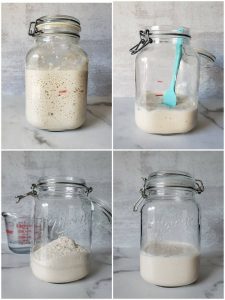
Day 6
- After 48 hours, repeat the same discard and feed process as done previously. Discard half, feed, mix, mark the level, and cover again. This time, make it slightly more wet – using 250 grams of flour and about 220 mL of water.
- Allow the sourdough starter mixture to sit for a final 24 hours.
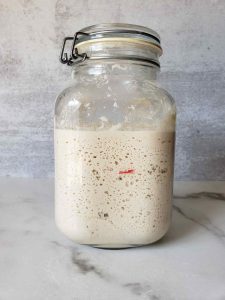
Day 7
- If it rises and falls after the last feeding, you now have a happy and active gluten-free sourdough starter! Store it in the refrigerator when not in use, taking it out to warm up and be fed weekly. See more feeding and maintenance tips here.
Notes
- If there is no activity, let it sit another day or two.
- If your starter has risen and fallen, or, if seems to not rise after the first discard and feed, and instead it has a dark liquid formed on top (called hooch), it may actually be overly active and hungry! Stir in a little more flour (and warm water as needed, if it becomes too thick and dry) and let it sit again. Wait a day or two to see if it perks up and begins to rise and bubble.
- If your home is cold, try to find a warmer spot if possible! Use a starter heating mat, or place it inside the oven with the oven OFF but oven light ON to create a nice warm environment.
- If the starter doesn’t rise at all after the first discard and feed, try opening the lid of your jar. Cover it with a coffee filter or something else that will prevent fruit flies or other debris from getting inside inside.
- Ensure that you use an organic apple.
- Throughout this process, if your starter ever seems too dry or far too wet, feel free to add a splash more water or flour until the desired consistency is reached as described. The amounts I am providing are a general guide. Different flour types and brands will have slightly varying weights.



209 Comments
Theresa
Hi! I am in day 2 of my starter and I noticed 2 black mold spots on the top. Does this mean that my starter is bad? Any advice?
Thank you!
DeannaCat
Hi Theresa – No, mold is not normal or good… Things that could lead to mold: the container wasn’t fully clean/closed, the apple not washed well, possibly the use of non-organic ingredients, or too low of a temperature. Sorry for your struggles!
Chantale
HI! I am so excited to find your recipes and make my own GF sourdough bread.
I began the journey and to my delight it took off! We had some warm weather and did some baking ( I keep my started next to the stove) which I’m sure helped with the first 2 steps. Then it cooled down and rained while in my final step. Did the final feed and waited excitedly for the 24 hrs to be done and start my bread. To my disappointment my starter only rose 1/4 of what it did previously and stopped. I used oven to help warm up the area and then left starter in oven over night to help keep her warm. It has now been 50 hrs with no activity. 🙁
I have put her back in the oven with light on to see if that would get her going. Oven temp is showing about 75-80F (not really exact below 100)
Any suggestions? Do I still have hope or should I start over?
DeannaCat
Hi Chantale – If a starter does a small rise and fall, it won’t continue to rise again without being fed again. An established starter actually needs to be fed daily (if left out at room temperature) because they self-limit and consume all their “food” then become stagnant and hungry. Try discarding half and doing another fresh feeding, and see if that perks it up again!
Chantale
I will try that right away..wish me luck 🙂
Thanks for getting back with me so quickly
chantale
Hi
first starter didn’t work. On to second batch. I’ve started in a large container to help with feedings and placed in oven to keep temp more even. Had a good rise in first 24hrs then it fell and at 48hrs it looks hungry…no more rise.
Should I go ahead and feed it?
Mary Sue
Getting ready to make the GF sourdough bread. In the article you said you’d put directions for baking in a loaf pan out ASAP. I haven’t seen them. Did I miss them somewhere?
DeannaCat
Hi Mary Sue – Sorry about that! I haven’t had time to write that up as I’ve been working on spring garden content. We tried a loaf using basically the same process but put it in a bread pan, and it turned out pretty good – but a tad more dense than the open boule method used in this recipe. I want to experiment with it more before releasing new instructions, hence the delay. I hope you can still enjoy it anyways!
MaryAnn
Morning
I posted a comment last night but don’t see it. Perhaps I did not hit, “post comment” button. On the 2nd step, no rise at all, but some hooch. I took it out, added more flour and warm water. Still nothing after 24 hours. Can a complete failure happen? Do I need to discard and start over?
Thank you
Mary Ann
DeannaCat
Hi Mary Ann – any progress? Is it cold at your house? Did you see the warm oven trick by chance?
Rebecca
Hello! your gluten free bread looks AMAZING! do you know if you can feed a gluten free starter with gluten free flours to transition it to a gluten free starter instead of starting again from scratch?
Thank you!
DeannaCat
I have never thought of that or tried it. From what I understand, you can definitely change the types of wheat flour in a gluten starter (e.g. sometimes we feed it bread flour, AP flour, whole wheat, rye)… but I am not 100% about switching from GF to wheat. You could give it a try! I would suggest a gradual change however, maybe feeding with 3/4 of its original flour and 1/4 wheat, then half and half, then slightly more more wheat than GF, and so on. I think a drastic switch could make it freak out. Haha!
mary Ann
Nothing…flat, no rise or fall. Been in the oven, light on and then off if it got too warm. I took the lid off, put a tea towel over it with a rubber band over the rim, still nothing. I set it in the laundry room which is dark and warm. I am in AZ. We are at 5000 ft elevation. Our house inside is about 73-77 degrees. I think I will feed the composter……start over. Thanks for getting back with me…appreciated
DeannaCat
Hi Mary Ann – Last suggestion! Did you try adding just a little more flour only? Does your starter seem watery/runny? Sometimes if it is too thin (like pancake batter) the bubbles can rise up and out of the mixture rather than being trapped inside the starter, making it poof up and become spongy.
mary ann
Hi
No I have not added anymore flour…..there is a tad bit of liquid on top. I guess I can add a bit more flour and see what happens.
Thanks
Nicole Gavrilov
Hey girl! So I am a little confused. Can I use the first discard to make the GF sourdough crackers or do I have to wait to use a discard until I get all the way through the entire set of instructions? I read through all of the comments I could before asking! Thank you!
DeannaCat
Hey there! You technically could use the first discard, but I personally wouldn’t. It will still have a bit of apple remnants (not a bad thing, just a little odd for crackers) and won’t really be developed in terms of strength and flavor. Sorry that wasn’t clear in the article! Happy baking!
Mary Ann
Morning
I started the sourdough last night and wow it is going crazy! Hopefully it will knock down. When I do take half out can I use that to start another starter? I apologize if this question has be asked and answered. I would like to give my neighbor some. In addition I am waiting for some more flour from online but do have white rice flour on hand. Would this be ok to use and mix with the brown rice flour. Love your website!
DeannaCat
Hi Mary Ann – Sure you can use the discarded half, put it in another clean suitable container, and feed both – and thus create two starters! We have experimenting with mixing rice flours in the past and it wasn’t quite as active as just brown, but worked fairly well! Good luck!
Mary Ann
Thank you for your quick reply. So far so good. I did name it….Melba, as in the apples! Something I did was use a wide mouth canning funnel to help with not getting the starter on the sides of the jar while getting into the jar. Worked perfect!
Laura
Hi, I just did the first feeding after 72 hours. The starter smells really gross. I used all brown rice flour. Did yours stink as well? Will the smell improve or did something go wrong? It did rise and fall. Thanks!
DeannaCat
Hi Laura – Our started with organic brown rice flour didn’t smell bad. Fermented flour can smell a bit sour, and more off-putting at first than later once it is more developed. Later it will be more established lactobacillus and should smell sweet and tangy. Keep going, it will get better! When we tried this recipe using a GF “all purpose” flour blend, it did smell worse – but it still made a good loaf of bread in the end!
Burcu
Hello Deanna,
Thank you very much for the recipe. I am trying it out , fingers crossed. I prepared it last night, putted it in the oven, and tonight it has risen quite a bit (nearly doubled) I thought it would take 3 days… So I don’t know what it means but I have a problem. There is not space left in my container!! What happens if it keeps rising? What should I do now??? Should I just stir it and try to get rid of the bubbles, and bring the level down? Should I just divide the dough into two containers and wait to feed it until 72 hours ends. Or should I just go ahead and discard the half of it and start feeding it right away, after 24h? Thank you in advance 🙂
DeannaCat
Hi there! Just put the container on a plate and let it overflow if needed. Try not to stir or disturb it until it has fallen all the way back down. The initial burst of activity is always more vigorous than the rest, as a different type of bacteria is initially active. We need that bacteria to do its thing but then die off for the good lactobacillus and yeast we want long term to take over. If it is moving too quickly or overly active, you can keep it in a slightly cooler spot than inside the oven (but not COLD) and it will slow down a bit. The oven trick is best for the second stage, after the first feeding. You COULD feed it a day or half a day early, but I wouldn’t do it after 24 hours.
Burcu
Great! Thanks for taking the time to respond 🙂
Alyssa
Hi! I usually like to keep smaller starters on hand and build them up when I’m ready to bake, I hate wasting discard. Is it okay to cut all weights in half for this to keep ratios the same? Really intrigued and excited to try this!
DeannaCat
Hi Alyssa – we haven’t tried it that way, but it sounds reasonable! Let us know how it goes, so we can also share that option with others! Thanks
VALERIA
Hi Alyssa,
I was wondering exactly the same, too… how did it go? 🙂
I am looking forward to trying your GF sourdough recipe, Deanna, thank you both!
Valeria