

Easy Fermented Hot Sauce Recipe: How to Ferment Peppers

Need a little extra spice in your life, or a fun way to preserve homegrown peppers? Come learn how to make fermented hot sauce with this simple step-by-step guide!
Even if you aren’t a huge fan of hot sauce or spicy foods, or haven’t dabbled with fermentation much in the past, don’t worry. This fermented pepper hot sauce recipe is easy make, and easy to tailor to your taste buds using any variety of peppers you wish to use. We often combine a mix of both hot chilis and sweet peppers to create a nice balance of flavors.
Honestly, I never liked hot sauce before… or spicy foods for that matter. Now, homemade fermented hot sauce is one of my go-to condiments. It’s fantastic with tacos, tostadas, eggs, veggie burgers and more. It makes also makes a fun gift for the hot sauce lovers in your life!

Would you like to save this?
Disclosure: Homestead and Chill is reader-supported. When you purchase through links on our site, we may earn an affiliate commission.
RELATED: Looking for more ways to use and preserve peppers? Don’t miss our popular cowboy candy recipe (aka candied jalapeños), easy refrigerator pickled peppers, homemade chili powder recipe, or this fermented jalapeño hot honey.
What’s the difference between fermented hot sauce and regular hot sauce?
Fermented hot sauce is made by combining peppers, onions, and spices in a mild salt water brine – not vinegar. As the peppers soak in salt water for a week or longer, beneficial lactic acid bacteria naturally present on the peppers multiply and lower the pH of the brine. Thus, the lacto-fermentation process effectively preserves the hot sauce AND introduces gut-healthy probiotics, making this fermented hot sauce recipe more nutritious than regular hot sauce.
In contrast, traditional (unfermented) hot sauce that is preserved with vinegar is devoid of probiotics. It also tends to have an overwhelmingly hot and single-note vinegary flavor. Instead, the fermentation process transforms the sharp, hot, often overpowering flavor profile of chili peppers into something far more mild, complex, flavorful, tangy and tasty than any other hot sauce you’ve ever tried!

Should I add vinegar to fermented hot sauce?
Some folks wonder if they should add vinegar to homemade fermented hot sauce once it’s done fermenting, as some recipes suggest to do this to potentially extend the shelf life. However, I don’t find it necessary. Naturally lacto-fermented hot sauce without vinegar already has an incredibly long shelf life: well over a year when stored in the refrigerator.
Plus, adding too much vinegar will halt the fermentation process and kill the beneficial probiotics you worked so hard to create! That defeats much of the purpose, if you ask me. Instead, we add a small splash of fresh lime juice at the end of our fermented hot sauce recipe – which gives it a nice tart little zing, but isn’t strong enough to kill the beneficial bacteria.

Ingredients
The following ingredient list fills a one-quart mason jar for fermenting, and makes about 16 ounces of finished hot sauce at the end. Scale up or down as needed, keeping the proportions similar. We routinely double the recipe and make a half-gallon!
- Peppers of choice – approximately 1 pound. We like to use about half (or just over) hot chilies such as serranos, jalapeños, gochugaru, Hungarian wax peppers, habaneros, or cayenne peppers, along with half sweet or mild peppers such as banana peppers or bell peppers.
- Fresh cilantro (optional) – 1/3 to 1/2 cup, loosely packed
- One small onion, or 1/2 medium to large onion. We prefer to use sweet yellow onions for our fermented hot sauce, though white or red can also be used.
- 2-3 cloves of garlic
- 1 tbsp fresh-squeezed lime juice – which you won’t need until the end of the fermentation process, a week later.
- Sea salt, pickling salt, or kosher salt – not iodized table salt!
- Filtered water – chlorinated water may interfere with the fermentation process
Adding other vegetables to fermented hot sauce
We’ve made many fun variations of this fermented hot sauce recipe over the years, using other vegetables in addition to peppers. Adding different vegetables creates even more complex and interesting flavors, so feel free to experiment! For example, we have added carrots or tomatillos from the garden.
To do so, simply stick with the same ratio (1 pound of veggies/peppers) per the other listed ingredients. For example, half a pound of hot peppers plus half a pound of chopped carrots. I suggest cutting tomatillos in half or quarters. Everything will get blended together later.

Supplies Needed
- A container for fermenting, such as a pint, quart, or even half-gallon mason jar
- Fermentation air-lock lid and weight. We use an all-in-one Kraut Source fermentation device, or this all-in-one ferment lid from Ball. Another option is to use a ceramic or glass ferment weight plus a separate airlock lid.
- Fine strainer (or cheese cloth) & bowl, used after fermentation
- Blender, used after fermentation
- Glass bottles or jars for storage of the finished fermented hot sauce
Instructions
Step 1: Prepare Peppers and Onions
Wash your peppers of choice. When preparing them, keep in mind that the goal is to fit as much vegetable matter into the jar as possible, so I suggest to cut the peppers into pieces or rings (depending on the size/shape of your peppers) instead of leaving them whole. Next, peel and dice the onion into small pieces as well.
To make your fermented hot sauce more mild, you can also core the peppers to remove most of the seeds and white inner membrane. I also highly suggest wearing gloves while working with hot chili peppers!
Step 2: Pack the Jar
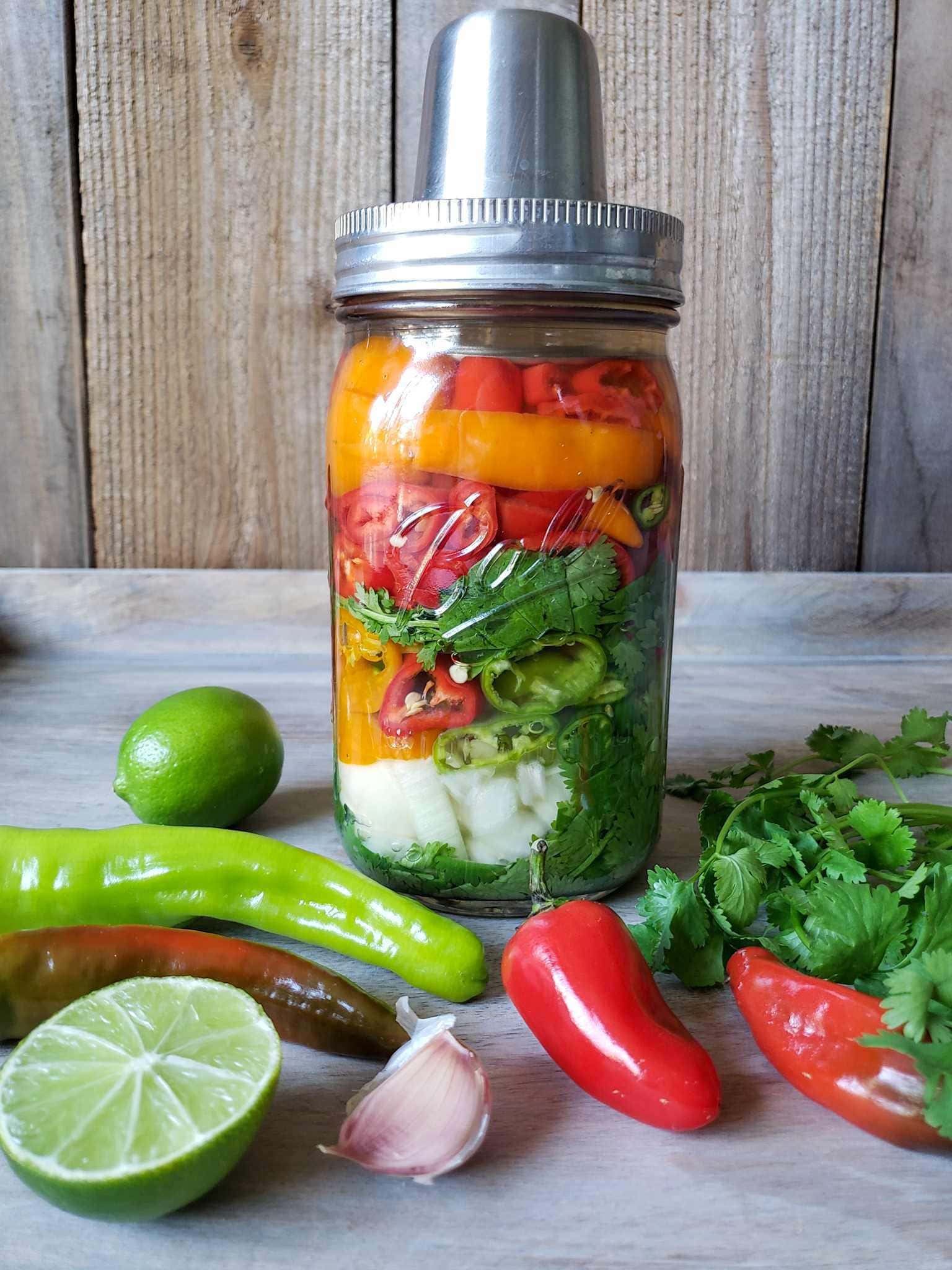
- In the bottom of a clean jar (or other fermentation vessel of choice) add a small handful of cilantro – about ¼ cup loose. Wash it first, but it does not need to be cut up or de-stemmed. Save a similar small handful of cilantro to layer into the jar later.
- Next, add 2 to 3 lightly crushed peeled cloves of garlic to the jar, followed by the diced onion. Lightly press the contents down to pack. The jar should only be about a quarter full or less at this time. The remaining space is for peppers!
- Now start adding cut pepper pieces to the jar, lightly packing them down as you go – reducing empty air space. I generally mix hot and sweet peppers together in layers.
- Once the jar is one-half to two-thirds full, add that last little bit of cilantro.
- Continue layering and packing peppers until the jar is nearly full, about an inch below the rim. (Note: You may need a little extra space at the top of the jar if you’re using a thick glass fermentation weight.)

Step 3: Make and Add Salt Water Brine
On the stove top, combine 2 cups of filtered water with 1 tablespoon of sea salt in a pot to create a simple salt water brine. The salt is what encourages a safe fermentation process and beneficial bacteria, while inhibiting the growth of harmful pathogens.
Gently heat the water until the salt dissolves, but avoid overheating it. The brine needs to be room temperature or barely lukewarm by the time you add it to the jar. (That said, you could also do this step prior to the veggie prep, allowing extra time for it to cool.)
Once the brine has cooled to the desired temperature, pour it into the fermenting vessel until the peppers are completely covered with liquid. Gently tap and wiggle the jar or push down on the peppers to release air pockets. Top off with more brine as needed after settling occurs.

Step 4: Cover with an Airlock Lid
When fermenting foods, it is important to keep the veggies (peppers, in this case) submerged below the brine. This helps prevent the development of mold. As the peppers ferment, they will release gasses that need to escape from the jar. Ideally, those gases should be allowed to escape without disrupting the fermentation process or introducing new air. This is where your weight and airlock lid comes in handy!
Cover the fermentation vessel with your weight and airlock lid system of choice. The stainless steel Kraut Source ferment device we use has a spring and plate that serve as a weight to keep the peppers submerged, along with a moat system on the top of the lid that creates an airlock. This all-in-one ferment lid from Ball accomplishes the same.
Alternatively, you can use a separate fermentation weight like these glass weights made for wide-mouth jars, ceramic versions, or even boiled stones. Then, add a separate airlock lid on top.

Step 5: Ferment
How long should hot sauce ferment? How do I tell when it’s done?
Now it’s time to let the peppers and lactobacillus do their thing! Set the fermentation vessel in a temperate location to ferment for 7 to 14 days. (See more temperature notes below.) Dark or light – doesn’t matter! Ours usually lives on the kitchen counter.
The shorter the ferment, the less “developed” and complex the flavor profile will be. However, the longer the ferment – the more chance there is to develop kahm yeast (also explained below) and get a little funky, especially in warmer conditions.
As the peppers ferment, the brine will change from clear to cloudy, the peppers colors will become more muted, things will compact under your weight, and will likely produce bubbles.
Some fermentation vessels bubble so much that they overflow from the container. Therefore, we always set ours on a plate to catch any runoff. Also note that ferments usually smell a bit funky, but don’t worry – they taste better than they smell! I promise.
What temperature should I ferment my hot sauce?
The ideal fermentation temperature for peppers and fermented hot sauce is about 68 to 73°F. Other ferments do okay with temperatures slightly warmer, up to the 80 to 85 degree range, but peppers are more finicky and prone to growing kahm yeast. Therefore, do your best to find a location in the preferred range.
A note about kahm yeast
In too warm of conditions, the peppers in fermented hot sauce are prone to developing something called kahm yeast. Though not harmful, kahm yeast can create an off-putting odor and flavor. It will appear as a thick white layer of sediment on the bottom of the jar, on the peppers themselves, or floating on the surface. A small amount of white sediment or film in totally normal in any ferment. In contrast, too cold of temperatures can lead to improper fermentation and mold development.

Step 6: Strain and Blend into Hot Sauce
After 7-14 days have passed, it is time to turn those fermented veggie chunks into fermented hot sauce! To do so, place a fine-mesh strainer over a bowl. Yes, over a bowl – not the sink! Next, open and remove the lid and weight from your ferment vessel and dump the contents of the container into the strainer. Keep the collected brine that is in the bowl below!
Transfer the fermented peppers, onions, garlic and cilantro into a blender. Next, add one tablespoon of fresh-squeezed lime juice, along with ¼ cup of the reserved ferment brine. Blend, and check the consistency.
Continue to add small amounts of the brine, little by little and blending as you go, until the fermented hot sauce has reached your desired thickness. Some like it thin, some like it thick! That is totally up to you. Give it a little taste-test too, and add another squeeze of lime if you’d like.

Step 7: Bottle and Enjoy
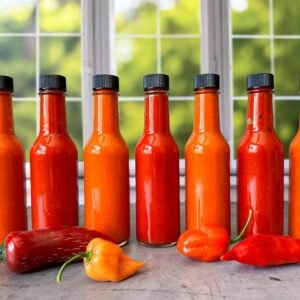
Once blended, transfer the finished fermented hot sauce into a storage container. Ideally, something that is glass and has an airtight lid. We like to store ours in these classic 5-ounce hot sauce bottles (especially for gifting), fun swing top bottles, or in small mason jars.
Now you get to enjoy your very own tangy, sweet and spicy fermented hot sauce! We enjoy drizzling this sauce over, eggs, frittata, veggies with rice and beans, fiesta-style stuffed squash, lentils… the list goes on. Aaron likes to eat it with chips like salsa, or even add a dash to his soup!


How long does fermented hot sauce last?
Fermented hot sauce stays good for up to a year in the refrigerator (or longer) which is where it should be stored. We’ve eaten fermented hot sauce that was over two years old before! Shake to mix before use, because some separation is normal. Discard if mold or off-flavors develop.

In all, I hope you love this recipe as much as we do! If you need any tips on growing your own peppers and chilis, learn more here. Please feel free to ask questions in the comments, share this post, and if you do make it – report back with a review!
Don’t miss these tasty recipes!
- Crunchy Refrigerator Pickles: Quick & Easy Homemade Dill Pickles
- Simple Low Sugar Apricot Jam with Lemon Juice (No Pectin)
- How to Make Sauerkraut: Easy Step-by-Step Recipe with Photos
- Fermented Pickles Recipe: Crunchy Brined Dill Cucumber Pickles
- How to Make Homemade Chili Powder, in 4 Simple Steps
Easy Fermented Hot Pepper Sauce Recipe
Equipment
- Fermentation vessel, such as a glass jar.
- Ferment weight and airlock lid (or all-in-one ferment lid)
- Strainer
- Blender
- Bottles or jars, for storage
Ingredients
- 1 lb peppers of choice, both hot chili peppers and some sweeter peppers recommended
- 1/2 cup fresh cilantro, loosely packed
- 1 whole small onion, or 1/2 medium to large onion
- 2-3 cloves garlic
- 1 tbsp sea salt, pickling salt, or kosher salt (no table salt)
- 2 cups filtered water, to combine with salt for brine
Instructions
- Wash and chop peppers and onions. Wear gloves is suggested. For a more mild hot sauce, core the peppers first to remove most of the seeds and white membrane.
- In the bottom of a clean quart jar, add a small handful (1/4 cup loose) of fresh cilantro and 2-3 crushed cloves of garlic.
- Next add the diced onion, and some peppers on top. Lightly press to compact and reduce air space as you go.
- When the jar is halfway to 2/3 full, add the remaining 1/4 cup of cilantro and then continue filling the jar with peppers, until completely packed full (within top inch of the jar).
- On the stovetop, combine 2 cups filtered water with 1 tbsp sea salt. Lightly heat until salt dissolves, but avoid over heating.
- Allow brine to cool to room temperature or lukewarm, and then pour over the peppers in the jar until the jar is full and they are fully submerged. Tap and wiggle jar to remove air pockets.
- Cover with fermentation weight and airlock lid, to keep veggies submerged below the brine during fermentation.
- Set jar in a temperate location (68-73°F) to ferment for 7-14 days.
- After 7-14 days, open jar and pour contents through a strainer that is positioned over a bowl to catch the liquid. KEEP the strained brine liquid.
- Add all solid contents (peppers, onions, garlic, and cilantro) to a blender. Add 1 tablespoon of fresh squeezed lime juice, and 1/4 cup of the reserved brine liquid. Blend.
- Assess the consistency of the fermented hot sauce. Continue to add reserved brine little by little, blending as you go, until the desired consistency of sauce is reached.
- Store finished fermented hot sauce in an air-tight bottle or jar in the refrigerator. Shake before use. It should stay good for up to one year in the refrigerator (or longer).



138 Comments
Brandi
I just made this and it turned out great! I am wondering if I could you roasted hatch chilis?
Aaron (Mr. DeannaCat)
Hi Brandi, glad you enjoyed it! You can use roasted peppers but just roast them by themselves with no oil, plus you will also need to use fresh chilis as well because the ferment needs the good bacteria from fresh veggies to properly ferment. I would try and use at least half the amount of fresh versus just a little under half the amount of roasted. Hope that helps and good luck!
Michael Terry Grubic
If I wanted to use a fermentation method to can hot peppers to be used as a condiment, how would the process be different?
Aaron (Mr. DeannaCat)
Hi Michael, you may choose to can fermented hot sauce but you will kill all of the probiotics and good bacteria that comes with the fermentation process. If you don’t have space in your fridge for storage and want to can the fermented hot sauce, I would let the hot sauce ferment for at least two weeks to reduce the pH of the sauce, making it more acidic which is what you want for canning. I believe the recommended process is to heat the fermented sauce in a pan until a slight boil, add to your canning jars, before water bath canning for at least 15 minutes. Hope that helps and good luck!
sheila
Thank you for this! Would it be ok to use frozen peppers?
Aaron (Mr. DeannaCat)
Hi Sheila, yes you can use frozen peppers but you will want to be sure to add some fresh ingredients as well to help the good bacteria get a kick start and grow more quickly for a more speedy ferment. Hope that helps and enjoy!
Barbara Schutt
I would really like to try this! We have made 5 gal buckets of kraut just using salt and the cabbage breaks down with it’s own moisture/brine. Tasty!
Aaron (Mr. DeannaCat)
It really is tasty!
Michael Grubic
This will be my 1st attempt at hot sauce. My wife hates cilantro. Have you found a good substitute?
Also, how will the fermentation process be effected if the temperature is in the 60’s?
Thanks.
Aaron (Mr. DeannaCat)
Hi Michael, the fermentation may just take a little longer if the temperature is in the 60’s. Just be sure that your veggies stay below the brine level so there is not risk of mold. We have made fermented hot sauce with only chili peppers and garlic and it was very delicious as well so I would just omit the cilantro instead of substituting for something else. Hope you enjoy the hot sauce and good luck!
Kiri-Ann
Thanks for this recipe, I enjoy it so much that ever since I found it, I’ve kept a constant supply on hand! Really great instructions.
I’ve just finished fermenting my latest batch, and the brine has turned out pretty viscous, which hasn’t happened before. I gather from a web search this isn’t harmful and is down to a particular kind of bacteria, but I was wondering if you’d experienced this before and had any tips on avoiding or reducing it?
Aaron (Mr. DeannaCat)
Hello Kiri-Ann, glad to hear you like the hot sauce so much! Sometimes your brie can become more viscous if the vegetables your fermenting have more sugar inside them. Maybe you added more sweet peppers than usual or they were just extra sweet? Keeping your ferments at a steady temperature that isn’t too hot or too cold will help as well. We find that kahm yeast is fairly common when fermenting peppers, especially if it gets too warm. Hope that helps and good luck!
Jessica W
I made this and blended it on Monday. My husband said it was great and our two young adult sons agreed. Mine came out more green than orangey red…I think because I used jalapeño and yellow bell peppers.
Aaron (Mr. DeannaCat)
Sounds tasty, enjoy!
Woody
Hello
How do I know whether I should stope between 7 and 14 days? Is it when it stops bubbling or just when I chose?
Aaron (Mr. DeannaCat)
Hello Woody, it’s mostly just choice, the longer it sits the more fermented it will become and more complex flavors will develop. Though usually 7 days is sufficient to successfully ferment the hot sauce.
Jody
It really depends on desired taste. It just gets more tangy with time (is the only way I know how to describe). I always let mine go 4 weeks.
Sharon
I love this recipe and have made it a couple times. This time one of my jars has some white mold at the top. Do I need to scrap the whole jar ?? It smells the same as the ‘good’ jar.
Thanks,
Sharon
Aaron (Mr. DeannaCat)
Hello Sharon, one could probably scoop out the mold with some of the top most portion of hot sauce that was in contact with it and be fine.
brenda sanchez
Hello! The white setiment your talking about, how can you tell the difference from it and mold? Just checking because one of my jars has setiment on the bottom and a layer of white “skin” on top… thanks for your help! Love this stuff!!! Lol
Aaron (Mr. DeannaCat)
Hi Brenda, any mold will take place towards the top of the brine as it needs oxygen to grow. Is this jar still actively fermenting or is it already in the refrigerator? If it developed the white skin after it had been placed in the fridge, it is likely not mold. If they are still at room temperature and fermenting, is the white “skin” on the top raised or bumpy as mold will usually grow this way. If the temperature in your house has been in the high 70’s or warmer, there is a greater chance of kahm yeast developing which is what you may be seeing. Google kahm yeast and compare the images to what you are seeing in your jar. Let us know what you decide and glad you enjoy the hot sauce!
kristin gonzales
I’m new to this & purchased Kilner fermentation jar to use for my abundance of peppers we’ve harvested. Is there a reason a salt/water combo is used vs vinegar? Thank you
Aaron (Mr. DeannaCat)
Hello Kristin, this is a fermentation recipe which doesn’t use vinegar because vinegar inhibits the growth of beneficial bacteria- which grow and naturally lower the pH of the hot sauce which preserves it in a similar but more natural/healthy manner than vinegar. Most hot sauce recipes that use vinegar need to use a lot of vinegar whereas fermented hot sauce allows for the other ingredients to shine through more. Hope that helps and good luck!
Christel S
Have you added fruit to it before, like mango in place of sweet peppers? I’m thinking mango chili lime would be delicious..
Aaron (Mr. DeannaCat)
Hi Christel, we haven’t experimented with adding fruit to the fermented hot sauce yet but it sounds tasty. Let us know how it turns out!