

How to Make Calendula Oil (Easy Calendula Infused Oil Recipe)
Come learn how to make calendula oil with our simple step-by-step recipe. It’s exceptionally easy and affordable to do! All you need is oil, dry calendula flowers, and a little time! Then you can use your super-soothing homemade calendula oil on its own, or as an ingredient in other DIY natural skincare recipes like salve, soap, or lotion.
This guide also explores the healing benefits of calendula oil and 7 ways to use it. We’ve been making calendula infused oil for nearly 10 years, so I have plenty of tips on how to make the most luxurious and nourishing oil possible. In fact, calendula is one of my favorite all-time herbs to grow!
Note: This post was originally published in October 2019 but has been significantly updated.
Would you like to save this?
Disclosure: This post may contain affiliate links to products for your convenience, such as to items on Amazon. Homestead and Chill gains a small commission from purchases made through those links, at no additional cost to you.
What is Calendula Oil?
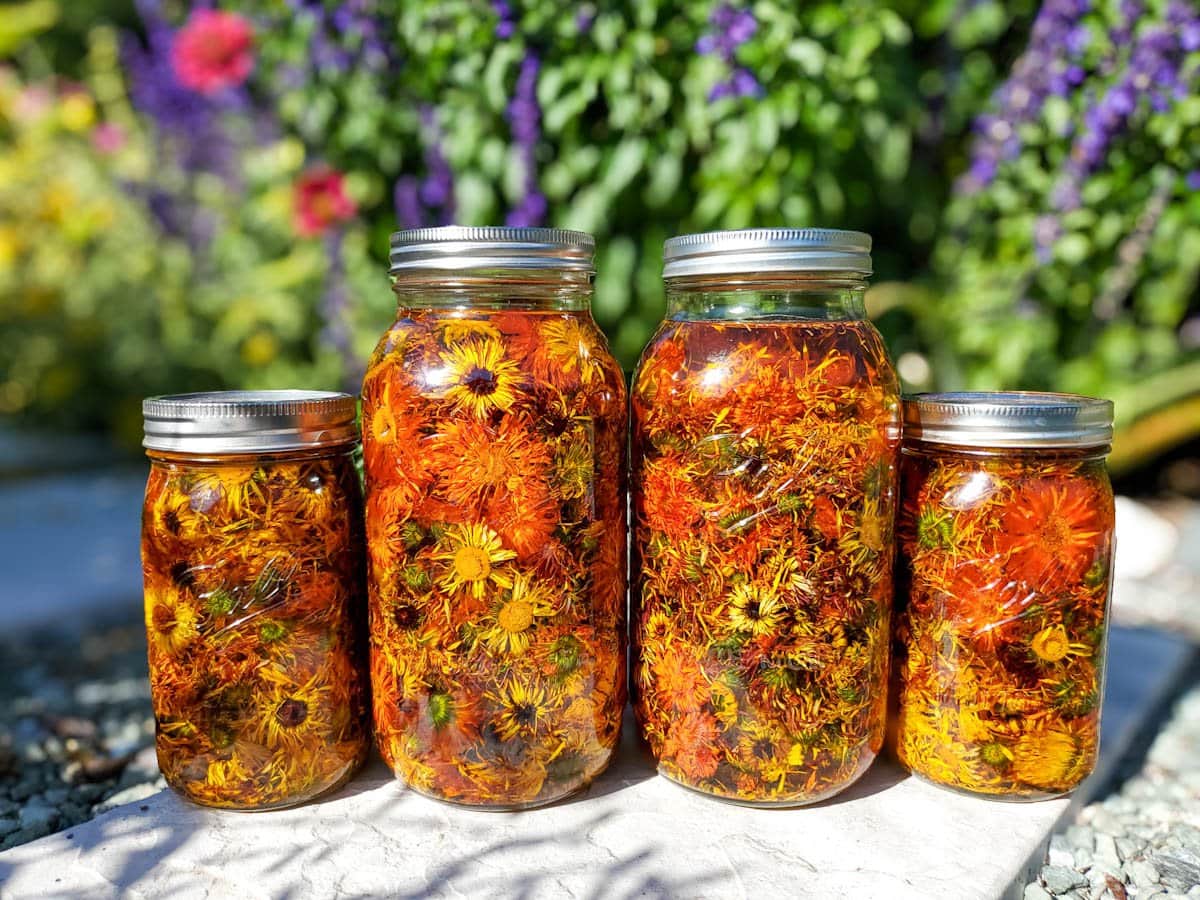
Calendula oil is made by soaking or infusing dry calendula flowers in a carrier oil of choice (such as jojoba oil or sweet almond oil) for several weeks or longer.
As they steep, the natural healing resins and other beneficial compounds found in calendula flowers are drawn out and into the surrounding oil. The result is a highly therapeutic oil that can be used to soothe a wide variety of skin issues including eczema, rashes, and more. Learn more about the benefits and uses of calendula oil below!
Note that calendula is sometimes referred to as “pot marigold” – but don’t confuse it with true marigolds, such as french marigolds! They’re distinctly different, and not nearly as medicinal in nature.
Benefits of Calendula Oil
Calendula officinalis is a key ingredient in many natural skin care products, and for a good reason! The medicinal resins found in calendula promote cell repair and growth (e.g. wound healing) and have proven natural antiseptic, anti-fungal, and anti-inflammatory properties.
When used topically, calendula can soothe, heal, or otherwise treat a huge array of skin conditions including rashes, sunburn, swelling, eczema, acne, stings, bites, wounds, burns, scrapes, psoriasis, scars, cold sores and more.
In her book Medicinal Herbs, A Beginner’s Guide, expert Rosemary Gladstar suggests using calendula oil or salve on babies to safely soothe cradle cap, diaper rash, or other skin irritations. It also calms my skin after shaving, to prevent or treat razor burn.
It’s hard to put into words just how magical this herb is… and it really works! Our organic calendula salve is the most popular item in our shop; its helped thousands of people heal stubborn skin issues, even when prescription medications did not!
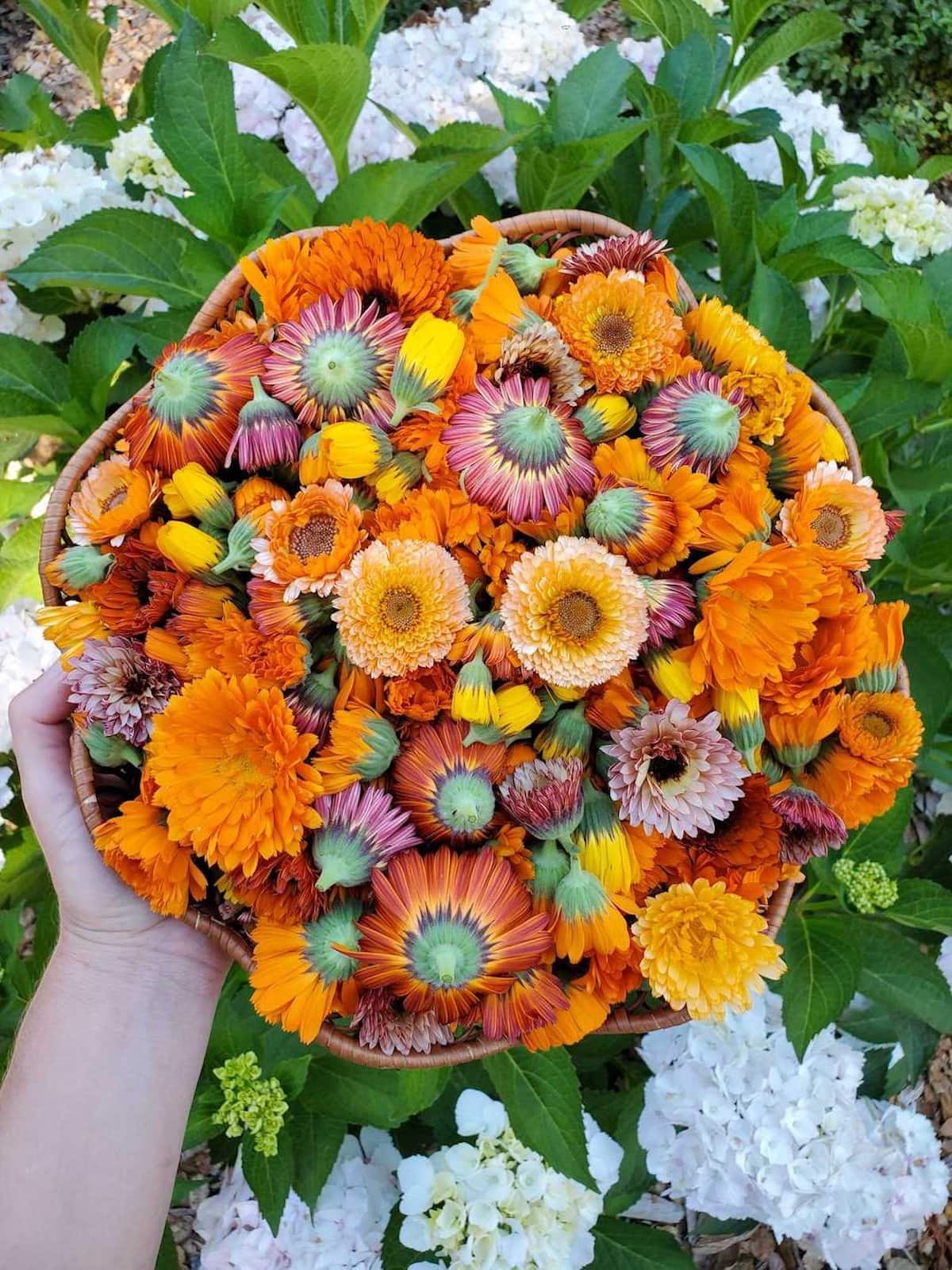
EXPERT TIP: Instead of using petals alone, we prefer to make calendula oil using whole dried calendula flower heads – because the base of the flower actually has the most medicinal resin, not the petals!

Supplies Needed
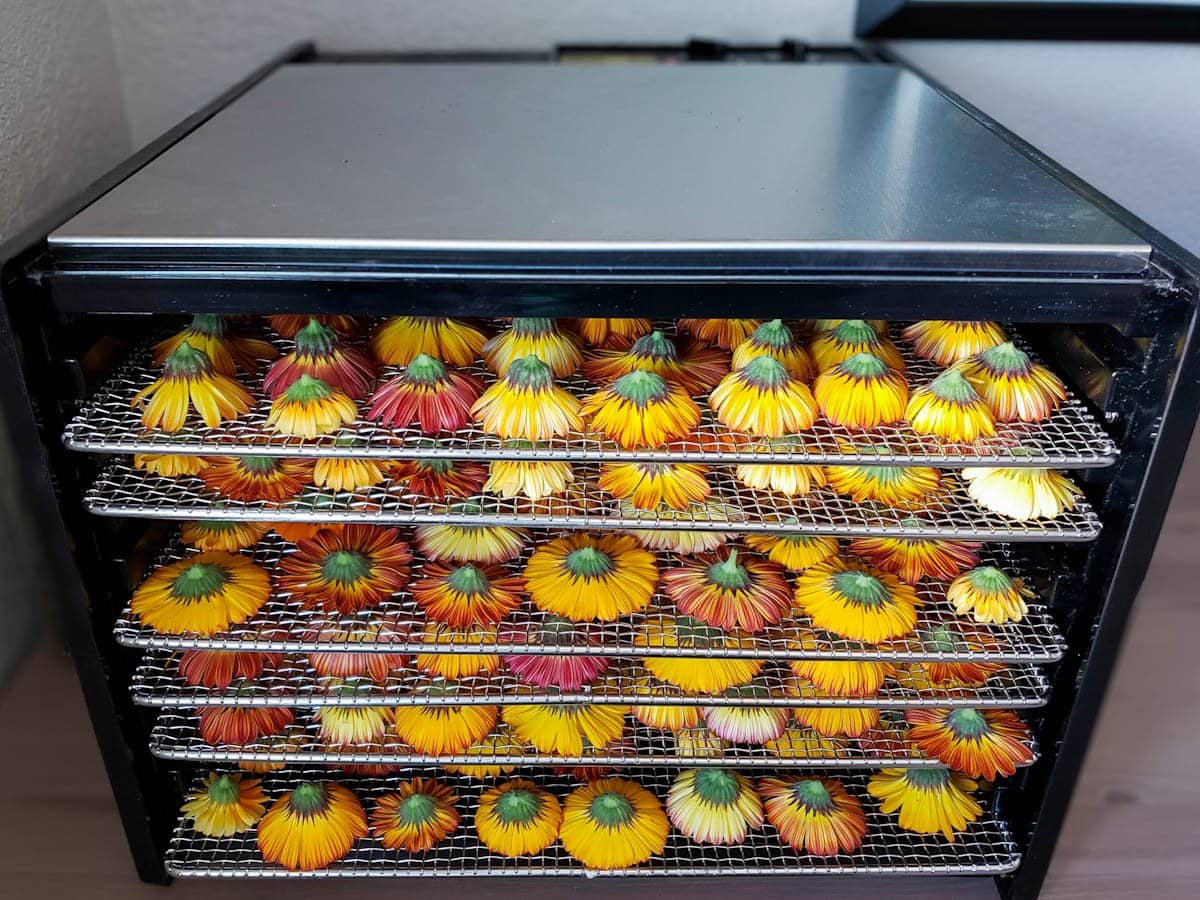
- Dried calendula flowers or petals, enough to fill your chosen jar or container at least two-thirds full. You can use homegrown or store-bought dried calendula, as long as it’s 100% dry. If the flowers are not fully dry, the leftover moisture can cause the calendula oil to grow mold or spoil! Using dry flowers also helps to extract the maximum essential oils possible. See four ways to dry fresh herbs here.
- Carrier oil of choice – such as olive oil, sweet almond oil, or jojoba oil. You’ll need about the same volume of oil as the size container you select. See more information about choosing the best carrier oil below.
- A glass jar or other container with a lid. Something like a 1/2 pint jar would be great if you only need a small amount. Yet if you intend to make calendula salve or other homemade body care products, I recommend using at least a pint jar or more.
- A fine mesh strainer, sieve, and/or organic cheesecloth
- Optional: organic essential oils to lightly scent it
EXPERT TIP: To create the most therapeutic calendula oil possible, harvest young fresh flowers instead of using older, fading blooms. The flowers should also be dehydrated on very low heat to preserve the maximum beneficial compounds. Don’t miss our guide on how to grow and harvest calendula flowers – including tips on how to dry it.
Best Carrier Oils to Make Calendula Oil
Popular carrier oils used to make calendula oil include extra virgin olive oil, sweet almond oil, argan oil, grape seed oil, coconut oil, and more. No matter what you choose, I highly suggest using a high-quality, unrefined, cold-pressed oil. Certified organic is all the better. The goal is to create a healing medicinal oil after all!
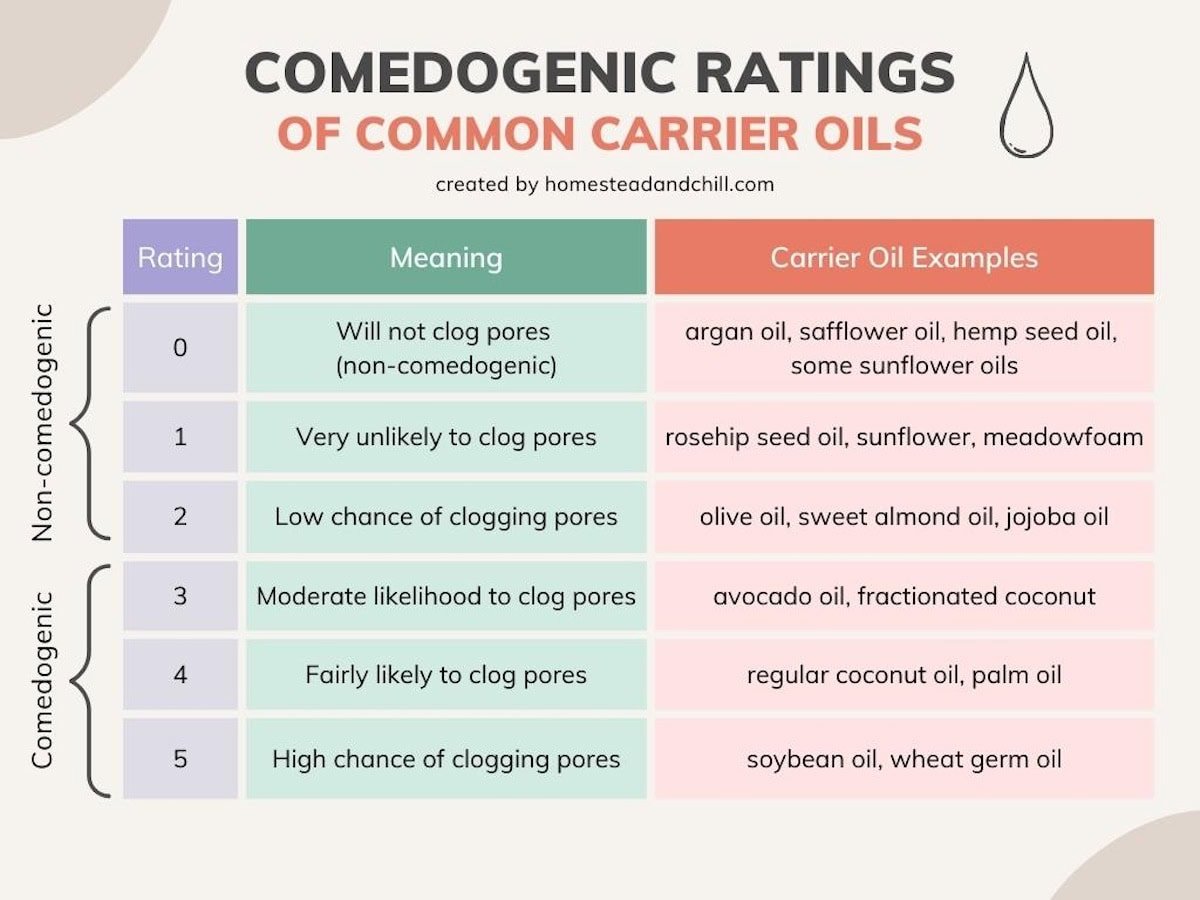
If you’re making calendula oil primarily for topical use, choose a carrier oil that’s compatible and beneficial for your skin type (e.g. consider comedogenic ratings). Organic jojoba oil is my personal favorite, especially for my face! We also sometimes blend two types of oils, such as almond and jojoba oil.
LEARN MORE: Visit our guide on the best 11 Carrier Oil Options for Skin Care, Salves and Infusions to learn more about the unique benefits and properties of each.
Instructions
1) Infuse
- Fill a glass container at least three-quarters full of dried calendula flowers or petals.
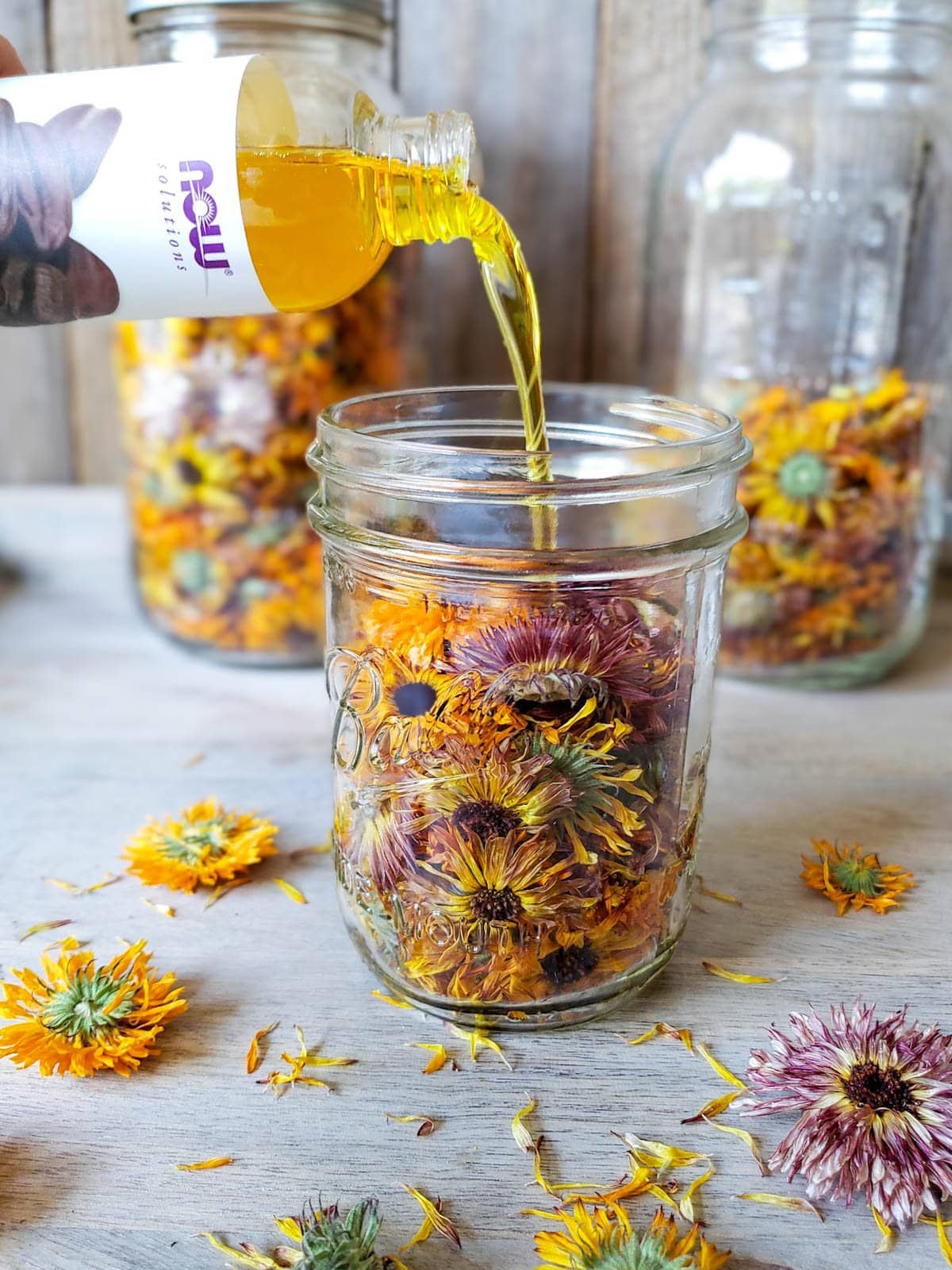
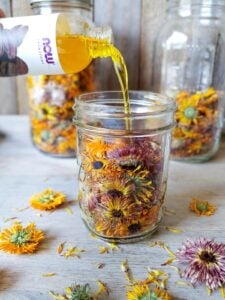
- Pour your carrier oil of choice over the calendula, filling the container enough so that all the flowers can be fully submerged and move freely in the oil. Add a tight-fitting lid.
- Place the jar in a moderately warm location, such as near a sunny window, inside a warm cabinet, or on top of a warm appliance. While some herbalists may have a preference, it doesn’t make much of a difference if the jar is stored in the dark or light – but a little warmth does help it infuse better!
2) Wait
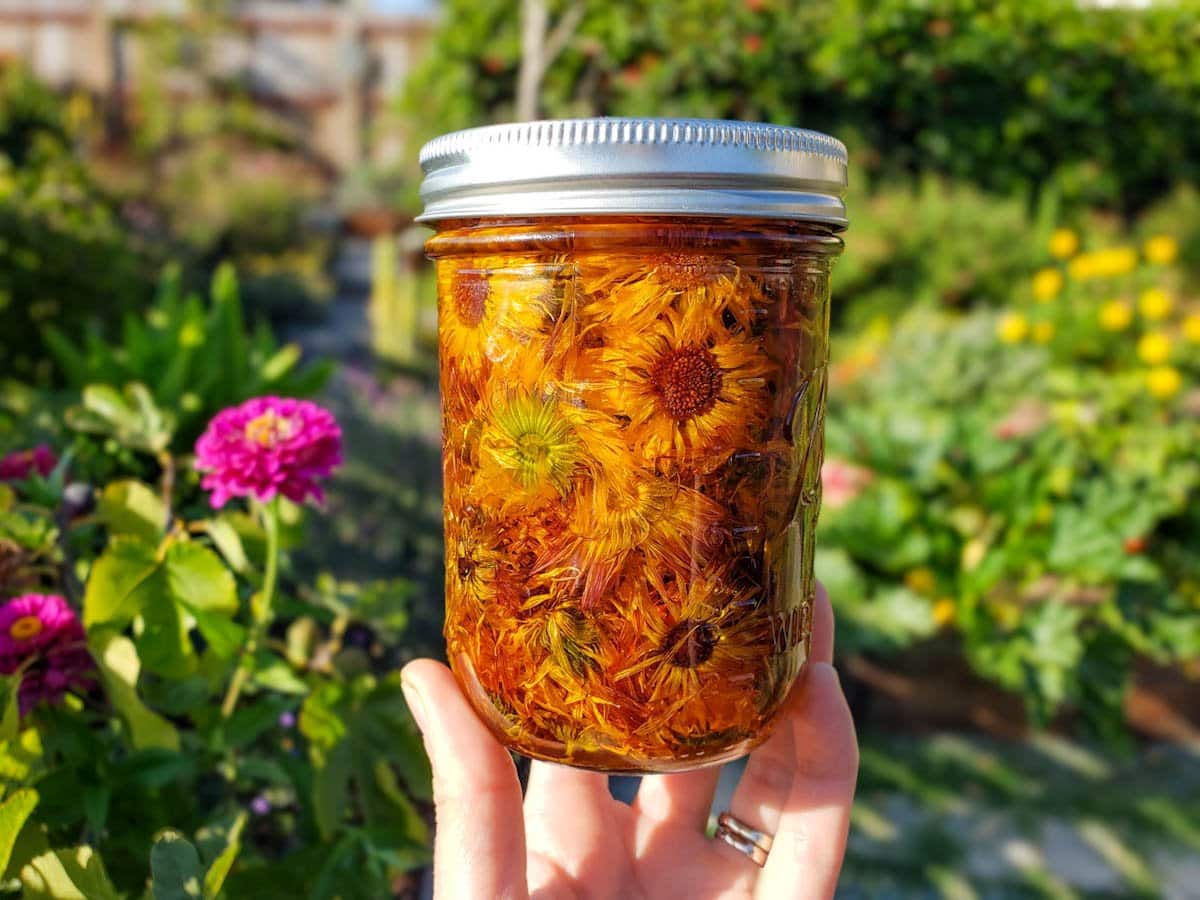
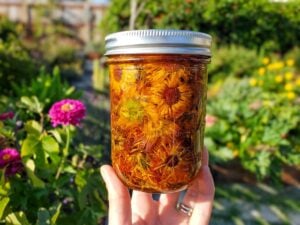
- Allow the calendula oil to to infuse for at least two weeks* or up to 1 month (or longer) for the best results and maximum extraction possible.
- If possible, set the jar somewhere you’ll remember to stop by and gently shake it on occasion to stir things up.
*I much prefer this slow, passive infusion process (since many therapeutic compounds can be destroyed by heat) but it’s also possible to gently heat calendula and oil on the stove to get same-day results. Learn more in this separate guide on how to make herb infused oil.
3) Strain
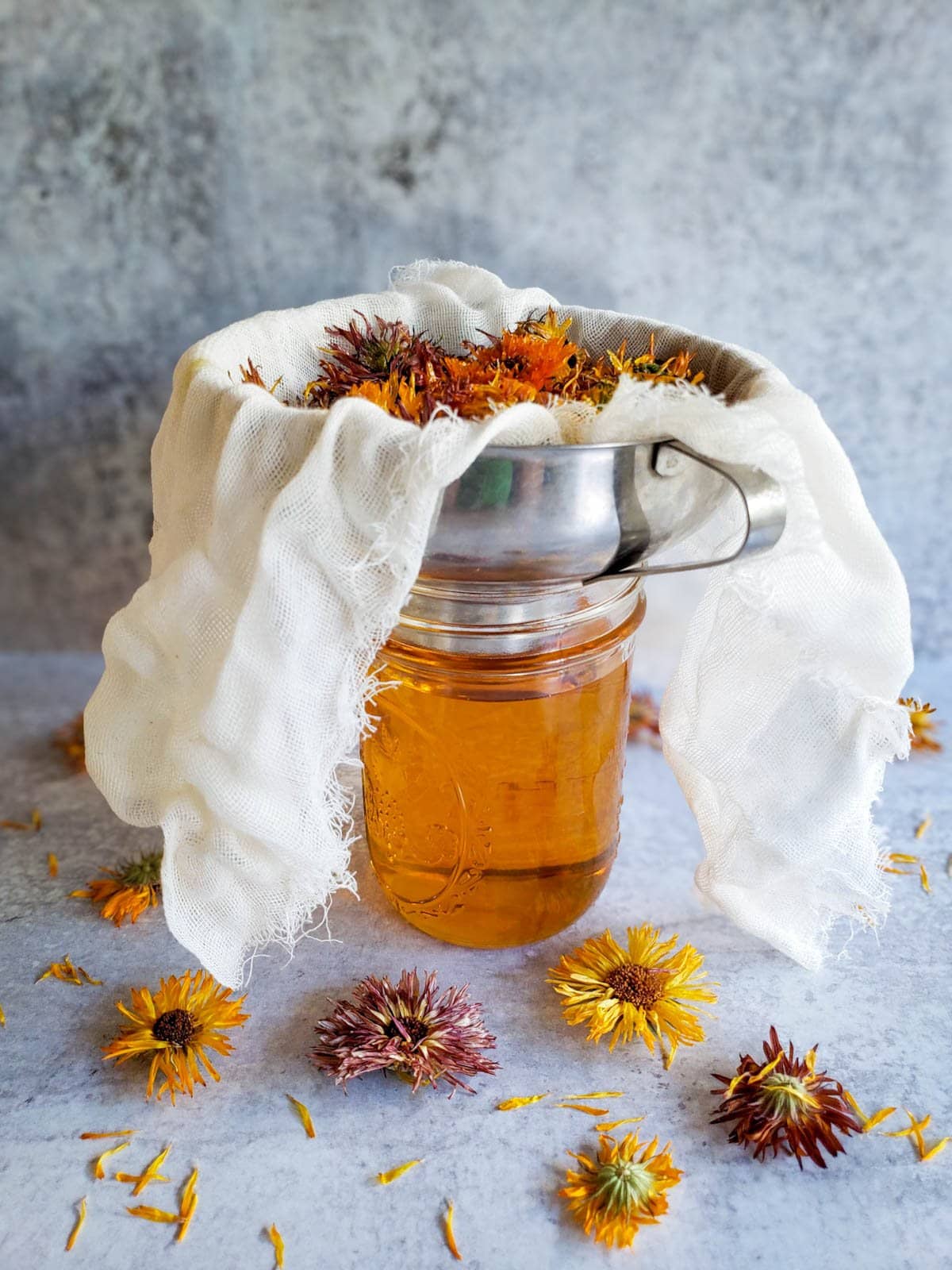
- When the time is up, strain the calendula flowers and reserve the oil.
- We usually do this by positioning a fine-mesh strainer over a bowl and pouring it all through. Let it sit to fully drip and drain for at least 15 minutes.
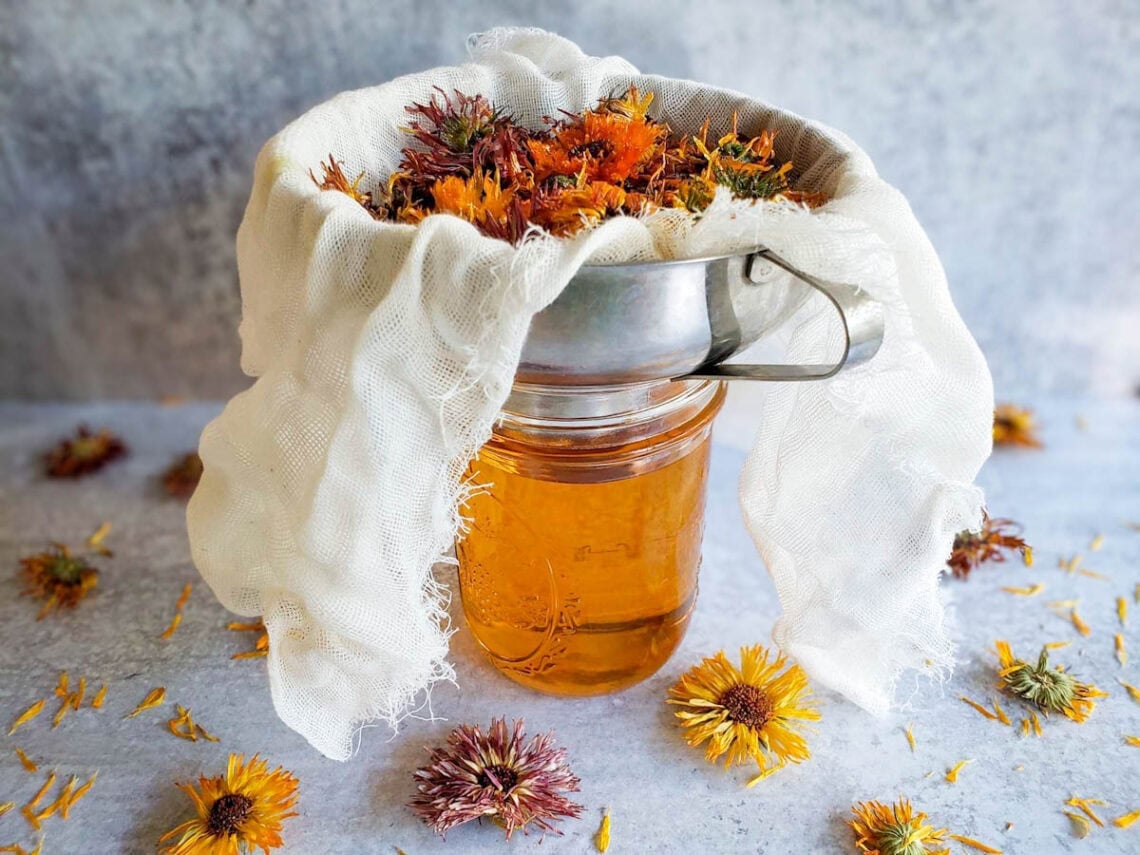
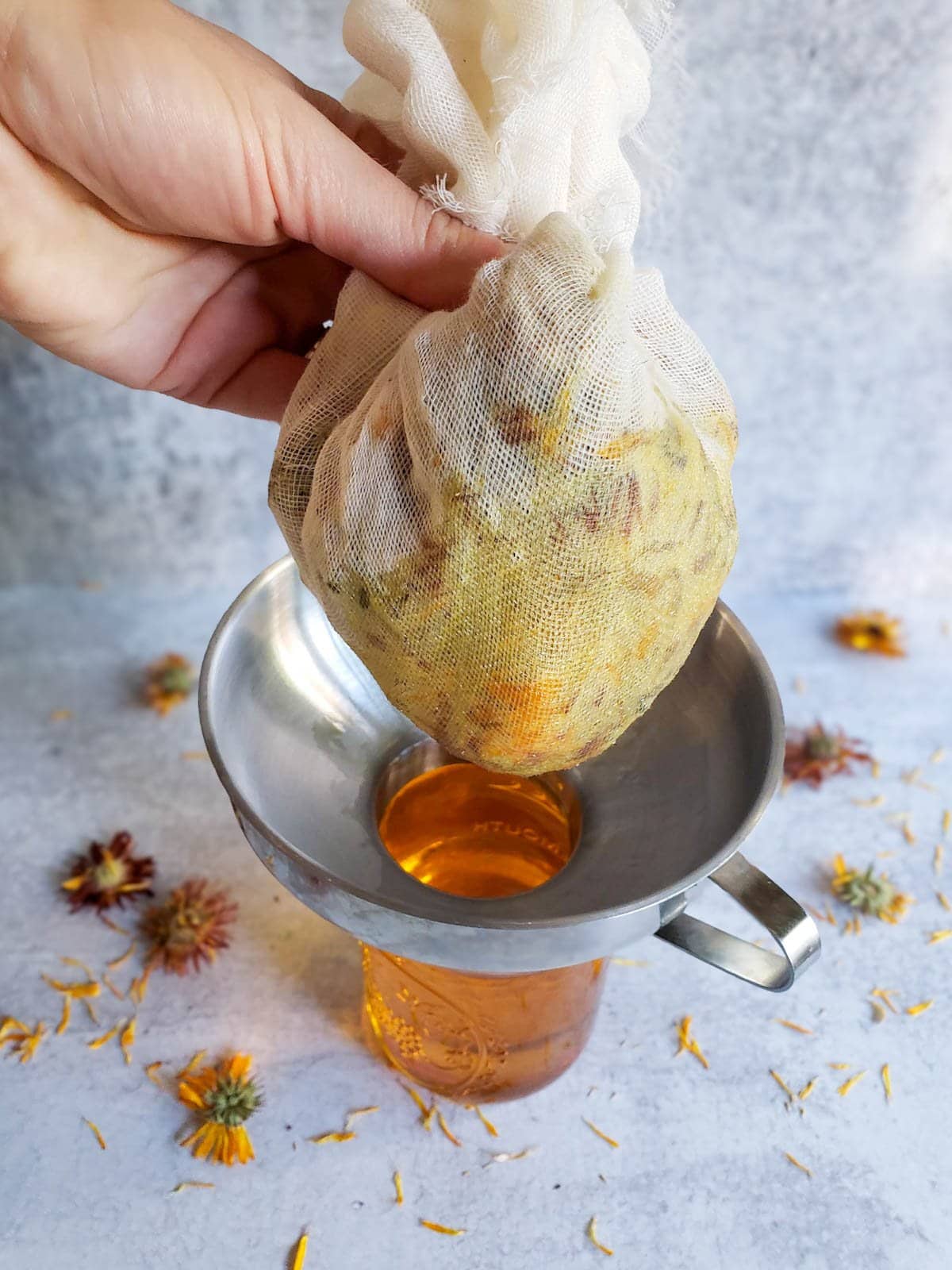
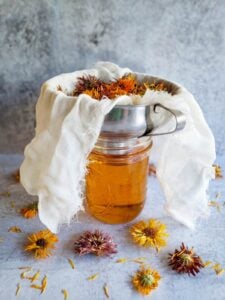
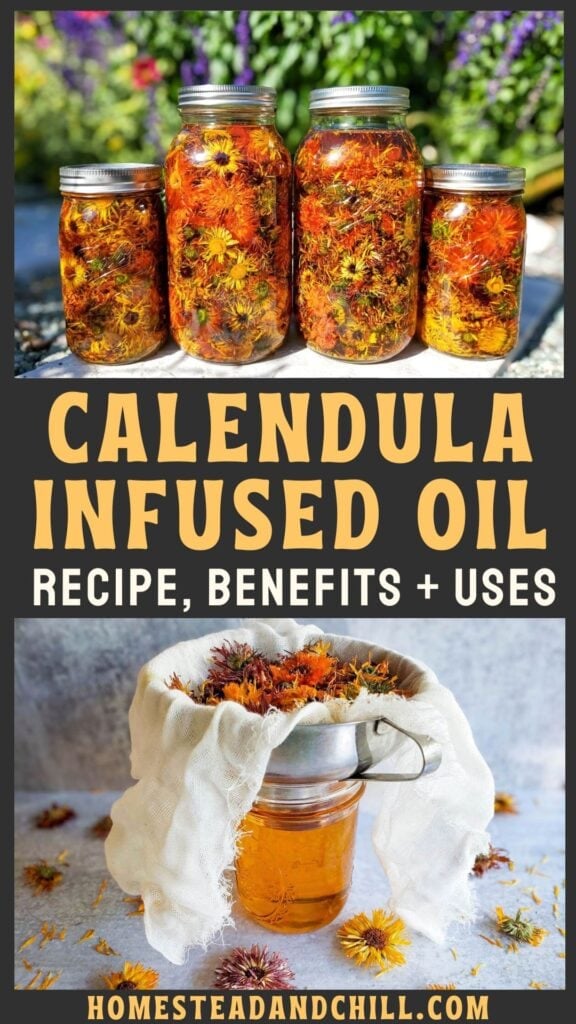
- I like to line our strainer with cheesecloth or a reusable nut milk bag for extra-fine filtration. That way, I can also wring out the cloth or bag of calendula to squeeze out every bit of oil possible. (I’ve also lined a canning funnel with cheesecloth over a clean jar, as shown in the photos.)
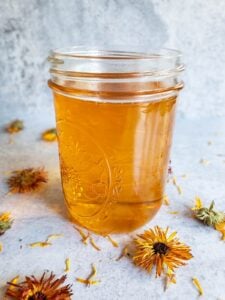
- Finally, pour the strained oil into a clean jar for storage. If you wash and re-use the same jar, be sure it’s fully dry before storing the oil in it!
- Optional: Since calendula oil has a very mild earthy aroma, feel free to add a few drops of your favorite organic essential oils to lightly scent it. I especially enjoy the addition of chamomile and lavender essential oil.
Storage and Shelf Life
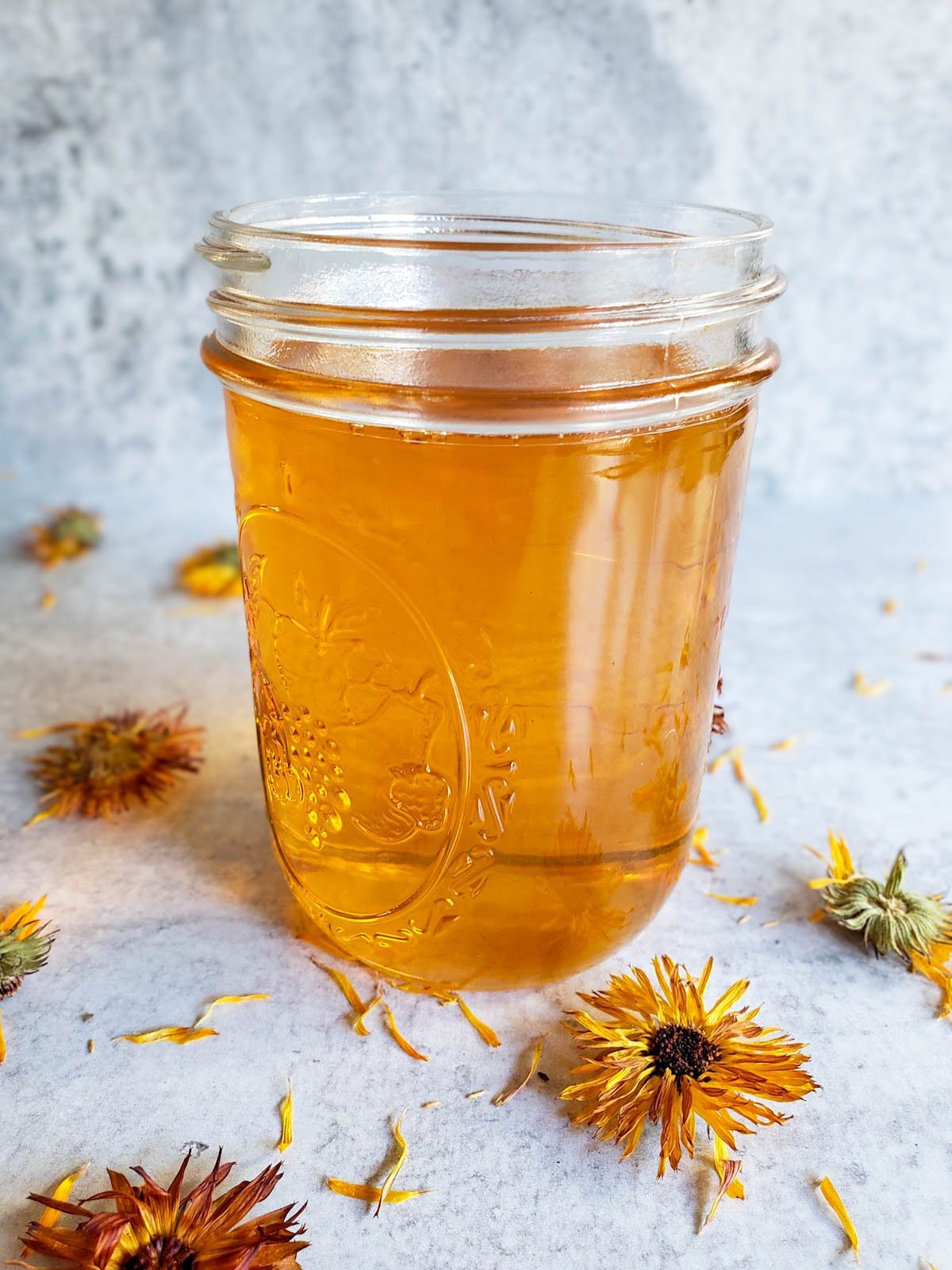
Store the finished calendula oil in a clean glass container with a tight-fitting lid. Keep the container in a dry, cool, dark location. You can also store calendula oil in the refrigerator to extend its shelf life.
The shelf life of homemade calendula oil varies and depends on the type of carrier oil (check the bottle) and condition of flowers used. Some oils are more prone to becoming rancid faster than others. Most have an average shelf life of about 1 year. (Another reason I love jojoba oil: it’s good for up to 5 years!)
7 Ways to Use Calendula Oil
- As a soothing facial moisturizer to help with redness, dry skin, acne, and more. A little goes a long way! You’ll only need a few drops.
- As an ingredient in other homemade skincare products. Many natural body care recipes call for oil, such as in homemade whipped body butter, lotion, salve, soap, and more! See our popular homemade calendula salve recipe here. For more ideas, I highly recommend this organic body care recipe book.
- As a luxurious and nourishing massage oil.
- Other topical applications: You can use calendula oil directly on other parts of your body as a general moisturizer, on bug bites, sunburns, eczema, stings, rashes, scars, scrapes, and more!
- As a hair treatment to condition hair, moisturize your scalp, and potentially thicken hair. Coconut oil, olive oil, and argan oil are especially popular for deep moisturizing hair treatments. Simply apply an even coat of oil to your hair, massage it into your scalp, pin your hair up away from your clothes, and allow it to sit for anywhere from 15 minutes to a few hours. Then use shampoo as usual to wash away the oil.
- To remove makeup. Calendula oil makes a great natural makeup remover! Oil naturally draws out impurities, while the calendula soothes redness, inflammation, and targets acne. Avoid contact with sensitive areas around your eyes.
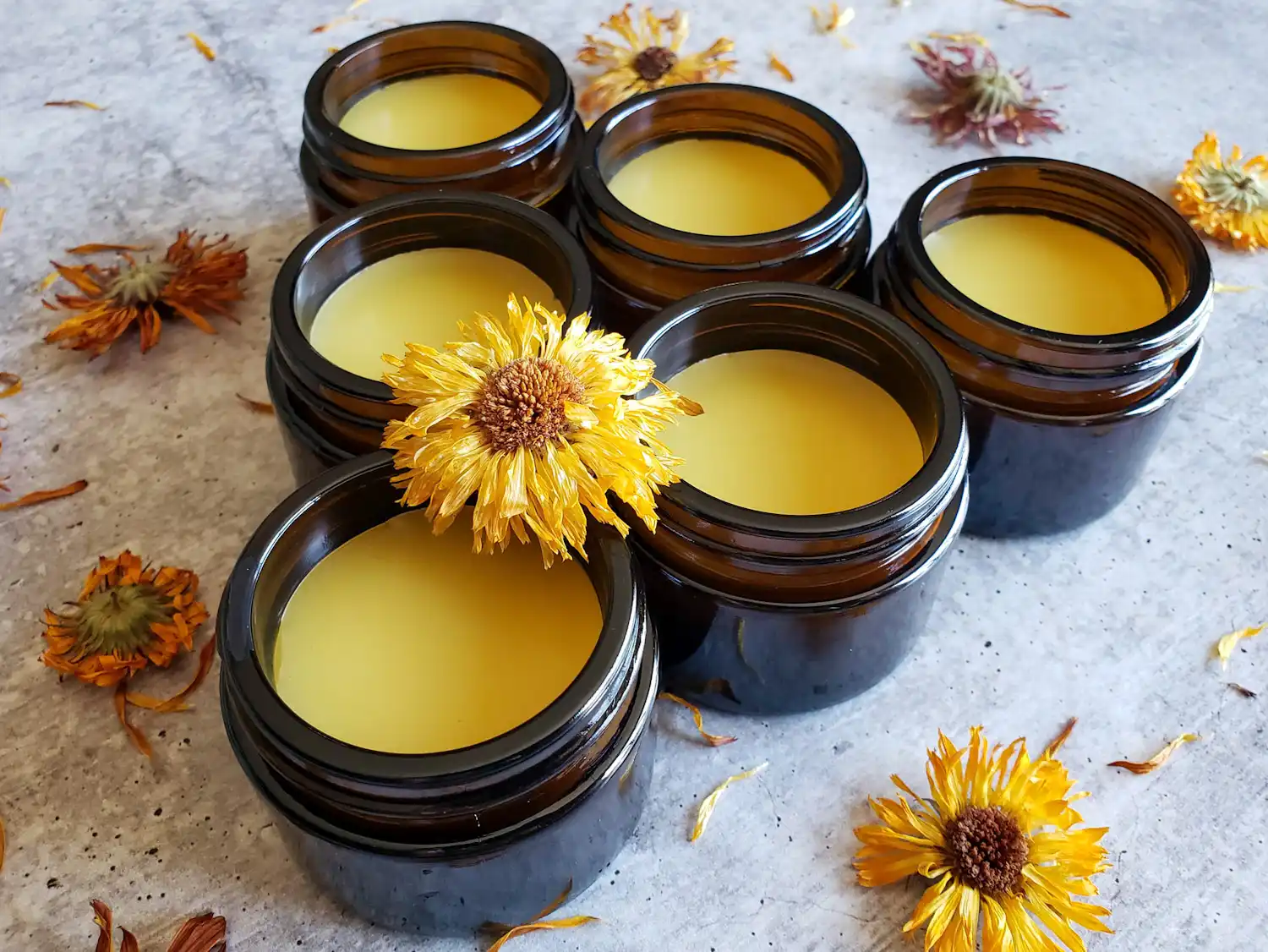
- Give it as a gift. Make a bigger batch and divvy it up into cute little bottles or jars to share with friends and family. Include a note or label to share the many ways to use it, or direct them here! See this list of my favorite 30+ DIY gift ideas, including mason jar gifts, food, sustainable crafts and more.
So beautiful yet simple.
So, what do you think? Are you excited to go make your own calendula oil? If you found this post useful, please leave a review below – and feel free to ask questions. Thank you for tuning in, and happy infusing!
You may also enjoy:
- How to Make Homemade Lavender Salve to Soothe Skin & Nerves
- How to Make Soothing Chickweed Salve Recipe and Infused Oil
- Natural Lip Balm Recipe: How to Make Homemade Lip Balm
- How to Make Nourishing Rosehip Oil + 12 Ways to Use It
- DIY Bath Salts Recipe: Beautiful Natural Herbal Bath Salts
- How to Make Salve or Balms 101: Simple Flexible Recipe
Homemade Calendula Oil Recipe
Ingredients
- Dried calendula flower or petals, homegrown or organic if possible
- Carrier oil of choice. Select a high-quality, unrefined, cold-pressed, and organic oils for the most healthy and healing calendula oil. Popular options for natural skincare include jojoba oil, olive oil, argan oil, hemp seed oil, grapeseed oil, sweet almond oil, rosehip oil, and more! **Choose an amount that matches the size of your infusion container.
- 1 glass container for infusing, such as a half-pint or pint jar
Instructions
- Fill a clean glass container at least ¾ full of dried calendula flower heads or petals.
- Pour your choice of oil over the dried calendula flowers, until the container is full and/or until the flowers are completely submerged. Add a tight fitting lid.

- Place the jar in a moderately warm location, such as near a sunny window, inside a warm cabinet, or on top of a warm appliance. While some herbalists may have a preference, it doesn’t make much of a difference if the jar is stored in the dark or light – but a little warmth does help it infuse better!
- Allow the calendula oil to to infuse for at least two weeks or up to 1 month (or longer) for the best results and maximum extraction possible. Gently shake it on occasion to stir things up.

- When the time is up, use a strainer and/or cheesecloth over a bowl to strain the flowers and reserve the oil. Let it sit to fully drip and drain for at least 15 minutes, and squeeze out all the excess oil from the dried flowers.
- Finally, pour the strained oil into a clean jar for storage. If you wash and re-use the same jar, be sure it’s fully dry before storing the oil in it!
- Store the finished calendula oil in a cool, dry location. It can also be stored in the refrigerator to extend the shelf life. Read the information on your carrier oil bottle to determine the recommended shelf life of your calendula oil.
- Enjoy! Use your calendula oil as a daily facial moisturizer (only a few drops needed), as spot treatment for irritated skin, a massage or body oil, an ingredient in other homemade skincare recipes (salve, lotion, soap etc), to condition hair, as a makeup remover, or give it as a gift!



99 Comments
Judy
Hi, stumbled upon your article while searching calendula oil, totally enjoy it. I have psorasis, do you think it is better to infuse the oil for a longer period to get the benefit of the medicinal, for psorasis is it better to use Sweet almond oil. Thanks
Aaron (Mr. DeannaCat)
Hi Judy, you could do an infusion for 1 to 2 months which should give you more time to get more medicinal benefits out of the calendula flowers, however, we have seen amazing results even with an infusion time of around 1 month. We do enjoy using sweet almond oil and think it’s a great choice for a medicinal fusion. Hope that helps and good luck!
Debra
Is there a way to speed up the infusing. And will it have the same strength as the long soak one. Thank you
Aaron (Mr. DeannaCat)
Hi Debra, you can follow the quick heat method which we outline in this post but you will still want the calendula flowers to be completely dry beforehand. The potency of the oil should be more or less what it would be after the slow cold infusion, hope that helps and good luck!
Leslie
I may be repeating myself from last season but these instructions are so thorough and helpful! I’m making my 2024 batch and came back for a refresher course! Thank you!!
Aaron (Mr. DeannaCat)
Hi Leslie, congratulations on your harvest(s) this summer and enjoy the healing properties of calendula!
Kelly
Love your site! Question: Can I use fresh petals to make calendula oil? Is there a reason why one is better than the other? I was taught a method of warming the fresh petals in oil, let it steep covered with cheesecloth, and stirred regularly. After a few months you would drain the oil from the flowers and proceed to use it in other recipes. Your recipe seems easier, and fewer options for mold. Just wondering if you receive more beneficial compounds from one method over another.
Thanks for your in depth information. I’ve just recently discovered you, and am now obsessed reading everything on your blog and watching your Youtube channel while I excercise. So fun!
Kelly
Aaron (Mr. DeannaCat)
Hi Kelly, we are so glad you found our site! We prefer the slow, cold infusion process using dried whole flowers being that the green flower bracts contain just as much if not more, medicinal resin on them. We have had great success making calendula oil this way and turning it into salve as well which can really help with a variety of skin ailments when applied topically. We have had many customers with a number of skin issues which become more manageable or even resolved using the calendula salve, even over prescription creams or even steroids. Hope that helps and reach out if you have any other questions.
Scott Maupin
Very helpful article, thank you! Does the brand of oil matter? For instance, locally we have found Pompeian Grapeseed oil or maybe a store brand; Kroger Sunflower Oil?
Aaron (Mr. DeannaCat)
Hi Scott, the brand and quality of the oil will make a difference in your salve as well, we like to use organic, virgin, and or cold pressed oils as they will be the most nourishing for your skin. I would probably try and find something other than the grapeseed oil or sunflower oil, maybe you can find organic, cold pressed olive oil which would be more preferable. Check out our article on 11 Best Carrier Oils for Skin Care, Salves, and Infusions for more ideas. We have linked the specific oils throughout the article if you aren’t opposed to ordering online as well. Hope that helps and good luck!
Moe
Hello
Is it okay to infuse the calendula in oil for several months to one year? or will it go bad?
Aaron (Mr. DeannaCat)
Hi Moe, it depends on the shelf life of the oil as some can last only 6-12 months after the oil has been opened versus some can last a couple of years. We find that calendula oil that is left to infuse for a couple of months is quite medicinal. I would just double check the shelf life of the oil you want to use for the infusion and that will likely make the decision for you. Hope that helps and good luck!
Bill Bache
On Amazon I can buy either 4 oz or 1 lb of calendula flowers. Would the 4 oz be enough to make one pint of calendula oil?
Aaron (Mr. DeannaCat)
Hi Bill, yes, a 4 ounce package should be more than sufficient. Hope that helps and good luck!
Tina
Thank you for all your wonderful articles! I need another lifetime… ;o)
Question about the oil: Can I leave some petals in the oil once infusion is complete? I would remove the flower heads, but I’m thinking it would be pretty to have some petals floating around in the finished product. Thank you!
Aaron (Mr. DeannaCat)
Hi Tina, thank you so much for the kind words and we are glad you enjoy the content! Yes you can leave the petals or even full flower heads in the oil if you prefer, the petals will add a nice touch to the finished product, enjoy.
Ashley
I can’t wait to try this! We grew lots of calendula this year to try it. Question: can we use flowers that have dried on the plant and then dead headed for this recipe?
Aaron (Mr. DeannaCat)
Hi Ashley, I would still be sure that the flowers are indeed fully dried before infusing them in oil. We like to use flowers that are more freshly opened in general compared to the older flower/seed heads as they seem to have more sticky and medicinal resin which will make your calendula oil more healing. Hope that helps and good luck!
Michelle Barger
Hello! So excited to give this a try.
I also use my garden flowers as dye plants, and calendula is known to dye fabric yellow/orange.
If you used the oil as massage oil – might it stain white sheets, towels, robes, etc…? Have you ever run into this with any of your products?
Thank you!
Aaron (Mr. DeannaCat)
Hi Michelle, the calendula flowers definitely turn the oil more golden orange in color but I am not sure we have seen the oil stain any more just due to the color added from the calendula flowers versus the oil being the main cause of the stain itself. However, we mostly turn calendula oil into salve for topical applications so we don’t typically use it in its oil form very often. Hope that helps and let us know how it works out for you as a massage oil. If you are a massage therapist, I would just caution that some people may be allergic to the Asteraceae/Compositae family to which calendula flowers are a part of. Good luck!
Gail Taylor
Will this cute athletes foot and other foot and nail fungus?
Aaron (Mr. DeannaCat)
Hi Gail, we have yet to try calendula oil for those ailments but we find it works really well for irritated skin, rashes or even eczema. Hopefully you find the medicinal benefits of calendula oil beneficial and good luck!
Emily
Fantastic article, I came across it while searching for calendula recipes and medicinal properties. Will definitely be printing this off asap! I didn’t know there were so many colours of calendula flowers – we’ve only got orange and yellow… for now!!!
It’s also my first visit to your site, so I’m about to start exploring! We’re on 5 acres in rural western Australia, and I’m seriously loving learning about the homesteading life! Thanks so much for sharing 🙂
Emily
Aaron (Mr. DeannaCat)
Thank you so much for reading Emily and we are so glad you found us! Calendula is on of our favorites to grow and it is extremely medicinal, really helps with skin irritations. You have quite a bit of space to play with there and hope you find some good ideas to try out, good luck and have fun growing!