

How to Grow Fig Trees: The Ultimate Step-by-Step Guide

Sweet, ripe, juicy homegrown figs put dry, bland grocery store figs to shame! Thankfully, fig trees are quite easy to grow at home. They’re low maintenance, attract few pests, and are easy to prune or grow in containers – perfect for gardens of all shapes and sizes. In addition to delicious fruit, they provide beautiful foliage for your landscape.
Come learn my top tips to successfully grow fig trees – from how to choose the best variety for your climate through how to plant, prune, fertilize, and harvest figs. I’ve also included a list of ways to prepare and eat figs at the end.
I’ve planted over a dozen fig trees over the years. They’re one of my favorite fruits to grow and eat!
Fig Tree Growing Requirements
- Growing Zones: Fig trees grow best in USDA hardiness zones 7 or 8-12, though some extra-hardy varieties like ‘Chicago Hardy’ can survive in zone 6. Lower zone gardeners can grow cold-hardy figs in containers and move them to a protected location over winter, such as a garage, shed, basement, or even indoors. Most established fig trees can survive temperatures down to 15 to 20 degrees F.
- Size and Structure: Fig trees grow 10 to 30 feet tall and up to 20 feet wide, depending on variety and pruning. Fig trees are deciduous, meaning they naturally lose their leaves in the winter and grow fresh ones each spring.
- Sun: Full sun to partial shade. Like most fruit trees, fig trees can tolerate some shade but will fruit more prolifically when provided at least 7 hours of direct sun.
- Soil: Grow fig trees in well-draining soil amended with ample organic matter (i.e. compost). They will also tolerate moderately clay soils, but not a lot of standing water. Figs prefer slightly acidic soil conditions (pH of 5.5 to 6.5) though I never adjust our soil pH; I’ve found they aren’t too picky.
- Water: Moderate water. Most varieties are drought-tolerant once established, though they will produce better quality fruit with continued moderate water.
- Fruiting Season: Depends on variety; often late summer. I like to plant a combination of early, mid, and late-season bearing varieties so I can harvest fruit over a longer period – rather than being overwhelmed with too many at once!
- Cross Pollination: Fig trees are self-fertile, meaning you don’t need a second fig tree nearby in order to bear fruit.

Want to save this?
Disclosure: Homestead and Chill is reader-supported. When you purchase through links on our site, we may earn an affiliate commission.
Getting Started: Seeds, Nursery Trees, or Cuttings
The best and most reliable way to grow fig trees is from cuttings that are taken from a female, fruit-bearing tree. While it’s technically “possible” to grow fig trees from seed, the resulting tree may not breed true or reliably bear decent fruit. Young fig trees sold at garden centers are propagated from cuttings and/or grafted rootstock.
I prefer to get a jump start and purchase decent-size trees from the local nursery in 5 gallon pots since fig trees can already take several years to bear fruit. However, you can also propagate your own cuttings from a friend’s tree and grow your own fig tree that way too.

Fig Tree Varieties
Black Mission and Brown Turkey are two very well-known types of figs, but there are dozens of interesting and delicious fig tree varieties to choose from. Come explore my detailed list of 18 fantastic fig tree varieties to grow!
It’s important to select a fig tree variety that is well-suited for your climate, space, and taste buds. Read descriptions before making a purchase. I always suggest checking locally-owned nurseries first; they should carry varieties that grow well in your area.
Climate
Most fig tree varieties grow best in hardiness zones 8 through 11 – where summers are long and hot and winters are mild. However, some fig tree varieties can survive in much colder climates too! For instance, the ‘Chicago Hardy’ fig grows in zone 6. Many others are adapted down to zone 7, especially when planted in a protected location. Celeste and Brown Turkey are two other popular fig varieties well-suited for cold climates.
Here on the Central Coast of California, I always choose figs that thrive in more temperate conditions since we have moderately cool, foggy summers. Desert King or Corky’s Honey Delight are two of my favorites. Other fig varieties prefer high heat, such as Violette de Bordeaux or Kadota.
Fig Tree Size
Some fig trees are available as dwarf or semi-dwarf varieties that will reach a maximum height of 10 to 15 feet, perfect for smaller gardens, tidy orchards, or containers. I’ve grown many semi-dwarf varieties that are still less than 6 feet tall, even many years after planting.
Other fig trees grow quite large, reaching up to 30 feet tall. Fig trees are bushy in nature and can grow a canopy as wide as the tree is tall.
However, figs are easy to train and prune to maintain a smaller size. Keeping your fig trees shorter also makes harvesting fruit much easier.

Fruit Characteristics
Now, let’s talk about the fruit itself! I’ve never crossed a fresh fig that I didn’t like, but some fig tree varieties bear sweeter, larger, or more unique fruit than others. Eye-catching striped ‘Penache Tiger’ figs, massive tennis ball-like ‘Yellow Longneck’ figs, extra-sweet ‘Honey’ varieties… the list goes on!
I personally love to grow green-skinned figs, also referred to as “white figs”. Green or white fig varieties stay green even once they’re fully ripe, turning only lighter green or yellow-green. Because of this, wild birds don’t tend to eat them! Unlike other figs that send a visual cue (hey look at me, I’m sweet!) by turning dark purple, red, or black as they ripen.

What are Breba Figs?
Breba figs are those that grow on last year’s wood growth, as opposed to ‘main crop’ figs that grow on the current year’s new branch growth. Some fig varieties produce an exceptionally large and delicious breba crop, such as Desert King. Others are known for their main crop. Most figs produce some of both, so you could get a couple crops of figs per season!
Overwintering as buds on the tree, breba figs develop and ripen earlier than the main crop, typically in late spring to early summer rather than late summer to fall. If you find your tree tends to produce a weak (or not tasty) breba crop, you can remove those fruits early so the tree can focus it’s energy on the main crop instead.

Planting Tips
To plant a fig tree, follow general tree-planting best practices:
- Choose a planting location that receives full sun and good drainage. In zones 8 and lower, consider a spot that offers some added protection in the winter such as near a fence or house.
- Space fig trees anywhere from 6 to 15 feet from other trees, depending on the variety, landscape, and planned intensity of pruning.
- Dig a hole large enough to accommodate the existing root ball or pot, up to 2 to 3 times wider but not much deeper.
- Plant the tree so the top of the root ball and base of the trunk are level with the surrounding ground surface. Do not bury the trunk.
- It’s okay to amend the planting hole with quality potting soil, worm castings, and/or well-aged compost, but otherwise do not fertilize at the time of planting.
- Optional: I like to sprinkle granular mycorrhizae on the root ball, or water with a soluble mycorrhizae after planting. Mycorrhizae helps reduce transplant shock, encourage strong root development, deter root knot nematodes and other pests, and boost overall tree health.
- Water the tree thoroughly after planting.
- Add a layer of mulch on top, but leaving a clear mulch-free ring several inches around the trunk.
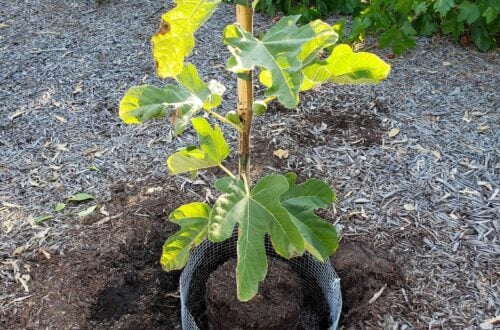
If you have gophers, I highly suggest planting your fig tree in a gopher cage to protect it from damage. Trust me. I learned the hard way that gophers find fig trees absolutely irresistible. They will chew and eat the roots as well as around the base of the trunk. You can either buy large pre-made gopher baskets, or make your own like we do! Learn more about making and installing gopher baskets for trees here.

Growing Figs in Containers
It’s possible to grow fig trees in large pots on containers, though they admittedly will grow best in the ground if possible. I’ve planted many fig trees in half wine barrel planters for many years. Growing figs in containers is an especially desirable option for cold-climates (zone 6 and lower) where it’s best to move fig trees to a protected location for winter.
Bear in mind that the size of the pot will directly limit the growth and production of trees (e.g. smaller pot = smaller tree). A dwarf or semi-dwarf fig tree variety will do best in a pot. Potted figs will need to be fertilized more often; see fertilizing notes below.

Fertilizing Fig Trees
Fig trees are not typically heavy feeders, especially if they’re planted in decent soil from the start. Plan to fertilize in-ground fig trees only once or twice per year (spring and possibly fall) with an organic slow-release fruit tree fertilizer like this one. I also feed our fig trees with homemade compost tea a couple times per year.
Fig trees growing in containers will need more frequent fertilizer than those planted in the ground, requiring up to quarterly feeding. I like to feed potted figs with a slow-release granular organic fertilizer by dusting it over the soil surface, lightly scratch it in, and then water thoroughly. Follow the amounts listed in the product instructions.
Pruning Fig Trees
Figs grow well with little pruning, though it can help maintain a more tidy and compact tree. Pruning can also encourage new growth, branching, and more fruit.
At the time of transplanting, I typically prune the top of young fig trees if they’re growing as a single vertical trunk. Topping straight “whips” young will encourage branching and a more bushy structure – perfect to easily harvest fruit. See the photos below for further instruction. Unpruned whips will eventually branch too, but not as soon or vigorously as when topped.
Thereafter, prune fig trees during the dormant season, once they’ve lost their leaves in late fall or winter. Use clean and sanitized pruning shears or loppers to remove weak, diseased, dead, or otherwise undesirable branches from the tree. Removing (or topping) vertical branches near the center of the tree will create a more open and wide canopy, and increased growth of lateral fruiting branches. Pruning back the main branches by one quarter to a third each year will promote continued branching.
Last but not least, remove any branches that spring up from the very base of the tree by the soil. These undesirable growths are called “suckers” because they draw energy and nutrients away from the main tree.

Diagram courtesy of Deep Green Permaculture


Winter Protection
In climates where temperatures dip below 15 to 20 degrees Fahrenheit for extended periods of time, plan to protect your fig tree during winter.
Potted fig trees should be brought inside or into a garage, shed, or other place that is sheltered from freezing conditions. In-ground trees can be protected with frost cloth or burlap if needed. A good deep layer of mulch around the base of the tree will help to insulate the soil and roots to reduce hard frost damage.
Fig Tree Pests or Disease
Thankfully, few pests or diseases bother fig trees. The most common fig tree pests we contend with are gophers (who eat the roots) and birds (who eat the fruit). Planting your fig tree in a gopher basket will protect them from gnawing gopher damage. As previously discussed, green or white-skin fig varieties are far less attractive to birds in my experience!
Another solution to stop birds (or squirrels) from eating your figs is to place reusable mesh bags like these over each fig as it becomes ripe. While tedious, it’s effective! You could also drape the entire tree with a fine mesh insect netting, but I don’t recommend using traditional “bird netting” as wildlife easily gets tangled in it.
Other potential fig tree pests or disease include thrips, root knot nematodes, rust, and leaf spot.

How long does it take for a fig tree to bear fruit?
Fig trees typically take about 3 to 5 years to start producing quality fruit. During the first few years, don’t be dismayed if your crop is dismal. Young fig trees may develop small, dry fruit on their branches for a couple years before their production really picks up. Every year will be better than the last!
Eventually, if your tree is producing a huge amount of figs, you can thin (remove) some of the smaller fruit to encourage larger, juicier figs if needed. Insufficient water and/or nutrients can lead to less than ideal fruit production.

Harvesting Tips
- As figs mature, they will become increasingly large in size and change color from dark green to whatever color is expected for that particular variety, such as dark purple, yellow-green, or reddish brown.
- Ripe figs become increasingly thin-skinned, soft, and droop on the branch. Very ripe figs may split or drip honey-like juices from the bottom end. The stem will also detach from the tree more easily.
- Gently squeeze the fruit to check for softness. Harvest when they’re supple to the touch, but before they get mushy.
- To harvest, gently pull up on the fig so the stem detaches from the branch. Don’t pull down, and avoid tearing or squishing the fruit.
- If harvested too early, underripe figs will not continue to ripen on the counter as other fruit might. Therefore, it’s best to harvest figs only when they’re fully ripe (or darn close to it) if possible.
- After harvest, figs have very short shelf life. They can be stored at room temperature for a day or two, but otherwise figs should be refrigerated. Store very soft or overripe fruit in the refrigerator right away.


What do fresh figs taste like?
Fresh figs have a unique sweet flavor – like a spectacular blend of honey, fruit syrup, and ripe berries. I just read this question out loud and Aaron replied “like a party in your mouth”! Lol. Figs are one of our favorite fruits to grow for a reason. If you’ve never had a fig right from the tree, you’re in for a real treat once you grow you own!
Ways to Eat or Preserve Fresh Figs
90% of the time, we simply enjoy our figs fresh – eating them whole like a pear or plum. I also like to cut them up to serve in breakfast with plain yogurt, nuts, seeds, and granola. Figs are amazing on top of sourdough pancakes, or over vanilla coconut ice cream.
Tree-ripened figs are plenty sweet on their own. They don’t require additional sugar or a drizzle of honey as I see many folks do. However, if you’re looking for an extra-special treat, or if you have more fresh figs than you can eat plain, please enjoy these tantalizing ways to eat figs:
- Oven-roasted figs with cheese, honey, nuts, and/or aged balsamic vinegar. Cut the figs in half, stuff or top them with a tangy rich cheese (such as goat cheese or blue cheese), drizzle with honey or thick sweet balsamic vinegar, sprinkle walnut or pecan pieces on top. Roast in the oven on 375°F until slightly softened, warm and juicy. Balsamic-honey marinated figs are also excellent grilled!
- Serve as a fresh fig bruschetta. Top crackers or crusty bread with a soft spreadable cheese like ricotta, mascarpone, or goat cheese. Then add chopped figs, chopped pecans, a drizzle of honey or reduced balsamic vinegar, and a sprinkle of fresh herbs like thyme or rosemary.
- Use fresh figs as a topping on salads, pizza, or even sourdough focaccia. In addition to tangy cheese, herbs, and balsamic, figs pair exceptionally well with caramelized onions.
- Turn your harvest into fig jam or fig compote.
- Dehydrate into homegrown dried figs. I can’t recommend our favorite Excalibur food dehydrators highly enough!
- Make chocolate-covered figs. Dip fresh figs in melted chocolate and then pop them into the refrigerator to harden.
- Freeze figs to enjoy later on desserts, in smoothies, transform into spreads, and more
- Use fresh figs as the filling for a sweet baked cobbler, crumble, tart, galette, or pie.
- Make homemade fig newtons or fig bars. Try these vegan gluten-free oatmeal fig bars!

And that sums up how to grow fig trees!
If all that doesn’t get you excited to grow figs, I don’t know what will! Even more, I hope this article helps you feel prepared and confident to plant, grow, care for, harvest, and enjoy homegrown figs. Please let me know if you have any lingering questions in the comments below. Do you grow fig trees too? I’d love to hear what your favorite varieties are and why! Last but not least, please feel free to pin or share this article if you found the information you learned to be useful. Thank you so much for tuning in. Enjoy those figs!
You may also enjoy:
- How to Grow Pineapple Guava (Feijoa): Cold-Hardy Tropical Fruit
- How to Grow Avocados: Tree Varieties, Climate, Planting & Care
- Growing Purple Passion Fruit vs. Maypops: The Ultimate Guide
- How to Grow Turmeric in Containers, in Any Zone!
- 18 Fantastic Fig Tree Varieties to Grow at Home




38 Comments
IVETTE IRIZARRY
Hello! I love to grow figs. I live in South Central TX and have noticed that my fig tree struggles through the summer. Mid summer it drops all its leaves, then leafs out again. It’s really weird. Any insight?
Aaron (Mr. DeannaCat)
Hi Ivette, how is the tree being watered? It may be getting too dry for the tree during the hot summer months and it sheds its leaves to protect itself by conserving its energy. I would investigate the soil in and around the tree to check the soils moisture level. Keeping the tree well mulched with bark or wood chips will help keep the soil more moist as well. Hope that helps and good luck!
Kathleen Hotmer
Hi there,
Do you have any advice for growing figs more like a shrub? I am in Zone 5 and have read about others doing this in the same zone. I’m not sure whether to cut back to ground in the winter or just leave everything and cover it.
Thanks!
Kathleen
Aaron (Mr. DeannaCat)
Hi Kathleen, how old is the fig tree that you have? If it is large, cutting off a large amount of the tree may shock it too much or possibly harm the tree. It think it is best to start shaping them into a bush when they are younger, you want to force the tree to shoot off branches closer to the ground. If your tree is young, similar to the tree we just planted, once it goes dormant, cut the main stalk down by at least half to force the tree to send out shoots closer to the ground once it starts growing again come spring. Let us know the size of your tree and what shape it is currently.
Maresa
I have a Chicago hardy fig tree in a 7 gallon grow bag that I’ve had for about 5 years as I live in zone 5a in Michigan. It has never fruited, probably because the pot is too small? Should I pot it up? And what size grow bag should I use? Is it ok to just use regular potting soil like miracle grow?
Aaron (Mr. DeannaCat)
Hi Maresa, do you bring your tree in during the winter months or do you leave it “protected” outdoors? It may be cold hardy down to your zone outdoors but you are right on the line as far as that goes. If the tree is left outdoors, it will most likely be happier being planted in the ground as opposed to in a pot. If you bring the tree inside during the winter and put it back out in the spring, a bigger pot is most likely necessary. If you can see the tree roots on the bottom of the fabric bag, you can most likely pot it up into a 10 or 15 gallon grow bag and you can use any high quality potting soil. Hope that helps and let us know if you have any other questions.
Cara
Hey, thanks Aaron for the metal sheeting idea! That would no doubt be harder for rats to climb up. I don’t know how to work with that material (or cut or transport it), but perhaps I can get help.
The critters are coming from everywhere — across and down rooftops through trees and fences. I have neighbors who leave fallen citrus in heaps on the ground, so that doesn’t help. I fantasize about getting an owl box or keeping a kestral, but my property isn’t really big enough (~10K sq. feet).
Thanks again for your thoughtful reply. And, I hope all is coming along swimmingly with your new property! Ah, to be 30 years younger 😉
Best wishes,
Cara in Pasadena, CA
Aaron (Mr. DeannaCat)
Thank you so much Cara! We know all about living close to neighbors whose yards may be more prone to harboring pests. I would look into galvanized steel sheeting, you may have seen raised beds made of this with a wood frame? You can probably build a square of sheeting around each fig tree (or at least try it on one for now) and connect each piece of sheet material in the corners using screws and nuts. You could also use a piece of 4×4 or 2×4 on the inside corners to screw the metal sheet into the wood. Anyway, glad to hear you still have a decent sized property as 10k square feet is pretty large for a city/suburban environment. Hope you will be eating fresh figs from your own trees before too long!
Corey Ellerbe
Have you ever had trouble with your trees fruiting? I’m in zone 9b and I have a brown turkey fig tree that’s very healthy, but isn’t fruiting. I’ve heard that figs do well with “pinching”, but I’m not sure exactly what to do.
Aaron (Mr. DeannaCat)
Hi Corey, how old is your tree? It can take a fig tree several years before it starts producing fruit, many of our figs that we have planted came in 5 gallon pots and they typically took several years after that before they were producing quality fruit. Figs like moist, well draining soil (like most plants) so if the soil around your fig is too wet or too dry, it may inhibit the tree from fruiting. Another consideration is how much sun does your tree get as at least 6 to 8 hours of sunlight is best for good fruit production. Let us know if you have any other ideas or questions, if your tree is happy and healthy, it is probably only a matter of time before you start seeing fruit. Hope that helps and good luck!
Lorena
I really enjoyed reading all about figs. Thanks for all the great info! I’m a lover of figs, but have been renting and not able to plant a tree in the ground. I am excited to see that they can grow in a pot. I’ve only been familiar with Mission Figs, but all your talk about Honey Delights have me swooning. 😊
Aaron (Mr. DeannaCat)
Thanks for reading Lorena, the Corky’s Honey Delight is incredibly delicious and would do well in a pot so it sounds like a good option for you. Good luck and let us know once you finally pick one up.
April
Thank you so so much for this guide! I just bought a Brown Turkey this past spring and i had no idea what to do with it, but i now know! I’m excited to try the one and only fig that’s currently growing on it, so fingers crossed for a bigger harvest next year!
Cara
Beautiful article, as usual! I have 7 mature fig trees here in Pasadena. ( I planted all different varieties). And, as time has gone by, between the squirrels and rats, I am able to actually eat close to zero figs! I’ve tried: Bird netting (a pain and chewed through), paper bags (can’t see the fruit), maggot barriers (usually for apples and chewed through), and plastic clamshell boxes (also chewed through). I’ve about given up. My only next thought is to surround the trees (prunned lowish) with a circle and top of hardware cloth supported all around by rebar stakes. But the material is very “tight” and hard to work with. Any other advice/suggestions? Thanks much!!
Aaron (Mr. DeannaCat)
Hi Cara, it sounds like you have some very serious competition for your fig trees and that is too bad you’re having such trouble with keeping the wildlife away from your fruit. On our old property we did have some issues with rats but they seemed to prefer passion fruit as they never ate any of our fruiting trees such as figs, persimmon, avocados, or even apples. It seems as if you have tried most options to protect your fruit, are the rats and squirrels getting into your trees from a fence, other trees, or are they climbing up the fig trees from the ground below? When we used to live in Northern California, we had a lot of grey squirrels that love to get into your garden, we found that putting up a small piece of fencing (it was about 6 inches tall) around it was enough to deter them from getting into the garden. Rats on the other hand may climb the fencing but creating a barrier around your tree may be an option if they are climbing up into the trees themselves. Using metal sheeting to wrap around the outside of your trees may deter them from getting into your trees as they won’t be able to climb the sheeting as well as hardware cloth. If your fig tree branches are touching other trees, fencing, or buildings, keeping them pruned away from other objects will deter the rats from running from one thing into your trees. Hope that helps and good luck!
Rachael
We are zone 8a. Should I plant figs in the spring when it starts warming up? or in the fall as its cooling off? Even now, in mid Aug, its still hot and will stay hot till mid Sept. (central Texas). Normally, we have mild winters with only a few nights that freeze (though a light freeze). Of course, Feb 2021 was just crazy with 4 days of freezing weather…. even into single digits! I know this is normal in some places, but not here.
Thanks!
Mama Rachael
Aaron (Mr. DeannaCat)
Hi Rachael, you can plant the tree in Spring or Fall so whatever works best for you!
Maria
I’m so excited for this post! I really want to plant a fig tree this year – and how did you know I made a fresh fig pizza for dinner?
Aaron (Mr. DeannaCat)
Great idea on the fig pizza! Sounds delicious and one we will have to give a try.
Tapaswi
Thank you the Lovely article. I always struggle to get to know the varieties because here in local nurseries they don’t label the varieties and also staff are not aware of it.
I have a fig tree need to identify what variety it is. It has started bearing fruit.
Is it advisable to trim when they are fruiting?
Aaron (Mr. DeannaCat)
Hi Tapaswi, it is best to wait until the dormant season to prune most fruit trees including fig trees. Harvest the fruit as it ripens and wait until the trees lose all of their leaves and go dormant before you decide to prune them. Hope that helps and good luck!
Amanda
Thank you so much for this article! I was recently given a fig sapling started from a cutting. It currently just has one tiny little leaf, about 5 inches across. It’s in a small pot now, and I’m wondering when I should I move it into the bigger pot I plan on growing it in? Is there a time that is too soon? Should I add gravel at the bottom of the pot for better drainage? I can’t seem to find guidance on when to transfer a cutting so any advice is appreciated! Thank you!!
Aaron (Mr. DeannaCat)
Hi Amanda, usually it is best to repot a plant or cutting once its roots are visible from the bottom of the pot. You should be able to slide the plant or cutting out of the pot with its root ball still intact. If the cutting is still very small, I would repot your cutting in steps and not plant it into a large pot while it is still so small. Maybe start with a pot that is twice the size of the one you are currently using and I would use quality potting soil as your medium without worrying about using gravel on the bottom of the pot. Hope that helps and good luck!