

Preserving Apples: How to Make Homemade Apple Cider Vinegar

Homemade apple cider vinegar is one of my favorite things to make and preserve. That’s because we use apple cider vinegar, also known as ACV, pretty much every single day! It’s also incredibly healthy for you. We love to use it for salad dressing, homemade fire cider, or take small shots straight! Since we have an apple tree that provides us with more apples than we can consume fresh, this is a fantastic zero-waste solution to preserve our apple harvests.
The best news of all is that apple cider vinegar is quite simple to make at home. We usually use whole apples since we often have abundance, but you can also make ACV using apple scraps too. One very common method is to save up used apple skins and cores over time, storing them in the freezer, before starting a batch of ACV.
Read along to learn how to turn apples or scraps into fermented, probiotic-rich, delicious homemade apple cider vinegar. This post will provide easy step-by-step instructions, tips to make the best-tasting apple cider vinegar, and ideas for ways to use ACV too.

Would you like to save this?
Disclosure: Homestead and Chill is reader-supported. When you purchase through links on our site, we may earn an affiliate commission.
Benefits of Making Your Own Apple Cider Vinegar
It’s Cost Effective
When we buy apple cider vinegar, we choose the high quality stuff: raw, organic, unfiltered, “with the mother”… such as Braggs, our go-to brand. While I wouldn’t call ACV expensive, it isn’t necessarily as cheap as more basic vinegars, like white or red wine vinegar. Plus, if you use it as regularly as we do, it can add up! Making your own apple cider vinegar at home has huge cost-savings benefits, especially if you’re using scraps, homegrown, or otherwise low-cost apples. Even if you buy them just for this project, a few apples can create a lot of vinegar!
It Reduces Waste
We always suggest discarding excess produce in a compost system, as opposed to throwing them in the trash. On this little homestead, we have several types of compost bins that help take care of the majority of our kitchen and garden waste. Personally, our favorite composting method is vermicomposting, also known as worm composting. So, while you could compost your excess apple scraps, why not turn them into apple cider vinegar instead? Up-cycling for the win!
It is Healthy & Versatile
Apple cider vinegar has many wonderful uses and surprising health benefits! As with all fermented foods, it’s loaded with probiotics. This means ACV aids in digestion and helps to balance gut health. Did you know there is a direct correlation between a healthy gut and every other organ in the body? To read more about the health benefits of fermented foods, check out this article that I wrote on that subject.
Homemade ACV can be used for a lot more than drinking or eating! See other uses for apple cider vinegar at the end of this post.
How does apple cider vinegar help diabetes and blood sugar?
One of the key active components of apple cider vinegar is acetic acid. Acetic acid is excellent at slowing gastric emptying and reducing blood sugar spikes, thus stabilizing blood glucose levels. Being Type 1 Diabetic, I find that if I take a shot of ACV before a meal, I have improved blood sugar levels following that meal! Studies have shown to have similar effects for those with Type 2 Diabetes, when either taken with a meal or before bedtime.

SUPPLIES NEEDED
- Organic apples, or apple scraps – For this recipe, you can use whole apples or apple scraps. A great time to make apple cider vinegar is after creating another apple dish, like baking apple pie, when you have a lot of cores and skins at once! If you cannot collect fresh scraps at one time, store them in the freezer as you continue to add to your supply. Organic produce is always the best choice, especially when it comes to fermenting! See notes on apple varieties below.
The amount of apples needed is totally flexible. As you’ll see in the recipe section below, you can scale the portions up or down as needed. - Filtered Water or other un-chlorinated water is best for making living, fermented things like homemade apple cider vinegar. Do your best with what you have! We simply run ours through a basic carbon filter (in the fridge).
- Organic cane sugar
- A large glass vessel, your choice of size. We make large batches in this two-gallon glass crock, but many people use far smaller containers – like quart or half-gallon mason jars!
- Bottles to store your finished apple cider vinegar in. You won’t need these for a few months, so you have time to collect some. We simply repurpose old Braggs ACV bottles!
Wait… Did you just say you won’t need bottles for a few months? Yes. Fair warning: this process takes several months from start to finish. The minimum time from starting to using the finished product is about 2 months, though some people let their ACV ferment for 4 months or longer.
What are the best apple varieties to make apple cider vinegar?
The best-tasting apple cider vinegar will result from using a variety of different apple types, if possible. Using a combination of sweet and tart apples creates a well-balanced finished flavor. A good goal is to use about two-thirds sweet apple varieties like Gala or Fuji (our Anna apple falls into that category) and one-third tart, such as Granny Smith. Pink Lady would fall somewhere in between. Truth be told, we don’t always mix in tart varieties with our Anna’s since some are picked slightly underripe and tart. It still turns out pretty damn good, just not quite as tangy.

HOMEMADE APPLE CIDER VINEGAR RECIPE
When you’re making apple cider vinegar, the goal is to fill your chosen container about halfway full of chopped apples or apple scraps. Then, the rest of the container is filled with a combination of water and dissolved sugar.
Sugar to water ratio: 1 tablespoon of sugar per one cup of water, or scaled up to 1 cup of sugar per one gallon of water.
Yes, the use of sugar is essential in this process. There are several types of beneficial bacteria naturally present on fruit, including our friends lactobacillus and acetobacter. The addition of sugar provides food for those bacteria to rapidly grow and thrive. They will change the environment in the crock through a series of chemical reactions, first changing the sugar to alcohol, and then further transforming that alcohol into acetic acid over time. Therefore, the final apple cider vinegar is very, very low in sugar, and the alcohol content is virtually non-existent!
INSTRUCTIONS
Step 1) Gather & Prepare Apples
If you are using collected apple scraps, this part is extra easy! There is no prep needed. If your apple scraps were frozen, let them thaw out before starting. A cold ferment is not a happy ferment! I do suggest adding at least some fresh scraps with your frozen ones, if possible. This will ensure your brew is inoculated with live bacteria. When making apple cider vinegar with whole apples, the prep is pretty dang easy too. Simply wash the fruit well with water (no soap!) and chop them up into smallish chunks. You can leave the skins, cores, seeds, and even stems in there!
Add the apples to your glass container of choice, filling it about halfway full with apples. We use this 2-gallon container, but many people make much smaller batches! Ensure the container is nice and clean, but doesn’t have any soap residue present – which can cause off-flavors. We clean all of our fermentation supplies with plain white vinegar and hot water.

2) Add Water & Sugar
Next, it is time to get wet and feed the bacteria! Pour room-temperature to lukewarm filtered water over the apples until the container is completely full. Keep track of how much water you add as you go! To do this, I suggest adding water with a measuring cup, or a jar that you can note the volume of. We need to know the water volume to determine how much sugar to add.
Unfortunately, it isn’t as simple as half of your container. For example, when we fill a 2-gallon crock “half full” of apples, that doesn’t mean it is taking up a true half of the volume – because of the air space between the cut fruit. We can generally still fit 1.5 gallons of water inside.
Now, scaling up or down as needed, add 1 tablespoon of sugar per one cup of water used, or 1 cup of sugar per one gallon of water. Stir thoroughly until all of the sugar appears to have dissolved into the water. Here is where the “lukewarm” water helps out!
To inoculate and kick start our batch, we usually add a few glugs of finished apple cider vinegar. This step isn’t necessary, but may help prevent the formation of mold – especially if you are attempting to do this during a cold time of year.

3) Let Sit to Ferment – and Stir!
Once the apples, water, and sugar are all combined, cover your container with a breathable material, such as a lint-free tea towel, old pillow case, or coffee filter. I do not suggest using cheesecloth or any looser-knit material – it may allow fruit flies in!
Set this container in a location that is around 70 to 75°F, if possible. This is the ideal temperature range for fermentation. The container should also be kept in a dark location. Because we need to see and access it daily for the first two weeks (described below), we keep ours out on the kitchen counter, but wrap the crock in a dark towel or pillowcase to block the light.
For the first two weeks, your fermenting apples should be stirred every day. The purpose is to ensure the sugar doesn’t settle on the bottom, and also rotate which pieces are floating on top. If the same apples are left to float, exposed to the air, there is a chance of mold developing on them. Stirring prevents mold. If you miss a day here or there, it isn’t the end of the world! However, I suggest making a concerted effort stirring daily during the first week especially.
During this time, you’ll notice the apples will turn more brown, and the liquid becomes cloudy. Small bubbles should also appear, and it will start to smell a bit like hard apple cider. A layer of yellowish-white sediment may also collect on the bottom. This is all normal and good! Any obvious, fuzzy, green or white raised mold on the surface is not. In all the years making ACV, we have never had ours mold!


RELATED: Looking for more ways to preserve apples? Try making dehydrated apple chips, or our delicious apple butter recipe for canning or the freezer!
Step 4) Strain Apples
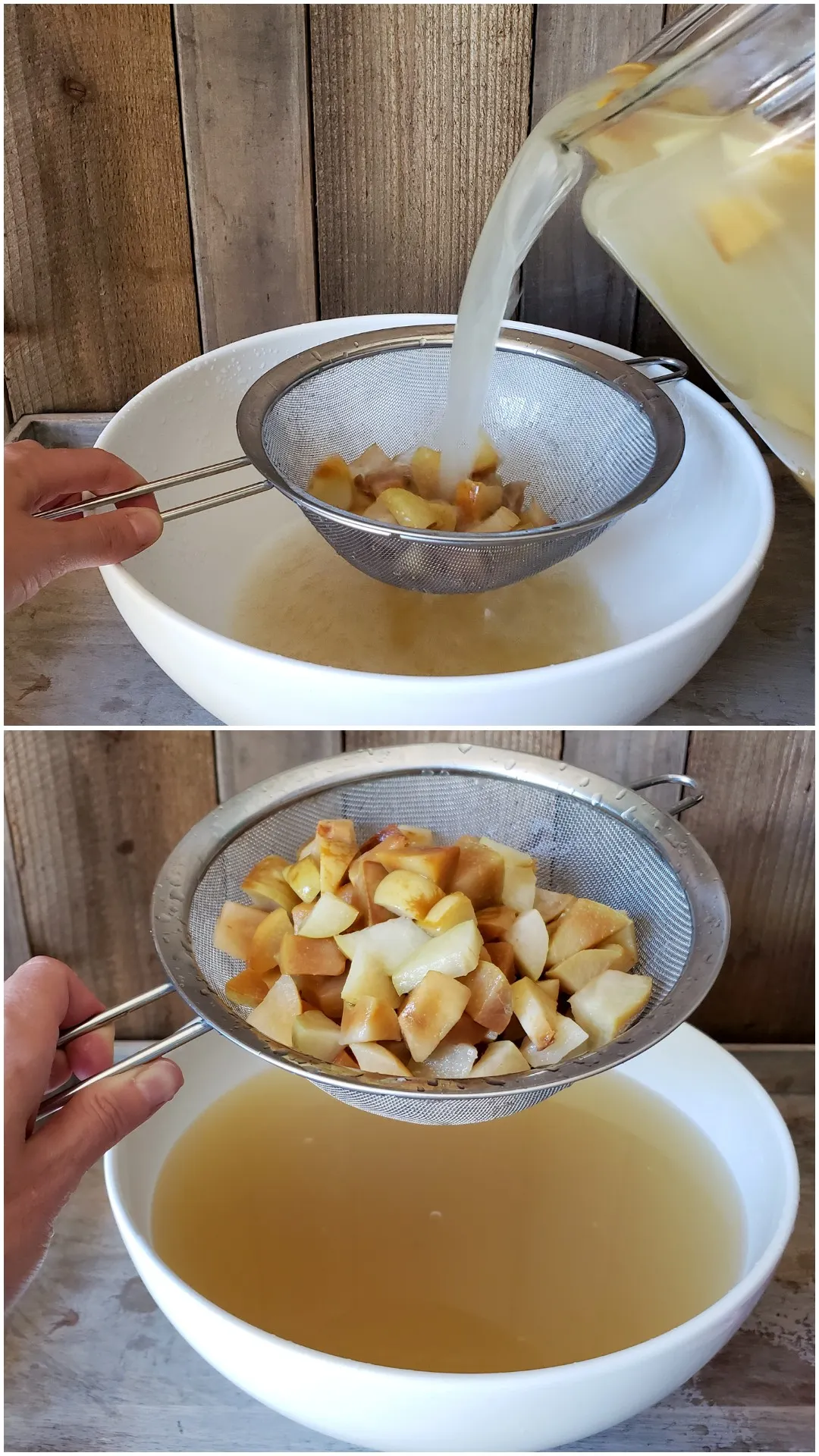
After two weeks of daily stirring, it is time to strain the apples to separate them from the liquid. To accomplish this, we set a fine-mesh strainer on top of a large bowl and slowly pour the contents of the crock through it. You can also use cheesecloth, or whatever else works! The collected fruit can now be composted. Return the captured liquid to a clean glass container of the appropriate size, and cover in the same manner it was before.
Step 5) Continue to Ferment
This is where the waiting game begins… Store your covered crock in a temperate, dark location for at least one month, or longer! The bacteria will keep working to convert more and more of the sugar or alcohol to acetic acid, creating vinegar. The rate at which your partially fermented apple cider turns into full-blown vinegar will vary, depending on the storage conditions and apples used. Our apple cider vinegar usually sits for about 2 to 3 more months before we bottle it.
After a month has passed, you can give your vinegar a taste-test. If it tastes plenty vinegary for your liking, move on to the next step. If not, allow it to ferment longer. When it doubt, you can check the pH of your apple cider with these simple pH test strips! Finished apple cider vinegar should have a pH in the range of 2-3.
Note: During this time, sometimes the vinegar develops a layer of SCOBY on the top – sort of like kombucha does! It is a thin, smooth, off-white membrane made up of accumulated beneficial bacteria and yeast. It is normal and harmless. We discard it once we are ready to bottle the vinegar. Our chickens love to eat SCOBY, but make sure to chop it up well for them!

Step 6) Bottle & Enjoy
Once it reaches that perfect fermentation level, transfer the apple cider vinegar into bottles with tight-fitting lids for storage. We re-use old ACV bottles, or store it in our swing-top kombucha bottles. As an acidic concoction, homemade apple cider vinegar does not have to be refrigerated for safety-sake! It is best to store it in a relatively cool, dark place.
If we have the space, we typically refrigerate at least some of our bottles at this point. Why? Well, once they’re refrigerated, the bacteria activity will slow way down and prevent the vinegar from fermenting beyond the point we enjoy it. Plus, most people like to enjoy their ACV cold anyways! I know we do.
Even stored at room temperature, homemade apple cider vinegar will stay good for up to five years! However, the quality and flavor will likely be best within the first two years.

Ways to Use Apple Cider Vinegar
Apple cider vinegar can be used in wide variety of meals, recipes, taken straight on it’s own, or used in other natural health, home, and body care applications.
- As a salad dressing – drizzled over salad with olive oil, or used in other salad dressing recipes.
- Make shrubs, aka drinking vinegar! Use our fruit shrub recipe to combine AVC, honey, and your choice of fresh fruit to make a delicious gut-healthy sweet and sour syrup to add to sparkling water, cocktails, mocktails, salad dressing and more.
- Use apple cider vinegar in other recipes that call for vinegar, such as our favorite easy refrigerator dill pickles. We also like to add a small drizzle to egg salad, potato salad, and similar dishes.
- Take a small shot (1 to 2 Tbsp) before a meal to reduce blood sugar spikes (aka postprandial blood glucose levels).
- Learn how to make homemade fire cider with apple cider vinegar here. Made with garlic, onion, turmeric, ginger, honey, and spices, fire cider a fantastic tangy tonic that can support your immune system and naturally reduce the intensity and duration of cold and flu symptoms.
- ACV can be diluted and used as a hair rinse, which removes built up minerals in your hair (such as from hard water) while also conditioning, balancing, pH, and healing hairs outer cuticle.
- Many herbalists and naturalists use ACV as a natural facial toner, or as an ingredient in other natural beauty and healing remedies!
- Acidic vinegar makes a great natural surface cleaner and disinfectant, such as in the sink, garbage disposal, stinky cutting boards, or even used to soften laundry. Learn more about using vinegar as a cleaner here.
And that’s how to make apple cider vinegar!
I hope you found this tutorial helpful, and interesting! Next time we have an abundance of apples, I think we are going to take a stab at making our own hard cider. I will report back! Do you brew your own apple cider vinegar, or hard cider? What are your other favorite ways to preserve apples?
If you are interested in other healthy fermented goodies, you may enjoy these articles:
- How (& Why) to Make Fire Cider for Immune Health – We use our ACV as the base for this recipe!
- Easy Fermented Garlic Honey Recipe + Benefits and Uses
- How to Make Kombucha 101: Brewing Basics for Best Booch Ever
- Fermented Dilly Radishes Recipe
- Homemade Elderberry Syrup Recipe – Not fermented… but oh so good for you!
Homemade Apple Cider Vinegar
Ingredients
- Diced apple chunks, or apple scraps (skins, cores). Enough to fill half of your chosen fermenting vessel (e.g. quart jar, half-gallon jar, 1 gallon crock)
- 1 tbsp sugar, per 1 cup filtered water OR
- 1 cup sugar, per 1 gallon of filtered water
Instructions
- Wash and chop the apples into chunks, or gather collected apple scraps (which can be saved in the freezer over time) and add them to your jar or other large fermenting vessel until it filled about halfway full.
- Pour lukewarm filtered water over the apples into the container until it is almost full, but measure/note the total amount of water added.
- Stir in sugar in ratios of 1 tablespoon of sugar per cup of water added, or for larger batches, 1 cup of sugar per gallon of water added.
- Optional: Add a splash of finished organic apple cider vinegar (e.g. store-bought) to inoculate the culture and encourage fermenting.
- Stir combined ingredients until thoroughly mixed, and cover with breathable material.
- Store in a dark location around 70 to 75 degrees F for two weeks to ferment, and stir everyday to prevent mold from forming on top. If needed, add another layer of material like a dark towel on top of the container to block light.
- After two weeks, strain and reserve the liquid into a similar sized container and cover again. Compost the spent fruit.
- Move the covered container of liquid to a location that is out of the way to continue long term fermentation. Maintain dark. A cooler "room temperature" at this stage is okay, but do not refrigerate yet.
- After one month, sample the vinegar to see if it is finished fermenting and tart to your liking. If needed, allow it to continue to ferment for a total of two to three months.
- Once it is fermented to your desired flavor, transfer the apple cider vinegar into bottles with lids (or swing top bottles). Store at room temperature or in the refrigerator, and enjoy!
- Properly fermented apple cider vinegar should "stay good" for over a year – as long as it does not have visible mold, or a strong and unusual flavor or appearance.


635 Comments
Katya
Hi,
I have a question, when you strain it to get the apples out and re cover it, are you putting a lid on it or back to a cheesecloth or towel on top, until you bottle it?
Thank you
Aaron (Mr. DeannaCat)
Hi Katya, we use the same tight knit cloth towel that we used during the initial two week ferment, don’t use cheesecloth as fruit flies will be able to get inside your ferment crock. Hope that helps and good luck!
Shammahwisdom
If the cider needs darkness to ferment, after the 2 week process, can I put it in an opaque container??
Aaron (Mr. DeannaCat)
Yes you can use an opaque container as long as it isn’t metal, ceramic or glass is best. Good luck!
Joanne Heberley
I have been making apple cider vinegar . It’s b. Sitting nearly 3 months and been stirring every day. I read instructions wrong. I didn’t take the apples out. Is it ruined now. So sad.
Aaron (Mr. DeannaCat)
Hi Joanne, no your ACV is not ruined now. You have kept up with maintaining your vinegar so it should still be good to strain and filter your liquid, since the apples have been kept in the liquid for three months, they may have broken down more so your vinegar could have a bit more sediment in it (which isn’t bad at all). I would taste the vinegar after you strain it and see if you still want to let it age for awhile in the crock before bottling or if it tastes well enough to bottle and use now. Hope that helps and enjoy your vinegar.
Umb
I have forgotten to take the apples out of the vinegar. It should have been done last April, it is the beginning of August now. No mold but a thick layer of the Mother is on top. Can I still process this or do I have to discard and start over?
Thank you
Aaron (Mr. DeannaCat)
Hi Umb, as long as the vinegar smells and tastes good, you can likely bottle it up and process to use it as you wish, so glad to hear it formed a mother and preserved your vinegar.
Susan
Hi Deanne
Thankyou for your recipe. It’s my first time making ACV and it has been bubbling away nicely for a little over a week now. Next week I’ll be straining off the apples and putting the ferment away in the dark. My question is about how to cover my container during this period. Should I put a permeable cloth cover on (as I did for the first 2 weeks) or a hard lid?
Regards Susan
Aaron (Mr. DeannaCat)
Hi Susan, we just use the same cloth cover for the long ferment as we did for the initial two week ferment, once the vinegar is finished fermenting, we transfer it to bottles with lids. Hope that helps and good luck!
Liberty Brown
Tried this recipe and it has been sitting for a year. However in step 8 when it said to cover and put away for a few months I put it into mason jars as I had no where big enough to store a crock. Coming back to figure out why it never turned to vinegar and seeing the comments I now realize it still needed air for those months. Is there a way to save the gallons of my attempt? Adding a bit of braggs to each jar and letting sit again maybe? Would I need to add any sugar to get it to start again? No mold or anything so up to that point I think I did okay.
Aaron (Mr. DeannaCat)
Hi Liberty, oxygen is definitely needed in the process to help turn your apple liquid into vinegar. If you don’t see any mold, it wouldn’t hurt to see if it will transform into vinegar if given the time needed, adding a splash of Bragg’s to each jar wouldn’t hurt. Hopefully the liquid was just in a stasis during the time it spent with lids and will pick back up shortly once it’s introduced to oxygen. Good luck and let us know how it turns out for you!
Shammahwisdomm
I’m gonna try this soon, thanks for the recipe.
Question, can I compost the SCOBY???
Aaron (Mr. DeannaCat)
Yes you can compost the SCOBY but we would typically leave the SCOBY throughout the ferment process until it comes time to bottle it.
Arianne
Hi Deanna!
Thanks for your recipe. I started my batch a few days ago and stirring everyday like you said, but I notice it smells pretty bad. What kind of smell am I supposed to get the first few days?
Thanks
Aaron (Mr. DeannaCat)
Hi Arianne, the mixture will start to have a more alcohol, yeast smell in time. Usually, it takes more than a couple days for the fermenting smells to appear though so I am not sure what “bad” smell you are referring to?
Donna
After 2 weeks do I cover with a tight fitting lid?
Aaron (Mr. DeannaCat)
Hi Donna, no, use the same tight knit cloth you used for the first two week ferment for your longer ferment.
Krista
Would it be beneficial if I used a canning jar vacuum sealer for my end result. I have a dark.cool.place to store it.
Aaron (Mr. DeannaCat)
Hi Krista, we don’t have much experience with canning jar vacuum sealers but it likely isn’t necessary. Once you have finished with the fermentation process, the vinegar shouldn’t mold or go bad very quickly, even without sealing the jars. Hope that helps and good luck!
sean kerrigan
Can I use a sterilised plastic fermentation container,to make ACV.
Thanks Sean
Aaron (Mr. DeannaCat)
Hi Sean, yes that should work just fine, good luck!
Charmain
Sounds nice an easy. Will definately give this a go! I’ve been using acv for years. Love making my our own “stuff”. Many thanks!
Edward K. Carver
Mr. Aaron Deannacat
I have been making vinegar for a number of years, {Im 98 years old} I learned it from a Man from Vermont which made 10 percent vinegar. But I am a Floridian and the only place I know of to have the acidity percent checked is in Gainselville Fl. at the University. There arent very many apple trees in Fl. that produce well.
His vinegar tasted much better than mine and I am thinking mine is probably 5 percent, like store bought. I never actually saw his technique, but it was the best tasting apple cider vinegar I ever ate.
Is yours more than 5 percent? And do you have a way of checking it at home?
Thank You.
Edward Carver Lake City, Fl.
Aaron (Mr. DeannaCat)
Hi Edward, that is some high acidity vinegar! We don’t have the ability to test the acidity level of the vinegar but I am not sure it is much higher than 5% though. I think the apple variety you use in your vinegar can also have an impact on the acidity levels that you end up with, here is a scholarly article that states as much. Hope that helps and good luck on your vinegar quest!
Edward K. Carver
Thank you for the answer you provided Aaron.
Last night I went through a 40 year old stack of papers I had and found one from the Vermont Man. He said he squeezed a thousand gallons of juice {He must of had a lot of trees in his orchard} and used the juice to make his vinegar the paper said he sold it to a vinegar company.. He also used a method very simular to yours. He was Older than dirt way back then.
He said the vinegar waas 10 %. I do know it was the best vinegar I have ever tasted. I did dilute it sometimes and other times I would use it as it was made but used a lot less for my salads etc.
I will surely let you know in July when Mine is 4 months old.
I used it on Louis Papas famous Greek Salad when I could afford to make it.
Ed Carver
Aaron (Mr. DeannaCat)
Hi Ed, thank you so much for sharing your story! I know making apple cider vinegar out of juice is likely the best way to make vinegar, however, that typically involves using an apple press which most people don’t have. Hopefully this easier method will still make a nice final product that you are happy with, thanks again for sharing and enjoy your vinegar!
Edward K. Carver
Hi Aaron.
Do you have an email address? I have information just for you.You might want to publiush it or you may not.
Aaron (Mr. DeannaCat)
Hi Ed, you can email us through our contact page here.
Quinn
I tried your recipe. I started it Feb 20th and now have this thin off white layer on top. Is this normal? The apples have sank and it is cloudy. The smell is somewhere between alcohol and vinegar. Should I strain and ferment or is the top layer mold?
Aaron (Mr. DeannaCat)
Hi Quinn, you may be seeing a SCOBY or mother forming on top of your ACV, you would have to visually compare between that and mold to know for sure what it is you are seeing.
Danielle
So, Im making this for the first time and after I strained the apples out, I out back in my large mason jar and stored away. It just ovcured ro me that I was supposed to cover with cheesecloth again and I actually closed up the mason jar with the latching lid. It doesnt taste like much. Do I need to start over or do you think I can unseal and cover with cloth and salvage?
Aaron (Mr. DeannaCat)
Hi Danielle, your ACV should be fine as usually the jars with a latching lid can still allow for a gas/oxygen exchange. How long has your ACV been fermenting for the second stage? The flavor will vary depending on the apples you used and we have yet to get our homemade ACV to taste like Bragg’s but you should definitely be tasting more like vinegar. Our ACV will typically reduce somewhat during the second ferment and the flavor seems to get stronger over time. Hope that helps.
sporean
Hi,
I’ve done this several times using apple scraps, but I usually get a layer of kahm yeast growing on top, and it never gets acidic enough.
I use mostly granny smith apple scraps and normal white sugar. My room temperature is 28 to 30 degrees C.
I would love some tips to prevent the kahm.
Thanks 🙂
Aaron (Mr. DeannaCat)
Hi Sporean, 28 to 30 degrees C may be a bit too warm for your ACV and that is likely the reason you are seeing kahm yeast developing. When we are fermenting vegetables or chili peppers, we find kahm yeast forms when the room temperature is in the high 70’s to low 80’s F (which would be 25-26 degrees C). If you see temperatures start to drop some in certain times of the year, it may be best to wait to start your ACV until the temps are 22-23 C or try and find a cooler room in your house if possible. Hope that helps and good luck!
Angela
Great, easy to follow recipe. I have strained my apples, but do I continue stirring during this long term fermentation process, or do I just set it and forget about it for 2 months?
Aaron (Mr. DeannaCat)
Hi Angela, no stirring required during the long ferment step, just put it away and forget about it for a couple of months.
Carol
I’ve strained my apples and have my jars covered with unbleached coffee filters in a cool pantry. They smell like yeast from my sourdough. 🙂 However, there are little spots of mold floating at the top. What did I do wrong? There is a lot of sediment at the bottom of the jars.
Aaron (Mr. DeannaCat)
Hi Carol, are you sure the spots floating on top are indeed mold and not a “mother” forming on your ACV? Sediment on the bottom of the jar is completely normal so I would just double check to make sure if it is mold or the ACV mother forming.
Jas
Do I need to strain the apples? I forgot to do so and it’s been burped/stirred along the months. I started it in the beginning of November 2023 🤭 I’m in Australia
Aaron (Mr. DeannaCat)
Hi Jas, as long as there isn’t any mold forming in your vinegar, you should be good to proceed. I would likely still strain the apples, taste test the remaining vinegar and see if you need it to ferment longer without the apples or if you can just bottle it up and use it. Hope that helps and good luck!
Michelle
I just finished my first 2 weeks and strained out the apples. My liquid is amber color and cloudy. Do you think I did some think wrong?
Aaron (Mr. DeannaCat)
Hi Michelle, our ACV is normally quite cloudy as well due to the sediment that is left behind, even after straining. As long as you don’t see mold, everything sounds like it is going the way it should, good luck!
Brittany Manning
Hey! How do I know if it’s mold? I have fermented other things and I understand to look for things that are fuzzy, raised up, discolored. But I had made some apple cider vinegar about a year ago and have been using it and then I went to another jar that I made about the same time and it had a whole bunch of what looks like white flakes in the ACV. Haven’t been able to tell if it’s mold, kahm yeast, or just the mother continuing to develop. I smelled the ACV that I’m using currently and feel pretty confident that it’s fine compared to the other and they both smelled equally strong/disturbing LOL.
Also, when I made/ brewed the ACV last year I had done it over three batches and came to feel really confident in what I had going and that it was clear and mold-free. So I don’t really know what to think now since it’s been stored in a dark cupboard in my kitchen.
Please advise! 🙏
Aaron (Mr. DeannaCat)
Hi Brittany, white flakes don’t necessarily sound like mold to me. You are right about looking for mold in regards to things that are fuzzy, raised, and or discolored. If the flakes are not exposed to oxygen and are submerged in the ACV, it shouldn’t be mold as that will usually form along the top of the jar and liquid where it is exposed to air. The flakes could be kahm yeast forming but we have only seen that in our ferments when the temperatures are a bit warm during the initial fermentation. Your best bet may be to filter out the flakes from the vinegar and see if it’s a reoccurring issue that continues once you get rid of what you can see. With that being said, if you are at all skeptical or unsure, it is best to discard the vinegar and not subject yourself to consuming food that may contain mold. Hope that helps and reach out if you have any other questions.
Tracey Ritchie
Hi, the recipe looks great and easy!
My question is whether it’s essential to use glass jars? I have a few but wondered if I could use food grade plastic buckets instead? Thanks Tracey. (writing from La Patagonia, Argentina!)
Aaron (Mr. DeannaCat)
Hi Tracey, food grade plastic buckets should work great for your apple cider vinegar and Patagonia is such a beautiful part of the world, enjoy!
Phuc Olive
Hi, Ms. I have one question: is 1 cup of sugar per 1 gallon of water equivalent to 220 grams of sugar per 3.7 liters of water? Many thanks!
Aaron (Mr. DeannaCat)
1 cup of white granulated sugar should be closer to 200 grams but you are correct on the liters. Good luck!
Jen
Hi there, I have three glass jars going and two of them look great (bubbly and happy) but one of them had a little mold on the top of just a few of the apples. I scooped that out and threw it away and it seems to be much happier now and is actually bubbling. It was not bubbling prior to me scooping those moldy apples out. Do I need to toss that batch?
Thank you!
Aaron (Mr. DeannaCat)
Hi Jen, we would likely toss the container which had mold growing on it as it isn’t something that we like to chance. However, you will see varying opinions on this, some people recommend just scraping it off or removing it and carrying on. You can let it continue to ferment and see how it looks going forward but you will have to decide whether you want to keep it or not. I would at the very least keep it separate throughout the process from the other containers which don’t have mold. Hope that helps and good luck!
Kristen
After straining, when it’s fermenting for 2-3 months do you cover it with a cloth or close it with a lid?
Aaron (Mr. DeannaCat)
Hi Kristen, just use the same cloth that you used for the first ferment stage, you don’t want to use a lid at this stage yet.
Cynthia E Armstrong
I’m loving your recipe! So easy to follow and I can’t wait to do this again!!!
I do have a question. At week 2 my apples aren’t sinking. Should I strain them now or wait?
Thanks again for such an easy recipe to follow!!
God Bless!!
Aaron (Mr. DeannaCat)
Hi Cynthia, if your mixture has a slight hard cider smell and was bubbly and seemed active during the two weeks, I would proceed with the straining of the apples and moving onto the second ferment stage. While most of the apples typically sink for us, it doesn’t necessarily mean that they still need to ferment longer if they don’t. Hope that helps and good luck with your ACV!
Kyle F
A fantastic recipe!
The instructions were very clear and easy to follow. By the end of the 3 months, I have 2 gallons of delicious ACV! It has a potent vinegar punch, but also a much stronger apple flavor than store-bought has.
I look forward to making more after picking apples this upcoming fall!
Aaron (Mr. DeannaCat)
Hi Kyle, so great to hear everything went so well and you ended up with 2 gallons of delicious ACV, enjoy!