

How to Make Homemade Cannabis Salve (CBD or THC)

To grow and make your own medicine… that is the stuff that dreams are made of, am I right?! We like to use our organic homegrown cannabis in a variety of ways, but making topical cannabis salve is on the top of the list. Cannabis salve can help to reduce inflammation, soothe skin irritation, joint pain, and more! It also happens to be quite simple to make your own cannabis salve, and easy to customize it to suit your needs.
Read along to learn how to make cannabis salve in 4 simple steps. With this recipe, you can use marijuana, hemp, high CBD, high THC, raw cannabis, decarbed cannabis, or any combination thereof! (Depending on what is legal and available in your area of course.) Let’s talk about benefits of each of those, how cannabis salve works, and what awesome healing potential it has.
What is Cannabis Salve
Maybe we need to step back a moment. How about, “what is a salve?”. A salve is simply the term for a healing solution that you put on your skin, including creams, ointments, or balms. Generally, salves are fairly thick, shelf-stable, and include nourishing oils such as coconut oil, olive oil, sweet almond oil, or others.
In our cannabis salve recipe, we prefer to use mostly coconut oil, because it is full of saturated fat that binds well with cannabinoids. It is also ultra-moisturizing. We also add a dash of olive oil to increase absorption and smoothness. To learn more about various carrier oils, check out our homemade calendula oil article – where I discuss the pros and cons of a dozen different oil options!
Salves also typically contain waxes or butters to bind the ingredients and make them semi-solid at room temperature. Beeswax is a popular option because it is readily available, easy to work with (especially when purchased in pastilles), and creates perfectly smooth results. See the ingredient list below for recommended vegan substitutions.
When cannabis is added to salve as an ingredient… voila! You’ve got yourself a cannabis salve. The most common way to add cannabis to a salve recipe is to create a cannabis-infused oil first, and then combine the oil with the other salve ingredients.

Would you like to save this?
Disclosure: Homestead and Chill is reader-supported. When you purchase through links on our site, we may earn an affiliate commission.
Therefore, that is exactly what we’re going to do in this recipe: make cannabis oil, and then the salve. But first: “what kind of cannabis should I use in my oil or salve?”
Using Decarboxylated or Raw Cannabis in Salve
How about a little bit of both?
If you aren’t familiar with the term, decarboxylation is the process of heating cannabis at an ideal time and temperature to transform raw cannabinoid compounds from their “acid” form to more active and potent versions. For example, CBDA and THCA are changed into CBD and THC respectively. Decarboxylation naturally occurs when cannabis is smoked or vaporized, but it needs to be accomplished by other means when using cannabis in oil or salves – such as by heating it in the oven. (Read more about decarboxylation here)
The medicinal benefits of decarboxylated THC and CBD are well-documented. Both are anti-inflammatory, anti-microbial, high in antioxidants, relieve pain, relax muscles, and suppress tumor growth. This is especially true when they’re used and work together, known as the “entourage effect“. THC is a particularly powerful analgesic (pain-reliever). CBD has even more expansive healing applications, and can help relieve seizures, rheumatoid arthritis, and psoriasis. That said, we definitely want to reap those benefits and use decarbed cannabis in this salve recipe!
On the other hand, emerging studies are revealing that raw THCA and CBDA have some pretty groovy perks too. THCA is showing a promising ability to reduce inflammation, muscle spasms, arthritis, and cancer. CBDA also fights inflammation and tumor growth.

Beyond CBD and THC, there are dozens of other compounds found in cannabis that may produce individual, interactive, or synergistic benefits, including phytocannabinoids, flavonoids, and terpenes. It should be noted that THC is psychoactive and CBD is not, though that doesn’t matter all that much when making a cannabis salve intended for topical use only.
Considering all of this, we like to use both decarbed and raw organic cannabis (containing both THC and CBD) to create a full-spectrum, well-rounded, ultra-healing finished product.
What Can Cannabis Salve Be Used For?
Cannabis salve is stellar at relieving many ailments! First of all, coconut oil and olive oil are extremely nourishing on their own – so you’re going to get plenty of moisture from your salve to heal dry, cracked, or otherwise irritated skin. If you add a few drops of essential oils to your salve, you’ll also get the benefit of aromatherapy.
The healing properties of your homemade cannabis salve may vary slightly depending on what type of cannabis you use. In general, cannabis salve can be used to treat or relieve the following :
- Psoriasis
- Eczema
- Rashes, itching, or other skin irritation
- General inflammation
- Sore joints
- Arthritis
- Muscle aches
- Carpal tunnel syndrome
- Irregular cell growth (e.g. skin cancer cells)
Personally, I like to rub a little cannabis salve on my tight and sore neck muscles, shoulders, wrists, knees, elbows, ankles, bottom of my feet, and behind my ears. Hey, all this gardening (and sitting to blog) does a number on my body!

How Does It Work?
Did you know we all have an Endocannabinoid System? Yep. Just like we have an endocrine system, immune system, digestive system, and so on. Our bodies have natural receptors, literally made to interact with cannabinoid compounds. This includes both internal, naturally-synthesized cannabinoids and those from external sources – like those from marijuana or hemp. Neat, huh?
When cannabis salve or medicated topicals are applied to our skin, the THC, CBD, and other cannabinoids present in the solution penetrate the skin to bind and activate our localized endocannabinoid receptors. They won’t enter the bloodstream however, so topically-applied salve will not get you “high”.

HOW TO MAKE HOMEMADE CANNABIS SALVE
Supplies Needed
- 7-10 grams of decarboxylated cannabis (ground or torn to fairy small pieces). If your cannabis is not yet decarbed, see Step 1 in the instructions below.
- 1 ½ cups of coconut oil OR, 1 ½ cups of already-infused cannabis coconut oil (*see notes about using different types of oil below)
- Optional: 5 grams raw cannabis, dried and cured.
- 1/3 cup olive oil
- 1/3 cup beeswax pastilles (vegan option: replace with the same amount of organic soy wax, candelilla wax, or carnauba wax)
- Optional: Essential oils of choice. Up to 1 tsp of essential oils (100 drops maximum) for a very strong-scented salve. I recommend using ¼ to ½ that amount or less. Lavender, roman chamomile, eucalyptus, rosemary, and peppermint are a few popular options. We like to use certified organic essential oils from Plant Therapy.
- Optional: 1 tablespoon of shea butter or 1 teaspoon of vitamin E oil for additional antioxidants and moisture
- A double-boiler, or make-shift double boiler – such as a glass pyrex bowl or stainless steel bowl perched on top of a saucepan with water below
- Cheesecloth (if your cannabis oil is not already made)
- Mixing bowl
- Glass jars or salve tins, for storage
- Recommended: probe thermometer
Makes: Approximately 2 cups (16 ounces) of finished salve
*Notes: If you want to scale this recipe up or down: the general rule of thumb for salve is to use about 1 part of beeswax to 4 or 5 parts oil, including both coconut and olive oil. Since we use virgin coconut oil that is solid at room temperature, we can get away with lesser beeswax and the salve will still set up well. If you use a different carrier oil that is liquid at room temperature, either omit the extra 1/3 cup olive oil mentioned above, or increase the amount of beeswax pastilles to 1/2 cup.
Learn more here: 11 Best Carrier Oil Options for Skin Care, Salves and Infusions

INSTRUCTIONS
Step 1) Decarboxylate Your Cannabis
If you haven’t done so already, the first step is to decarboxylate the cannabis you intend to use in this salve recipe. Or at least some of it, if you want to also use some raw material.
Grind or tear up the cannabis into fairly small pieces. Spread it evenly on a baking sheet, and heat it in the oven on 250°F for 25-30 minutes for THC-dominant strains. CBD requires about double the time to fully convert from CBDA to CBD, so heat hemp flower at the same temperature for 50-60 minutes instead. Or, meet in the middle at 45 minutes for balanced THC/CBD strains.
Another option is to use an easy Ardent Nova device to discreetly decarb cannabis without the oven.

Step 2) Create & Strain Cannabis-Infused Oil
If you tuned into our “How to Make Cannabis Oil” tutorial, you will recognize these steps. The process is virtually the same, except we are going to use slightly more coconut oil here. If you’re interested in making medicated edibles, check out that article!
When making cannabis oil, it is important to not overheat it. Because we are starting with already-decarboxylated cannabis, maintaining a lower temperature will preserve the already-active THC and CBD content as well as the terpenes. Avoid heating it over 200 degrees F. 120 to 180°F is even better.
That is where a double-boiler comes in handy! Even over the lowest flame, heating oil in a pot directly on the stove is much more difficult to prevent overheating, and can create “hot spots” – destroying our precious cannabinoids.
I suggest monitoring the oil temperature with a probe thermometer if possible. Because oils have a higher boiling point (or “smoke point”) than water, the oil will not appear to be as hot as it really is! For example, the oil may be well over 212 degrees but not visibly bubble and boil like water would at the same temperature.
Steps to Make Cannabis-Infused Oil:
- Add water to the bottom pan of your double-boiler. Now add 1.5 cups of coconut oil to the top section of the double-boiler. Heat until it melts.
- Stir in 7–10 grams of decarboxylated cannabis to the melted oil. Add an optional few grams of raw ground cannabis if you desire.
- Continue to heat the cannabis and oil over a low heat for 30 to 60 minutes, stirring occasionally. Use a probe thermometer to check the temperature, and adjust the heat as needed to maintain the oil below 200°F. We aim for a target temperature range of around 130 to 150°F and infuse for one hour.
- When the time is up, line a strainer with cheesecloth and position it over a glass bowl. Pour the cannabis and oil mixture through the strainer. Gather the cheesecloth and gently squeeze out the excess oil from the cannabis. Warning: the oil will be hot, and your hands will get greasy! You may want to wear food-grade gloves.
- Keep the strained cannabis oil aside for now. It will be added to the salve mixture soon.

Step 3) Mix the Salve Ingredients
Just like the last step, we want to avoid excessively heating the cannabis oil in order to preserve cannabinoids. If you happen to be using solidified cannabis-infused coconut oil that you previously made, I highly suggest mixing everything in a double-boiler once again (since you’ll need to heat it longer and hotter to re-melt your oil).
On the other hand, if you just made your cannabis oil and it is still liquified, you can do this step straight in a pot on the stove – keeping the heat as low as possible once the cannabis coconut oil is added.
In either a pot or double-boiler, add ⅓ cup of beeswax. Heat until it is completely melted. Now turn down the heat to low. Next, stir in 1.5 cups of strained cannabis coconut oil and ⅓ cup olive oil. Stir until everything looks completely combined. Once it is, remove the liquid salve from the heat and add optional vitamin E plus a few drops of optional essential oils as well. Finally, quickly transfer it into your storage containers of choice.


Step 4) Cool & Store
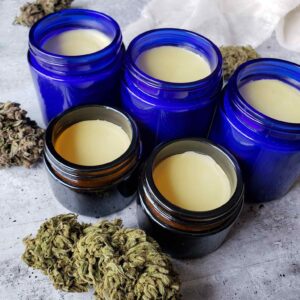
When it is ready, I pour the liquid salve straight into these 2 ounce glass jars, or these 4 ounce glass jars. You can also use these shallow wide aluminum salve tins. The cannabis salve will harden as it cools, and then it is ready to use!
It is best to store your finished cannabis salve in a cool dark location because light degrades cannabinoids. The amber and cobalt jars we use block UV light, which protects the salve if I leave it out.

Note: Sometimes, the surface of the salve may crack just a little bit as it cools. See the photos below. I have found that salve in our 2-ounce glass containers don’t crack, but larger volumes may. This is really only an aesthetic “issue” if you care. Personally, I don’t mind. It disappears as soon as you begin to dig in and use it!
However, some folks may not like the appearance of the cracks – particularly if the cannabis salve is going to be sold or given as a gift. To avoid settling cracks, put the cannabis salve in a mixing bowl before transferring it into a storage container. Allow it to only partially cool and solidify, whip and mix it up, and then pack into your containers.


Step 5) Feel Good
Lather up! Apply a thin, even layer to the affected area. You should start to feel the results within 5 to 20 minutes, depending on the severity of your issue and strength of your salve. Repeat several times per day as needed.
Will this make me smell like weed?
Just slightly! I find our salve to have a mild cannabis odor, but nothing overpowering. The coconut aroma also stands out. If you add essential oils to your recipe, that can also help to mask the smell. I often apply salve after showering (including before going to work) and don’t think there is much of a noticeable odor after a half an hour or so. No one has ever said anything to me at least!
How long does cannabis salve last?
When stored in ideal cool and dark conditions, homemade cannabis salve should last up to a year. The potency will only slightly decrease during this time. I try to use clean hands when I dig into my salve jars, to avoid introducing any contamination that could make it potentially mold or spoil faster. You could also use a salve spoon.

Ready to make your own medicine?
I hope you found this tutorial to be useful, interesting, and informative! I also hope that it helps you soothe your trouble spots, whatever those may be. Finally, please remember to heed caution depending on your local laws, and always be careful with your cannabis products around curious kiddos or pets.
If you enjoy this article, be sure to check out:
- How to Make a Cannabis Tincture (Cold Alcohol Extraction Method)
- Vaporizing Cannabis: Science, Safety, Quality & Technology
- How to Grow Cannabis, Organically: Soil, Seeds, Containers & Care
- How to Make Homemade Cannabis Oil (or CBD Oil)
- How to Harvest, Dry, Trim, Cure & Store Homegrown Cannabis
Please feel free to ask questions, or spread the love by sharing or pinning this post! Thank you for tuning in.
How to Make Homemade Cannabis Salve (CBD or THC)
Equipment
- A double-boiler, or make-shift double boiler (such as a glass pyrex bowl or stainless steel bowl perched on top of a saucepan with water below)
- Cheesecloth, like this organic unbleached cheesecloth
- Fine mesh strainer
- Glass bowl
- Glass storage jars or salve tins
- Recommended: a probe thermometer
- A baking sheet, if not using already-decarboxylated cannabis
Ingredients
- 1.5 cup Coconut oil
- 1 cup Loosely ground decarboxylated cannabis. To be more precise, I suggest to use a kitchen to weigh out approximately 7 to 10 grams (a quarter ounce or just over) (If not yet decarbed, see Step 1 below)
- Optional: 5 grams of raw cannabis, dried and cured
- OR 1.5 cups already-infused cannabis coconut oil (see notes about using different types of oil below)
- 1/3 cup Olive oil
- 1/3 cup Beeswax (vegan option: replace with the same amount of organic soy wax, candelilla wax, or carnauba wax)
- 1 tsp Vitamin E oil, or 1 Tbsp shea butter (optional)
- 4-5 drops Essential oils of choice (optional) Up to 1 tsp of essential oils (100 drops maximum) for a very strong-scented salve. I recommend ¼ to ½ that amount or less.
Instructions
Decarb Cannabis
- If your cannabis is not yet decarboxylated, grind or tear it up into fairly small pieces. Spread evenly on a baking sheet, and heat it in the oven on 250°F for 25 to 30 minutes for THC-dominant strains, 50 to 60 minutes for high CBD strains, or 45 minutes for balanced THC/CBD strains.
Make Cannabis-Infused Oil (skip to next section if you already did this)
- Add water to the bottom pan of your double-boiler. Now add 1.5 cup of coconut oil to the top section of the double-boiler. Heat until it melts.
- Stir in 7-10 grams of decarboxylated cannabis into the melted oil. Feel free to also include an optional few grams of raw ground cannabis if you desire.
- Continue to heat the cannabis and oil over a low heat for 30 to 60 minutes, stirring occasionally. Use a probe thermometer to check the temperature. Adjust the heat as needed to maintain the oil below 200°F. (We aim for 130 to 150°F, and infuse for one hour)
- When the time is up, line a strainer with cheesecloth and position it over a glass bowl. Pour the cannabis and oil mixture through the strainer. Gather the cheesecloth and gently squeeze out the excess oil from the cannabis. Warning: the oil will be hot, and your hands will get greasy! You may want to wear food-grade gloves.
- Keep the strained cannabis oil aside for now. It will be added to the salve mixture soon.
Mix Salve Ingredients
- If you're using solidified cannabis-infused coconut oil that you previously made, I highly suggest mixing everything in a double-boiler once again (since you’ll need to heat it longer and hotter to re-melt your oil). OR, if you just made your cannabis oil and it is still liquified, you can do this step straight in a pot on the stove – keeping the heat as low as possible once the cannabis coconut oil is added.
- In either a pot or double-boiler, add ⅓ cup of beeswax. Heat until it is completely melted. Now turn down the heat to low.
- Next, stir in 1.5 cups of strained cannabis coconut oil and ⅓ cup olive oil, along with optional vitamin E plus a few drops of optional essential oils as well.
- Stir until everything looks completely combined. Once it is, quickly remove the liquid salve from the heat and transfer it into your storage containers of choice.
- The cannabis salve will harden as it cools, and then it is ready to use!
Storing & Using Cannabis Salve
- Store the finished cannabis salve in a cool dark location because light degrades cannabinoids (amber/colbalt glass jars or salve tins will block UV). Keep out of reach from children.
- Apply a thin, even layer to the affected area. You should start to feel the results within 5 to 20 minutes, depending on the severity of your issue and strength of your salve. Repeat several times per day as needed.
- When stored in ideal cool and dark conditions, homemade cannabis salve should last up to a year. The potency will only slightly decrease during this time. I try to use clean hands when I dig into my salve jars, to avoid introducing any contamination that could make it potentially mold or spoil faster.
Notes


563 Comments
lex
I just made this recipe, my question is, my parents are both truck drivers with random UA’s. Can they use this salve or will it show THC in their UA?
DeannaCat
Hi Lex – They’re all good! As a topical salve, it will not cross into the blood stream (or otherwise get into the internal body systems to show up on a urine test) – why it doesn’t get you “high”. I think this should help them… that has to be a tough job! Thanks for reading and best of luck.
Candychamberlain
Can I add melted beeswax to my jars with can I us cream in them? They are still runny or will they set up more? It’s been about 12 hours since putting n jars
Aaron (Mr. DeannaCat)
Hi Candy, if your salve is still runny, empty the jars back into your double boiler and add the beeswax then until thoroughly combined. Once it has completely melted, refill you salve jars and let them cool until solid.
Hash Again
I forgot to ask. What if we use Rick Simpson Oil. How much RSO (ml) for 2 cup recipe? Thank you
Aaron (Mr. DeannaCat)
Depending on how strong it is, 1 gram of the RSO sounds about right for one cup of oil. Directions for topical use of RSO recommend adding a drop of oil onto affected area of the skin and massage in, just use your best judgement to make the salve both effective as well as economical. Hope that helps and good luck!
Ellen
Do you feel high from the rub with THC ?
Aaron (Mr. DeannaCat)
Hi Ellen, absolutely not. It doesn’t go into your blood stream so there is no way for it to have any psychoactive effects on you. Thanks for reading.
matt hunneshagen
Hello , I’m new to the medical marijuana world and am wanting to use a cbd/thc cream for my arthritis in both knees. I’m in NY , so unfortunately i can’t get flower legally to make my own cream. I can get a cbd topical from a local dispensary. Can i use thc vape cartridge juice or thc concentrate and add it to the cbd lotion and mix well for a thc/cbd balanced salve?
Thanks for any help,
Matt
Aaron (Mr. DeannaCat)
Hi Matt, so you can’t get flower legally in NY but you can get vape cartridges and concentrates? I would avoid using the vape juice because I am unsure of what the ingredients are and I would not feel confident putting that on my body. I believe people do at times use concentrates to make salve, just be sure that the concentrate is decarbed or be sure to heat it well enough in the oil beforehand. You may have to research how much concentrate per cup of oil to use. Hope that helps and good luck!
Matt
Thanks for the reply. This is what I can purchase here :
https://weedmaps.com/brands/curaleaf/products/curaleaf-liquid-concentrate-90-20-1-sativa-450mg/reviews?undefined
Seems like this should do the trick. Wondering though if 450mg of THC mixed with 1000mg of CBD would do the trick. Would 900mg be better?(2 bottles)
Aaron (Mr. DeannaCat)
Hi Matt, I think mixing the THC and CBD together should be just fine for you per 1 to 1.5 cups oil. THC usually works better as an analgesic but the combination of THC and CBD has an “entourage effect” that should work great. Make a batch and see how you like it!
Krystal
I’ve tried this, and love the product. I do have one question though, I had a plant with powdery mildew and was wondering if I could use it strictly for creams only?
Aaron (Mr. DeannaCat)
Hi Krystal, it probably depends on the severity of your powdery mildew infestation. I prefer to use healthy plant material for all uses and will usually destroy a plant before putting it to an alternate use. One cause for concern is if you are slightly allergic to mold, putting it on your skin may cause an allergic reaction of sorts. Use your best judgement, if the flowers don’t look healthy, will they provide health promoting benefits to you? Hope that helps and good luck!
Jacob Miller
Just a heads up. Blue glass is not as protective against uv light as amber.
Aaron (Mr. DeannaCat)
Thank you, we typically store the containers in a dark cabinet anyway.
Owen
Thanks for the information. I made this recipe yesterday by subbing cocoa butter for beeswax and replacing an ounce of olive oil with CBD oil made from coconut MCT oil. My salve turned out liquid at room temperature. Can I just put it all back in a pot on low heat with some beeswax that I’ve ordered? How much beeswax would you recommend to make the salve gooey but not liquid? Thanks for any advice.
Aaron (Mr. DeannaCat)
Hi Owen, if you roughly used the same amount of oil that we recommend go with 1/3 cup beeswax. When you’re ready to reheat everything, put your beeswax into the double boiler first until it is all melted, once that happens add your salve and combine, keeping the heat to a minimum just to combine all of the ingredients. Pull from heat and pour into your container of choice. Thanks for reading and good luck!
ReetaVeeda
Me again…
Thank you for your speedy reply!
Just to be clear, doesn’t heating the dried but not decarbed cannabis,
actually decarb the cannabis because you are heating it?
Should the dried but not decarbed cannabis be added after removing the liquid salve from heat?
Thanks again for your expertise & inspiration!
Aaron (Mr. DeannaCat)
Hello ReetaVeeda, we don’t usually heat the regular dried cannabis long enough or hot enough in the oil for it to really activate the THC but we want to let it infuse in the oil long enough to pass on some of the benefits from THCA. Hope that helps, good luck!
Kathleen
Hi Deanna and Aaron! Thanks for the excellent article! I am wondering if you have a recommendation of a CBD pain salve to purchase, rather than make ourselves? I bought the nuvita CBD oil based on your recommendation and love it, hoping you might have a salve product recommendation as well? Thanks again!
DeannaCat
Hi Kathleen! When we aren’t using homemade, we like Green Gorilla for topical CBD salve. It’s certified organic, and they have a few different strengths (I like the stronger one that also has arnica in it). Using the code “deannacat20” will also save you 20% there! Thank you so much for tuning in to the blog, and the feedback! Happy to hear NuVita has helped you. Take care!
Susan
Your recipe uses the amount of cannabis to use in grams of plant material. Since varieties can have very different amounts of thc and cbd in them, what is the suggested amount of the thc and cbd (in mg) that should be infused into the oil. Thank you.
Aaron (Mr. DeannaCat)
Hi Susan, unfortunately we haven’t tested our cannabis for percentages. However, we have used various strains throughout time and they always work very well. Just give it a go and see how it turns out, we haven’t had a bad batch yet!
Ralph
Hello,
What are your thoughts on decarbing using the sous vide method? I have the equipment already and from what I have researched it sound like a great method.
Thanks
DeannaCat
Hello Ralph, it sounds like a great method to maximize and preserve all the terpenes and cannabinoids. A much higher tech than a simple decarb in the oven. Good luck and let us know how it works out for you. Thanks for reading!
Mazi
I have one question. You did not suggest this in this article, but I was wondering if placing the salve in the fridge harms it in any way?
Thank you for your time and attention.
Indeed.
~Mazi
Aaron (Mr. DeannaCat)
Hi Mazi, I don’t see there being any harm in keeping it cold. If the goal is to keep the salve more firm during the hotter months you could always play with adding more beeswax or vegan wax to the salve which will make it more firm.
ReetaVeeda
Hi Deanna!
I’m so glad to have found your site and can’t wait to try your recipe for my joint pain;
this is the first time I have tried growing cannabis and just cut down 3 plants 2 days ago,
and they are in the drying phase now!
I really appreciate the links to all the equipment as well; so helpful!
My question is this: if I only plan to use the cannabis to make the salve, is it really necessary to cure it?
Can I just go straight from drying to decarbing the cannabis?
Thank you so much for sharing your expertise!
Aaron (Mr. DeannaCat)
Hi ReetaVeeda, you will be just fine not curing the cannabis for the salve, we also add a little dried but not decarbed cannabis to the salve as well for other benefits. Thanks for tuning in and congratulations on your first harvest, good luck!