

How to Make Dehydrated Lemon Powder + 13 Ways to Use It

Looking for clever ways to use lemon peels and reduce waste? Come learn how to make dried lemon powder! It’s easy to do in either a food dehydrator or the oven, and results in a uniquely delicious, sweet and zesty homemade seasoning powder.
Lemon peel powder is loaded with flavor, vitamin C, and can be used in a wide variety of sweet or savory dishes including baked goods, spice blends, rubs, tea, or even homemade body care products like DIY bath salts. See a full list of ideas at the end of this post!

Want to save this?
Disclosure: Homestead and Chill is reader-supported. When you purchase through links on our site, we may earn an affiliate commission.
Citrus grows plentiful here in California, so we’re always looking for ways to use our homegrown lemons. In addition to homemade lemon powder, we also enjoy making preserved lemons, natural lemon vinegar cleaner, and freezing lemon juice cubes. We also love to dry orange slices to make beautiful holiday ornaments, use in tea, or to make a dried orange garland!
Instructions
1) Collect Lemon Peels
It’s best to use organic lemons to make lemon powder, as non-organic lemons have nasty chemicals embedded in the rind. Also, it is best to use fresh lemon peels to make homemade lemon powder. Therefore, the ideal time to make lemon powder is when you’re already using a large quantity of lemons! For example, if you’re juicing lemons to save the juice in ice cube trays, baking lemon bars, making lemonade, or something else deliciously-lemony.
However, you don’t necessarily need to collect your lemon peels all in one day. One option is to save the rinds for up to a week in the refrigerator in an air-tight container. Better yet, peel a bunch of lemons at once to use throughout the week (stored in the fridge), and then you’ll have all your rinds ready at one time.
Or, instead of collecting and drying a large batch of lemon peels at one time, you could also dehydrate a few in smaller batches – albeit less efficient.
A note on freezing lemon rinds: Though I haven’t tried it, I assume it’s possible to save collected lemon rinds in the freezer over a longer period of time if needed – and then dehydrate them later after defrosting. However, I have a feeling the color will be a bit off and darker orange to brown. At least that is what happened when I used slightly older softened lemon rinds to make lemon powder one time. If you do try the freezing option, be sure to report back and let us know how it went!

2) Prepare Lemon Peels
This step will vary depending on the type of lemon you are using.
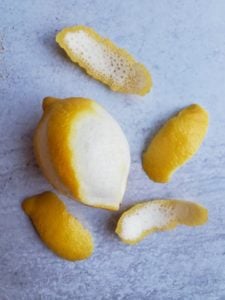
We are fortunate to have a tree full of sweet, thin-skinned Meyer lemons at our disposal. If using Meyer lemons (or similar), you don’t need to fuss with removing the white pith, as it is usually very minimal compared to the sweet tender rind. Therefore, when I want to make homemade lemon powder, I simply peel Meyer lemons whole – as I would an orange!

For other thicker-skinned lemon varieties, such as Eureka lemons, you will want to remove most of the bitter white pith from the inside of the peel. One way is to peel just the outer layer of the lemon rind using a vegetable peeler – creating thin ribbons of zest. Alternatively, you could peel the lemon whole (like an orange) and then use a spoon or knife to carefully scrape away the white pith.

3) Dehydrate Lemon Peels
How to dry lemon peels using a food dehydrator:
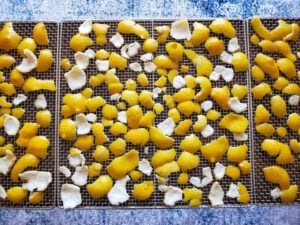
- Lay out the lemon rinds on your food dehydrator trays. The rinds should be in a single layer and not overlapping, since we want good air flow between and around each piece.
- Next, load up your dehydrator and turn it on to a low heat setting (between 95-105°F is good, if your dehydrator has temperature settings).
- Dehydrate the lemon peels until they are completely dry. The time it takes for them to fully dry will vary depending on your individual machine and the thickness of the peels, which may be several hours to a couple of days. It takes about 24 hours to dry Meyer lemon peels in our current badass Excalibur dehydrator, and 36-48 hours in our previous basic Nesco dehydrator.
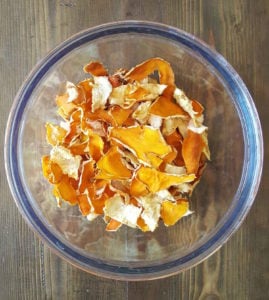
- You know the lemon peels are finished drying when they easily crack and snap in half, rather than bending.
- Failing to completely dry your lemon peels before grinding will result in a clumpy lemon powder with a shorter shelf-life!


How to dry lemon peels in the oven:
This method will work best for thin, zest-like peels of lemon rind. Spread the lemon peels out on a cookie sheet or baking pan. Preheat the oven to the lowest temperature setting possible. Because ovens don’t have uber-low temperature options like dehydrators do, the finished lemon rinds will be darker in color and possibly a different flavor (more roasted) than those dried in a dehydrator.
Bake the lemon rinds on low heat until they are completely dry, crisp, and easily snap in half. This may take several hours to a full day to dry in the oven. If your climate is very arid and warm, you could allow the thin lemon zest ribbons to partially air-dry at room temperature for a couple days before baking, reducing the time needed in the oven.


4) Grind into Lemon Powder
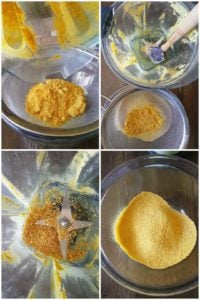
Once the lemon peels are totally dry, it is time to turn them into powder! Use a blender, food processor, or coffee grinder to churn the dried lemon peels into powder. Our Vitamix does a stellar job at creating a fine, fluffy lemon powder!
TIP: Even using a Vitamix, I find that some larger hard bits are left behind after the initial blend. Therefore, I like to pour the ground lemon powder through a fine mesh strainer poised over a bowl and sift it. Then, I take the collected leftover hard bits and run them back through the Vitamix another time to pulverize them into powder. Repeat if necessary. Then use a rubber scraper to gather all of the lemon powder stuck inside your blender or machine. That is valuable stuff!

Storage
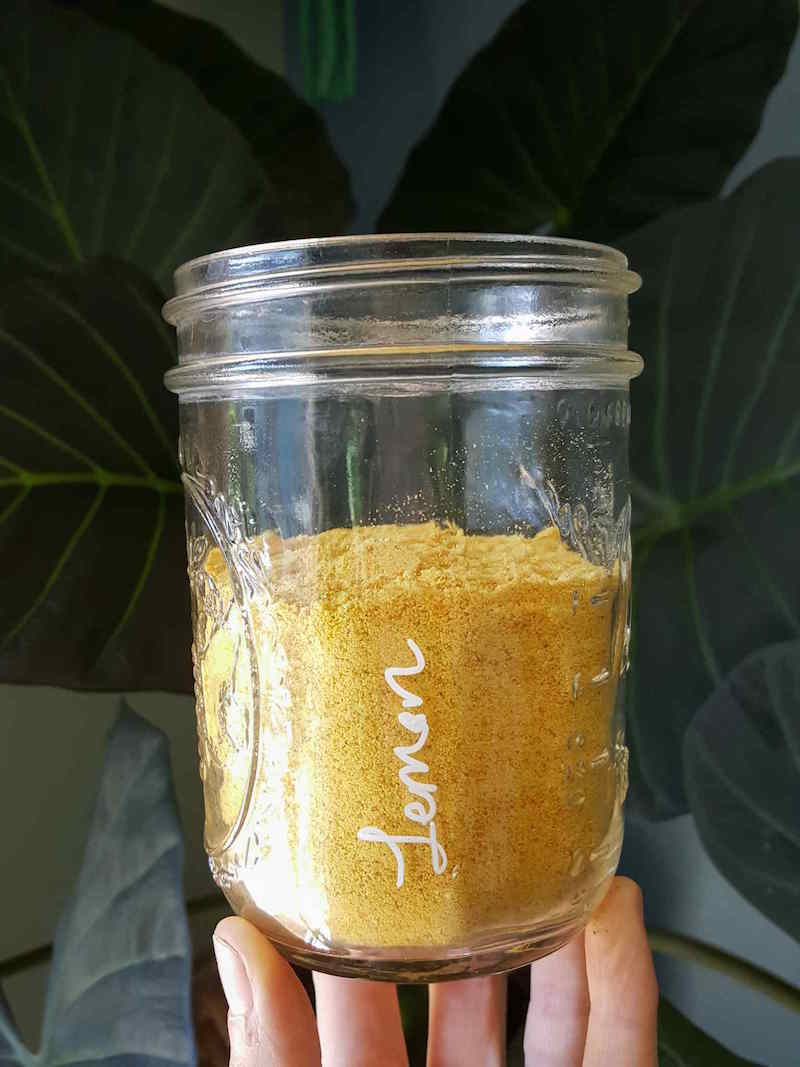
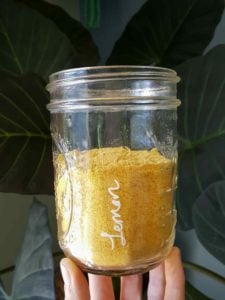
Finally, transfer the homemade lemon powder in an air-tight glass container, such as in a mason jar with tight-fitting lid. A canning funnel really comes in handy to transfer the power into a jar without spilling!
Store lemon powder in a dry, dark, cool location. We store ours in the pantry. When properly dried and stored, your homemade dried lemon peel powder should last for over a year. That is, if you don’t use it all up before then!
13 Ways to Use Dried Lemon Peel Powder
Dried lemon powder is insanely delicious. To be honest, I was shocked at how good (and versatile!) it was when we made our first batch many years ago. It can be used in meals, beverages, cleaning products, or even in organic body care! Check out the ideas below.
- Add it to salad dressing. I’m a big fan of simple combinations like olive oil, apple cider vinegar, and a dash of lemon peel powder. Or, sprinkle it right over the salad instead!
- Use it in dips like guacamole, hummus, salsa, or this yogurt dill lemon dipping sauce.
- Mix it with salt, pepper, and/or dried herbs to create lemon pepper and other custom seasoning blends.
- Sprinkle lemon powder over sautéed vegetables, during or after cooking.
- Add it to baked goods like sweet breads, muffins, cookies, or even in frosting or pudding.
- Add it into artichoke cooking water for a bright pop of flavor.
- Incorporate lemon powder into your loose leaf tea blend, or simply mix it straight into hot water or tea.
- Sprinkle it over plain yogurt with granola, nuts and seeds.
- Add it as an ingredient in homemade body care products, such as bath teas, salves, body scrubs, facial masks, or soap. Check out this book for amazing DIY organic body care recipes.
- Use dried lemon powder as a replacement for lemon zest in any recipe. Use 1 tsp of lemon powder for every called-for tablespoon of fresh lemon zest (the commonly suggested ratio for all dry-to-fresh herbs substitutions).
- Sprinkle dried lemon peel powder over avocado toast with salt and pepper.
- Give some away as a gift, if you have any to spare! My mom loves our lemon powder so I give her a little jar every year around the holidays.
- Use it as a fish or meat seasoning – if you’re into that.

Lemon powder is easy to make, and even easier to find ways to use it! I hope you love your homemade lemon powder as much as we do. Please feel free to ask any questions, report back with a review, and share this article!
If you are into dehydrating food, check out the tutorials below – they’re some of our favorites!
- How to Make Homemade Garlic Powder
- Preserving Onions: How to Make Onion Powder in 6 Easy Steps!
- How to Make Tomato Powder (Fresh Tomatoes or Skins)
- How to Make Homemade Dried Turmeric Powder
- Herb “Sun” Dried Tomatoes Recipe
- How to Make Homemade Chili Powder

Homemade Dried Lemon Peel Powder
Want to save this?
Equipment
- Food Dehydrator, or Oven
- Blender, Food Processor, or other appliance for grinding
Ingredients
- Lemon peels
Instructions
- Wash and peel your lemons. If using thin-skinned sweet lemons (like Meyer lemons) peel them whole like an orange. For thicker-skinned lemons (such as Eureka lemons) use a vegetable peeler to remove the outer part of the rind, leaving behind most of the white bitter pith.

- Lay out the lemon peels in a single layer on your food dehydrator racks (or on a baking sheet, if drying in the oven).

- Dry the lemon peels in the dehydrator at 95-105°F, or in the oven on the lowest heat setting possible.
- The time it takes for them to fully dry will vary depending on your individual machine and the thickness of the peels, which may be several hours to a couple of days.
- Dehydrate the lemon peels until they are completely dry. The lemon peels are finished drying when they easily crack and snap in half, rather than bending.

- Use a blender, food processor, or coffee grinder to churn the dried lemon peels into powder.

- Optional: Pour the ground lemon powder through a fine mesh strainer poised over a bowl and sift it. Take the collected leftover hard bits and run them back through the Vitamix/blender another time to pulverize them into powder.
- Store the finished lemon powder in a glass air-tight container, such as in a mason jar with tight-fitting lid.
- Keep the container in a dry, cool place – such as the pantry. When properly dried and stored, your homemade lemon peel powder should last for over a year.



98 Comments
Melissa
I love this idea! Our little lemon tree is still struggling, so we only have store bought, organic lemons. I thought citrus was usually covered in wax, so I’ve been hesitant to do anything edible with the peels –is this no longer the case? Anyone know? I’d love not to give all the peels to the compost.
DeannaCat
Hi Melissa! Great question. It is my understanding that if they do wax them, organic options should use a natural wax like beeswax, and it should wash off fairly easily if you soak the lemons in hot water for a few minutes and then give them a good rub/scrub. Good luck!
Kerry
You have taught me something new, thank you so much! I can’t wait to try this. Now I wish I had a lemon tree. The Meyer lemon tree I grew indoors got inundated by mealy bugs and I had to pitch it. Maybe this is a good reason to get another one.
Kerry
Aaron (Mr. DeannaCat)
Hi Kerry, mealybugs can be an issue with citrus trees. Sorry to hear you had to get rid of your Meyer lemon tree but getting another one sounds like a good idea. Thanks for reading and good luck!
Annette
Recipe looks great and can’t wait to make my own lemon powder.
@Kerry…mealy bugs can be dealt with naturally with a mixture of organic Neem oil, a drop or two of dish soap to emulsify the oil, and water in a spray bottle. Whenever I see them appear on my canna flower plants, I spray the leaves both sides, and the dirt, then dump the rest of the solution in the dirt, then water the plant. It may become a regular treatment, but it works. You can find the recipe on line (I use about 1/4 tsp Neem, a few drops of dish soap into a small, or Home Depot size sprayer bottle—recipe can be adjusted).
Vicky
Hi,
I really want to try this! But I was wondering how many lemons you actually need to have a decent amount of powder?
Thanks so much for the recipe! =)
Greetings from Germany.
Aaron (Mr. DeannaCat)
Hello Vicky, we typically use about 10 to 12 lemons when we make the powder and it seems to make close to two cups of powder. We typically make this recipe when we have a lot of lemons on hand such as when we make The “Besto Pesto”: Lemon Walnut Basil Pesto Recipe. Thanks for reading and good luck!
Michelle
Yes you can use frozen lemon peels and they work great. They will be limp. Just don’t over do it on the dehydrator as they can turn a brownish color. The frozen peels are all especially good when I’m making extract seeing how I need to fill the jar 3/4 way full!
Dianne Smith
Instead of lemons can I use oranges?
Aaron (Mr. DeannaCat)
Absolutely!
Elsa Sale
Wow, thanks for the recipe! I just recently became a fan of Meyers, having only planted Eurekas before, as I started drinking tea with a whole lemon in it. My one tree of Meyers was loaded, but I didn’t take advantage of all the fruit, as I thought it would always have fruit! Was I wrong! I’d love to know if you SELL your powder?? All the powders sold out there do not specify which kind of lemon they use..
Thanks again for the recipe; from now on, I will always have it in MY pantry too!
Nona
Love the recipe and thank you for the information. Rinds can be frozen. We make frozen juice and rind cubes for use in cooking or our mixers when we process a bag of lemons. Just be sure to clearly mark the rind ones or your drink will be ruined when you grab a frozen lemon cube as the ice and pour our slivers of peel.
Little issue though”Choose organic lemons to make lemon powder, as non-organic lemons will have nasty chemicals embedded in the rind”
Organic does not mean chemical free. (Technically everything we consume is chemicals except salt which is a mineral) Organic farmers still use pesticides and supplements but they are more limited in what kinds they use and may even need to use more to get the results needed to stay viable, which is why organic still tends to cost a bit more but being more afforable over time. When produce, or animals, getting closer to harvest for market these chemicals are generally reduced or discontinued to allow the plant to ‘get it out of it’s system’ as it were and this is done by organic and non-organic farmers. It is not in their interest to poison their consumers. Just clean your produce and learn a bit about what it really takes to go from farm to table.
Or better yet grow your own, these can be grown as a dwarf plant and kept inside with a bit of help from a solar lamp to make up for indoor lighting.
JoAnn Brewer
You have a wonderful web site. So informative. And I was surprised to see someone so young so knowledgeable about gardening etc. Your mom and Grandma must be proud!
GABRIELA COTET
These is just invaluable information! I love you article and your blog!
bubblebathify
Thank you for sharing 😊♥️
Jessica
I love it!
I made it with limes too, mixted it with salt for an amazing margarita glass rimmer.
Curtis
Awesome instructions and idea. I will definitely be doing this. Thank you!