

Garden Companion Planting Chart, Plans, and Benefits
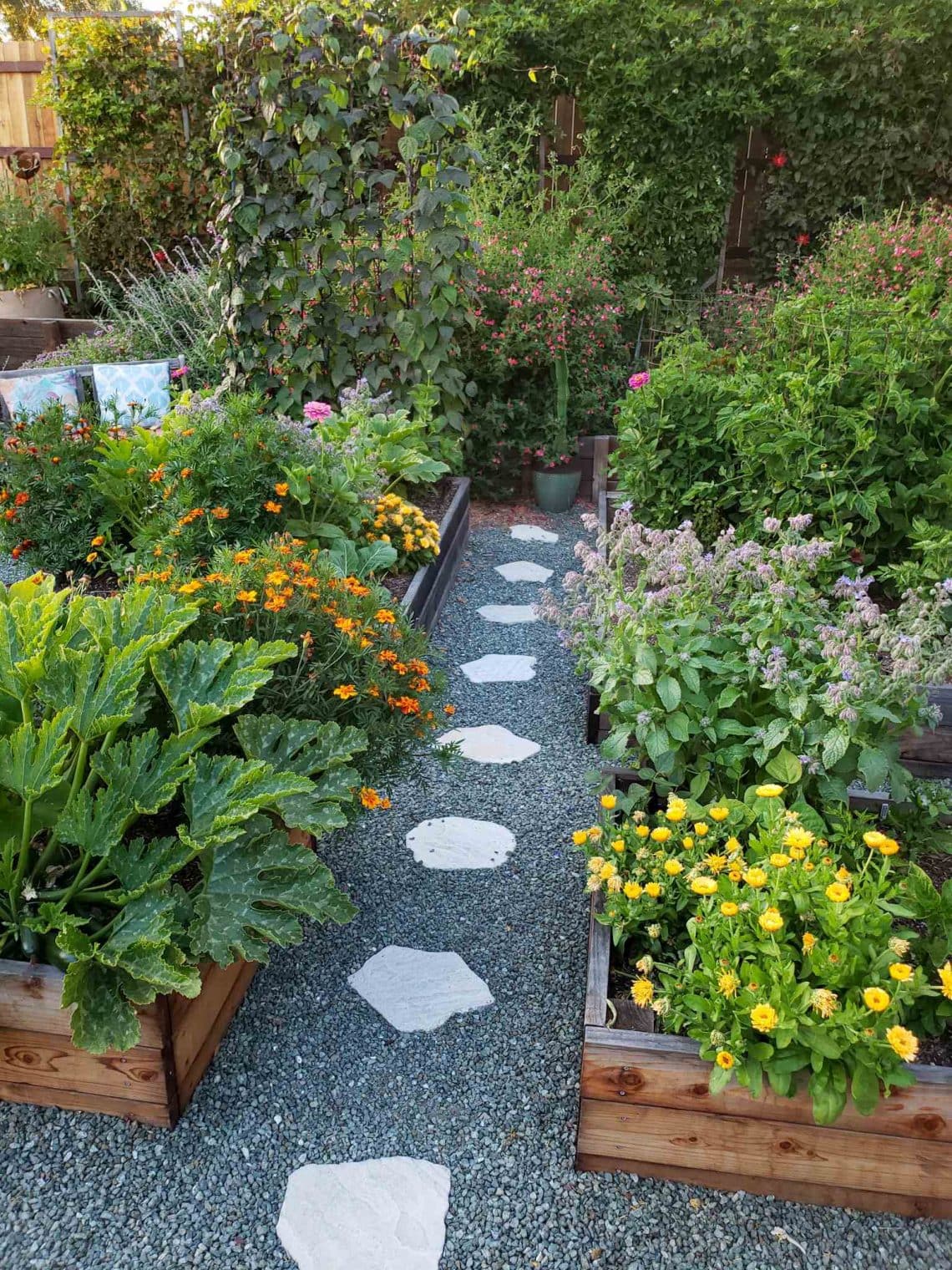
Come explore the beautiful world of companion planting and get a free printable garden companion planting chart for easy reference. This article will explore the benefits of companion planting, what flowers, herbs and vegetables to plant together in raised beds, and how to practice companion planting in your garden. I’ve included inspiration photos and layout plans from our gardens as examples too!
What is Companion Planting?
Companion planting is the idea that some plants benefit from growing near one another, while others would prefer to be kept at a distance. Practicing companion planting in your vegetable garden can offer a plethora of benefits – and look beautiful too! Follow our companion planting chart below to see what plants grow best together.
The University of Massachusetts further explains: “companion planting is growing two (or more) crops near each other with the theory that they help each other in nutrient uptake, improved pest management and reduced pesticide use, enhanced pollination and higher vegetable yields”.

Would you like to save this?
Disclosure: Homestead and Chill is reader-supported. When you purchase through links on our site, we may earn an affiliate commission.
Good Partner Plants
A recommended companion planting combination usually provides some sort of benefit to one (or both) of the plants, or brings an added perk to your garden in general. You can find these listed as “good friends” in our companion planting guide below. Some may have a profound relationship, such as relying on each others natural plant hormones to promote growth or protection. Other relationships may be as simple as one providing shade for the other.
Example: Consider the classic Native American “Three Sisters” companion planting combination of corn, squash and beans. Perfect for maximizing yield in compact spaces, the corn grows tall and narrow, leaving open space for sprawling squash plants below. The squash shades the soil to help it retain moisture. Pole beans can climb the corn as a support trellis, all while adding nitrogen to the soil that feeds both the squash and corn.

Incompatible Plants
On the other hand, some plants are often recommended to not plant directly next to others – their known or suspected “foes” as I call them in our companion planting chart. Those combinations may cause each other issues, such as stunted growth. For instance, the cabbage family, fennel, and dill are known to inhibit the growth of tomatoes.
Example: You’ll often see recommendations to avoid growing peas in close proximity to onions or garlic. Why? Well, there honestly isn’t much scientific evidence to support it, but theories suggest it’s because garlic and onions are “heavy feeders” while peas are not. This makes their fertilizing needs incompatible. Peas also add nitrogen to the soil, while onions and garlic don’t like too much. Another idea is that the pea’s sensitive shallow root system may be disrupted by the growth or harvest of onions and garlic nearby.

Benefits of Companion Planting
1) Increased Pollination and Yields
Pairing fruit or vegetable plants with pollen-rich flowers like calendula, cosmos, zinnia, bachelor buttons, or borage is the perfect way to attract pollinators such as bees and butterflies to your garden. Many vegetable crops are not self-fertile and rely on pollinators in order to grow fruit, including zucchini, winter squash, cucumbers, melons, most berries and fruit trees. Therefore, more pollinators = more to harvest!
Related: Learn more about my 7 favorite easy annual companion flowers to grow from seed, or our overall top 23 best plants for pollinators here. Even with plenty of bees around, I still often hand-pollinate my squash to prevent end-rot and increase yields!

2) Attract Other Beneficial Insects
Bees and butterflies aren’t the only good guys we want to encourage in our garden! Companion planting with flowers and herbs likebasil, cilantro, sage and dill creates habitat, food, or otherwise attracts other small beneficial insects like lacewings, parasitic wasps, hover flies, predatory mites, or ladybugs. Those guys all play an important role in natural pest control. For instance, did you know that a single ladybug can eat over 50 aphids per day?

3) Natural Pest Control
While many companion plants draw in beneficial bugs, some can also help deter pests or disease. For example, garlic, chives, onions, and fragrant herbs like basil, dill, and cilantro can help repel aphids – ideal for natural aphid control around susceptible crops like brassicas or leafy greens. The sharp smell of marigold flowers also reportedly keeps pest insects like whitefly away.
Interestingly, hot pepper plants contain a substance within their root system that is effective at warding off and preventing root rot diseases, such as Fusarium rot. This helps keep root rot away from other companions in the same garden bed as peppers.
Other companion plants DO attract pest insects – but distract pests away from your fruit and vegetables plants instead! These are referred to as “trap crops” or sacrificial crops. Nasturtium is a prime example of a trap crop. The flowers attract bees and hummingbirds, but nasturtium leaves are also magnets for aphids and cabbage worms. Trap crop plants should be removed from the garden once they become heavily infested.


Prime Example: Marigolds and Root-Knot Nematodes
French marigolds are possibly one of the most famous companion plants, as their roots contain a natural nematocide that kills root-knot nematodes. (Root-knot nematodes are a microscopic and harmful nematode that feed on root systems, reducing plant health and yields.) This makes marigolds excellent companion plants for tomatoes, squash, melon, peppers, and other crops frequently affected by root-knot nematodes.
This particular beneficial relationship IS scientifically backed! Yet it is often misunderstood by the well-intended gardener. In order to reap the benefits of French marigold companion planting, the marigold root system must be left in place. That means it’s best to cut marigold plants out at the soil line at the end of the season (leaving the roots in place, no-till gardening style) rather than pulling the plants out. Even better results are achieved if many marigold plants are grown prior to planting the veggie crop in the same location.
Learn more about the best tomato companion plants (and foes!) here.

4) Increase Biodiversity and Beauty
Variety is the spice of life! It’s beautiful and fun to mix different vegetables, flowers and herbs together in your garden beds. Companion planting adds interest, and is generally better for plant and soil health.
Companion planting is a form of polyculture, or planting several types of crops together in a small space instead of just one. Polyculture and companion planting help increase biodiversity and turn your garden into a mini-ecosystem – an esteemed achievement in organic gardening!
When compared to traditional agriculture or monoculture, a bio-diverse garden is less likely to be overrun with disease or pests. It reduces the need for pesticides, synethic fertilizers, or other chemical products. Diverse gardens also have more robust immune systems to handle environmental stress such as drought, heat, or cold snaps.

Companion Planting Chart
And now… what you likely came here for! Please enjoy this free printable companion planting chart as an easy visual resource and reminder of what plants grow well together (or not). I like to keep our companion planting chart on the fridge, along with the seed starting calendar for our zone. To create this, I gleaned information from dozens of my favorite gardening books and online resources to compile one comprehensive companion planting guide.
For even more helpful garden resources, don’t miss our 20-page Free Garden Planning Toolkit. It includes tips to start a garden, raised bed plot plan templates, journal pages, plus seed starting and planting calendars for every growing zone.

I realize the font is small, especially if you’re on a mobile device. There was a lot of information to fit on one page! If it’s difficult to view online, get a printable PDF version here.
How to Companion Plant in Your Garden
- Make a plan. Rather than heading outside with a bunch of seedlings and stuffing them in a bed willy-nilly, refer to our companion planting chart and sketch out a garden layout plan of where you want to plant everything first. You’ll be less likely to run out of room or accidentally put incompatible plants next to each other. It doesn’t need to be set in stone, but a general plan helps me stay more organized! See our vegetable garden plot plan example below.
- Some of the best and easiest companion plants to grow amongst your vegetables are flowers and herbs. Calendula, nasturtiums, basil, cilantro, oregano, parsley, thyme, and rosemary all have no known “foes” – so feel free to mix them into your garden where ever you can! Calendula is my all-time favorite flower (and medicinal herb) so you’ll find it in almost every one of our garden beds. I’ve also become increasingly fond of planting cosmos, bachelor buttons, and zinnia amongst our vegetables, which draw in a ton of pollinators! Get growing tips on our favorite easy companion flowers here.
- Remember to practice good plant spacing – companions included. Over-crowding plants can thwart the benefits you’re trying to gain with companion planting in the first place! Crowded plants compete for nutrients, water, sunlight and air flow. They’re more prone to disease like mildew and blight. Pests and disease also more easily pass between them. The good new is: most companion flowers and herbs take kindly to pruning, so feel free to cut them back as needed to give your veggies the space they need.
- When companion planting in raised garden beds, I usually add flowers or herbs to the corners of each raised bed at minimum. Then after I plant out all the vegetables, I assess where I have room to tuck more flowers or herbs between them.
Raised Bed Garden Layout Plans


The Science: Does Companion Planting Really Work?
Some benefits of companion planting are undeniable, such as increasing biodiversity and attracting more pollinators to your garden. Yet some companion planting recommendations are more based on theory or anecdotal evidence. This is especially true when it comes to the supposed incompatible plants.
I’ve tried to research scholarly articles that back companion planting with science, and truth be told, they’re sorely lacking. That doesn’t necessarily mean it’s all bunk though! Some things are well-studied, like the benefits of marigolds. Plus, experimentation and personal observation is how all scientific theories get started, after all. If many gardeners have seen the results of companion planting in their own garden, I say it’s worth considering.

My Experience and Final Thoughts
Companion planting must have some truth behind it, or it wouldn’t be such a popular subject in the gardening world. However, I personally pay most attention to the beneficial planting combinations. Those make clear sense to me! Plus the fun and colorful mix of things bring me joy. When possible, I try to avoid the frowned-upon combinations too – but with less scrutiny.
I like to think of the “incompatible” plant combos like neighbors. We don’t adore all of them, right? We all have different needs, lifestyles, and tolerance for nuisance. But will I up and die if I have to live in close proximity to someone I don’t particularly care for? No, probably not. I will chug along and live my life, perhaps just a little less happily…
For instance, we have inter-planted beans with peppers in the past, as well as garlic near peas – both supposed incompatible foes. They still grew, though I do admit they seemed less healthy and vigorous than usual. Perhaps it was just an off year? Or maybe it was the nuisance neighbor.
In all, I try to set my plants up to live their best life, with as few hindrances as possible. My suggestion is to make a modest effort to follow the “rules” of companion planting. Yet if limited space or other circumstances leads you to break the rules, don’t stress about it too much!

And that’s companion planting 101!
Have you experimented with companion planting yet? What are your thoughts? Do you think it works, or is the jury still out? As far as I am concerned, there is no harm in trying. Plus, the more flowers and herbs, the better! Please feel free to ask questions, leave feedback, or share this article. Happy (companion) planting!
Other organic gardening articles you may enjoy:
- Seed Starting 101: How to Sow Seeds Indoors
- How to Amend & Fertilize a No-Till Garden Bed Between Seasons
- Composting 101: What, Why & How to Compost at Home
- Organic Pest Control: Over 25 Ways to Stop Pests from Destroying Your Garden
- How to Design & Build a Raised Garden Bed


69 Comments
Janice
I am in the process of planning my first square foot garden. I understand the planting companion plants. I however am unsure how faraway I need to try and keep antagonistic plants. I only have a 12×4 raised bed to work with.
Thanks for your assistance.
JANICE
Aaron (Mr. DeannaCat)
Hi Janice, If we have two plants that are considered “foes”, we try to keep them from sharing the same bed. However, we have planted them together but try and keep them on the opposite sides of a raised bed. A lot of it is also trial and error, if you need to plant them closer together, just monitor how they grow together and keep track of the results. This summer we had sunflowers (said to suppress other plants growth) planted amongst many summer crops that did very well. Hope that helps and good luck! Let us know your results.
Saskia
Hi! I’ve started planning my veg for next spring and summer and was looking at the picture of your garden plot plan here as an example. I noticed you’ve got the hot and sweet pepers are not all grouped together and also not all in the same bed. This made me wonder.. Why do you mix it all up like that? Esthetics, just for fun (or rather boredom) while colouring the chart, diversity, crop rotation?
Thanks for the always well informed and humorously written articles as well as the planning tool! 🙂 Much appreciated.
Aaron (Mr. DeannaCat)
Hello Saskia, we just like mixing things up and enjoy seeing a mixture of peppers growing amongst each other as opposed to all of the same peppers growing next to one another. If you look into our winter garden photos, you will see that we plant the same variety of vegetable next to each other in rows. Thanks for reading and have fun!
Roxanne Kruger
I just found your blog through Pinterest and I’m so grateful and happy to have found you. You write so well and your wisdom is so appreciated! Thanks homie 🙏👍 excited to receive your newsletters, in the mean time I will show my support by reading all your blogs ❤️
Aaron (Mr. DeannaCat)
Thanks for the support!
Danieka Kruger
This was so insightful! Thank you soo much for this article. We will be moving to an eight hectare plot in a few months and I am starting to do a bit of research around companion planting to optimise growth. This is by far he most useful article, I just had to stop myself from reading all the linked articles when clicking on them throughout this one. Will move on to read the others too.
Thank you for sharing what you’ve learned over the years.
Bob
Good morning. I found your site a few days ago on Pinterest and am definitely interested in learning. I bought my place 5 years ago and have been trying to square foot garden ever since with very little luck. This year I am doing different. Studying, investigating, and learning. I found several sites that say to use a mixture of vermiculite, peat moss, and garden soil. I am trying it this year. At presentI have three (3) 4’x4’ boxes. Using a companion planting chart, I have started planting the North box. I am interested in getting your chart and layout tool but when I put in my information instead of sending me a link it sends me back to put in information again. Have done this at least eight (8) times. Getting a little frustrated. I want to learn but this is taking time awY from my learning. Pleas help.
Thank you
DeannaCat
Hi Bob – welcome! I see your email in our subscriber list, so it worked! It was “failing” because it worked the first time. Check your “promotions” inbox in Gmail – the welcome email often goes there. You’ll find a link for the garden planning toolkit in that email, along with at the bottom of our weekly emails thereafter. I’m sorry you’ve been struggling with your garden. I will say this… while I haven’t tried it myself, I don’t believe in square foot gardening. Any time I have seen a garden planted that, it appears far too crowded to me. Sure, some plants can be spaced more closely, but if they’re too close for comfort they WILL struggle – as the plants will be competing for nutrients, water, sunlight, air circulation and more. I am a big proponent of properly thinning and spacing plants. However, that may not be the issue and of course soil quality/compost/amendments play a huge role. Feel free to browse through our garden>compost menu section and see if anything strikes your interest there. Thanks again for being here! Let me know if you still have issues finding your welcome email.
Bob
Got it. Did a search 2 days ago, didn’t show up. Just did search again….voila, there it was. Thx.
The reason I went to square foot is my soil is totally void of nutrients. I think this soil was hauled in from a dump or somewhere.grass and weeds don’t even want to grow here. Have got organic nutrients coming that is designed for my yard specifically. Did soil samples and sent off to “Sunday”. They are sending organic soil amenities specifically for my yard. Should be here within a week or so.
Samantha
Bob- FYI, Sunday is NOT for soil amendment. It is specifically for lawn (grass) growth. While it /may/ add nutrients to your soil, it’s not intended to help with the goal of growing food- it is meant for growing grass.
Sheila
I really appreciate your thorough videos. They are well made and informative. You inspire me. I have 6 new basil plants about 3 inches tall. Ready to try. I am thankful for people like you who take the time to share their passion.
Lydia
Thank you so much for sharing all your wisdom in the garden. I seriously love all your articles and your garden is so inspirational! Just wanted to send some positive vibes and let you know you’re doing a phenomenal job!
Michelle
I love your articles and tips–you’re helping me build my own homestead! Question: do you plant by the phases of the moon, or do you simply garden according to your own timeline? I’ve been following the Stella Natura calendar and I feel it’s taking me FOREVER to get my garden going because I’m having to wait for specific “root days” or “fruit” days to plant my seeds (and frankly, I’m not seeing incredible results by doing this).
Thanks in advance for your help!
DeannaCat
Hi Michelle – As much as I love the moon (Cancer here, total moon child) I don’t allow the moon to dictate our garden schedule. My mood is another story however! Lol. But we are WAY too busy to plan around it. When we have free time to get things done, we get things done! Thank you for being here, the sweet words, and reading! I love knowing that this is all helping you on your journey!
Michelle
Thank you SO much for responding so quickly–you have no idea how relieved I am to hear this from you LOL. I was thinking, “Ok, if THEY can have that amazing homestead without planting by the moon, I CAN!”
Cheers and blessed be!
Michelle
Brittany Gierke
Love all of your articles and tips!! I’ve already planted some things and realized I need to rearrange a couple things!! So excited for this years garden!! I have a lot of great pollinators and herbs planned for our cannabis beds too! Have you found anything that doesn’t work well? About to start our favas too!!! Thanks so much lady!!
Erin
Thank you for the article and chart! I wonder if companion planting also has something to do with the soil Ph and with the pests that a plant attracts (not just deters).
DeannaCat
Yes I believe so! I have pondered about the pest-attracting plant combinations often too!
Breeze_Gardener
Great post! I have read a lot about companion planting in different books and websites. I always find conflicting information here and there and I’m left to guess what to trust… well, until I found Homestead and Chill 🙂
So far all the companion planting I have used from your gardening tool kit seemed to have worked. Last year my tomatoes did wonderful surrounded with marigolds and basil among others. This year I’m going to experiment with the organic ways to stop cabbage worm from your other post. 😉 Thank you for sharing your knowledge and helping my garden flourish.
Have you ever planted any berry bushes? I don’t remember seeing any videos or posts about them. We love berries, specially my kids. But they are so delicious that all the wild life in my yard seem to enjoy them as much as we do. I was wondering if you had any tips for them as well.
DeannaCat
Hi there! Thanks for the comment! We do have blueberries in a few wine barrels, and used to grow black berries. The only bummer was that the cane berries die back pretty significantly in the winter and became an eyesore where we were growing them (since here we can grow lush green things year round… haha, California problems!) The only tip I have is that blueberries like acidic soil – so that is why we have them in their own containers with adjusted soil. Also that birds like berries, so you may need to consider netting bushes when they’re close to ripe. Otherwise, I don’t have many tips off hand. Sorry!