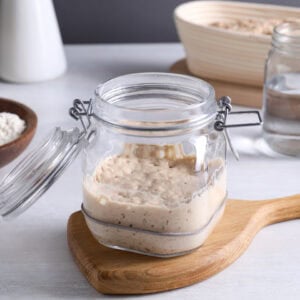
How to Feed Sourdough Starter
Learn how to feed your sourdough starter to keep it healthy and happy! Here are instructions on how to feed starter by weight (grams) or by volume measurements (cups) to get it active and ready for baking - plus storage tips and how often to feed for general maintenance.
Ingredients
Feeding Starter by Weight (1:1:1)
- 100 grams sourdough starter
- 100 grams water (room temperature or warm, and non-chlorinated filtered water recommended)
- 100 grams flour *Note that using whole wheat or rye flour (instead of white) can help increase starter activity.
Feeding Starter by Volume (1:1:2)
- 1/2 cup sourdough starter
- 1/2 cup water (room temperature or warm, and non-chlorinated filtered water recommended)
- 1 cup (scant, just under a cup) flour
- *Scale up as needed to maintain a larger starter with the same ratios
Instructions
Introduction
- "Feeding" sourdough starter is simply adding fresh flour and water to an existing starter. This may be after you use some starter in a recipe (to build its volume back up), to get a starter ready to bake with, or as a maintenance feeding between bakes.
- The frequency depends on how you store it. Starters stored in a refrigerator can be fed once every week or two (or even monthly, once mature and established). Starters stored at room temperature must be fed daily.
- Some bakers combine the starter, fresh flour, and water in a bowl and then transfer it into a clean container each time. Others simply mix fresh flour and water right into the starter jar. Either way, try to keep the sides of the starter jar fairly clean, and change it out or wash it on occasion. Built-up gunk in the jar can more easily lead to mold.
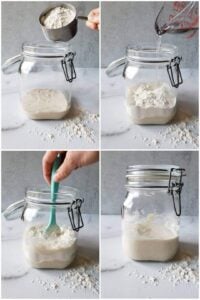
Before Feeding
- Warm up: Starter is most active at 70-80F. If store your starter in the refrigerator, allow it to warm to room temperature for several hours or overnight before feeding. You can also quickly warm up a starter by feeding with warm water (not hot) or using a warming plate.
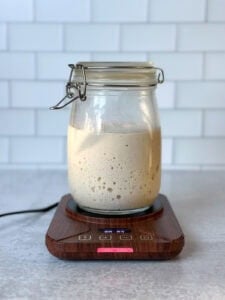
- Discard a portion: scoop out and remove a portion of the starter until the desired amount remains in the jar. Compost, trash, or use it in a discard recipe – but do NOT put it down the sink! (If there's only a very small amount of starter in the jar, you don't HAVE to discard first - simply feed it.)
- Now, add more fresh flour and water to the remaining starter, either following the "weight" or "volume" instructions below
How to Feed Sourdough Starter by Weight
- To feed sourdough starter using weight, simply combine equal parts starter, flour, and water. For example, 100 grams of each. Or for a larger starter/multiple loaves, 200 grams of each. This is a 1:1:1 ratio, ideal for beginners or activating a starter to bake.
- You can also experiment with other ratios such as 1:2:2 (e.g. 50 grams starter, 100 grams flour, 100 grams water) which will result in a longer, slower fermentation time - ideal for long term refrigerator storage or if you don't want your starter to peak too quickly (such as feeding it overnight).
How to Feed Sourdough Starter by Volume (Cups)
- To feed sourdough starter using volume measurements, simply combine 1 part sourdough starter, 1 part part water, and just under 2 parts flour. For example, 1/2 cup starter, 1/2 cup water, and just under 1 cup of flour. (This is very close to a 1:1:1 ratio by weight).
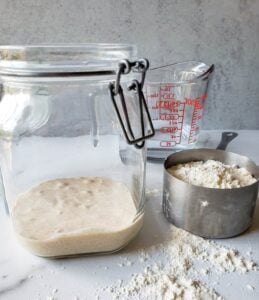
- To scale up for a larger starter/multiple loaves, use 1 cup starter, 1 cup water, and just under 2 cups flour.
Preparing Starter to Bake
- For baking, feed your starter about 4 to 8 hours before making dough. Leave it out at room temperature (70 to 80°F is ideal) to rise and reach peak activity before mixing it into your bread recipe.
- Peak activity is when the starter has at least doubled or tripled in sized and is no longer rising, but before it starts to fall back down. Don’t rush this step! It’s best to use starter when it has reached full peak activity or even just after (when it starts to fall back down, but hasn’t fully deflated yet) instead of mixing it into your dough too early.
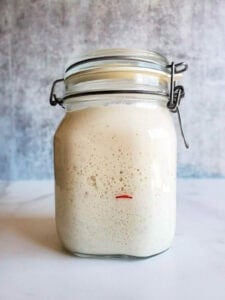
- Note that it can take anywhere from 4 to 12 hours for a starter to reach peak activity depending on the age/strength of your starter, when it was last fed, ambient temperature, and how you store it. Warmer temperatures increase activity, cooler temperatures slow it down.
- A slow, sluggish starter that hasn’t been fed recently (e.g. after several weeks or longer in the fridge) will benefit from being fed twice before baking with it. To do so, let it warm to room temperature, feed it, and then let it fully rise and begin to fall again before feeding it a second time.
Maintenance Feedings
- Take the starter out of the refrigerator, discard a portion, feed it, and then let it sit at room temperature for just a few hours to rise slightly before putting it back in the fridge. You don’t want it to fully peak and deflate however, or you’re basically putting it away hungry again!
Tried this recipe?Let us know how it was!