

Male or Female Chicks? 5 Ways to Tell the Difference (with photos)

Are you wondering if your chick is a female or a male? Come learn all about about sexing chicks – with five ways to tell the difference between male and female chicks (or young roosters and hens). We’ll explore how to evaluate their comb, feathers, behavior, and more.
I’ve included plenty of example photos of the chicks we’ve raised over the years, plus a handy reference chart at the end of this post!

Would you like to save this?
Disclosure: Homestead and Chill is reader-supported. When you purchase through links on our site, we may earn an affiliate commission.
RELATED: Don’t miss our beginner’s guide on raising baby chicks for more essential tips, including how to set up a chick brooder and best practices on introducing new chickens to the flock.
Before reaching sexual maturity, young female chickens (hens) are referred to as pullets and young male chickens (roosters) are called cockerels.
Sexing Chicks at the Hatchery
At hatcheries, trained professionals can often determine the sex of chicks by examining their cloaca (vent opening and sex parts) just after hatching. Certain autosexing breeds can also be distinguished by more apparent physical features such as color, explored more below.
Large commercial hatcheries are usually fairly accurate at sexing chicks, while small farms or breeders may not sex them at all. Yet the sexing process isn’t foolproof! It’s not uncommon for folks to end up with an occasional cockerel despite ordering all females.
Learn more about the pros and cons of large hatcheries vs smaller operations in this guide on where to buy baby chicks.
Speculation, Variation, and Breed
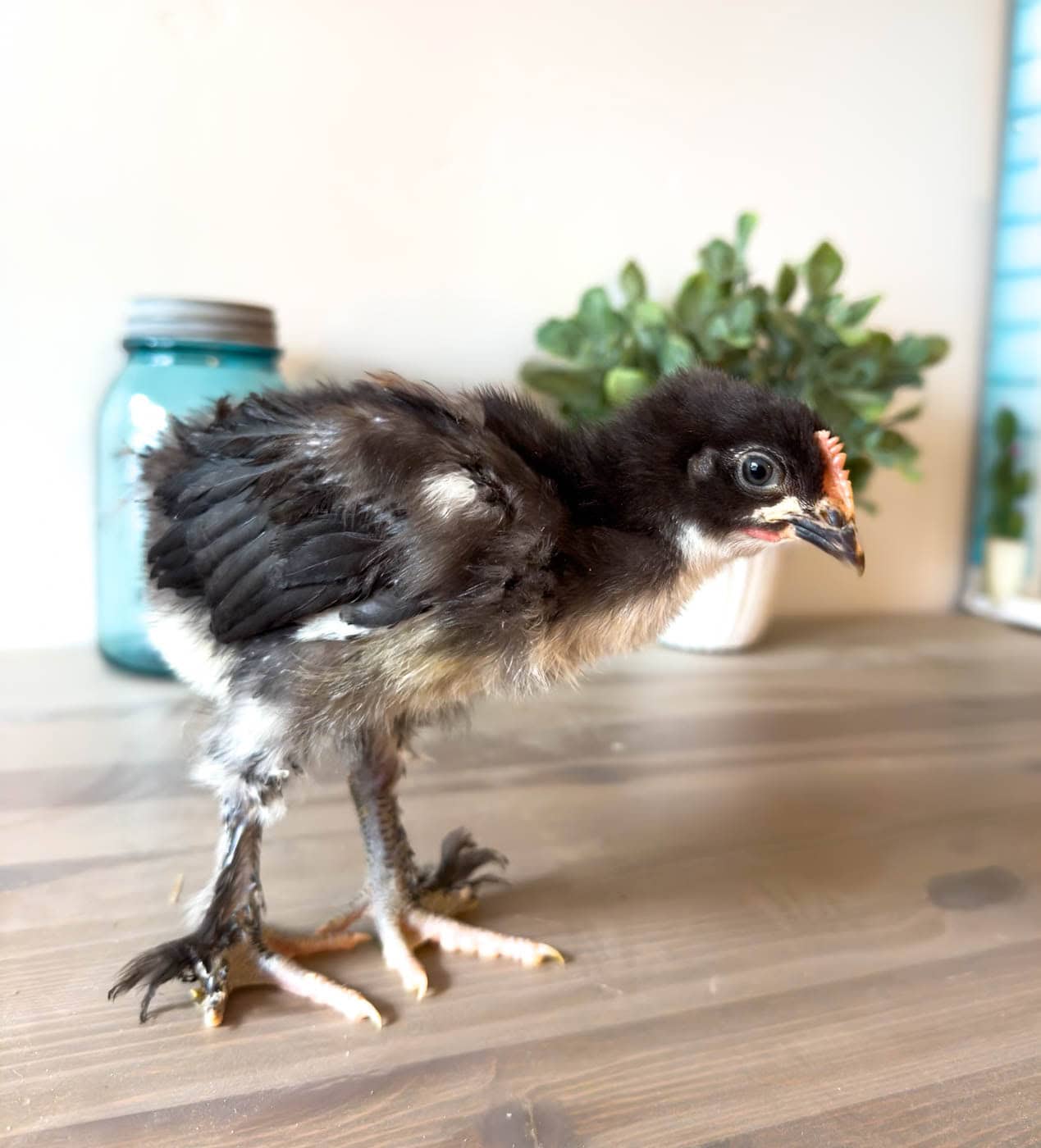
When raising chicks, there’s always a lot of speculation and guessing around chick sex – especially before they reach 8 to 10 weeks old (when the differences become much more apparent). Between imperfect sexing at the hatchery, androgynous individuals, early or late bloomers, those chicks keep us on our toes!
As you read through this guide, please keep in mind that there are always exceptions to the “rules”. Also remember there are usually several factors involved in sexing chicks, not just one characteristic. Every backyard chicken keeper I know has had a suspected rooster, though it often turns out to be a hen!
The joke goes: you won’t know until they crow… or, lay an egg!
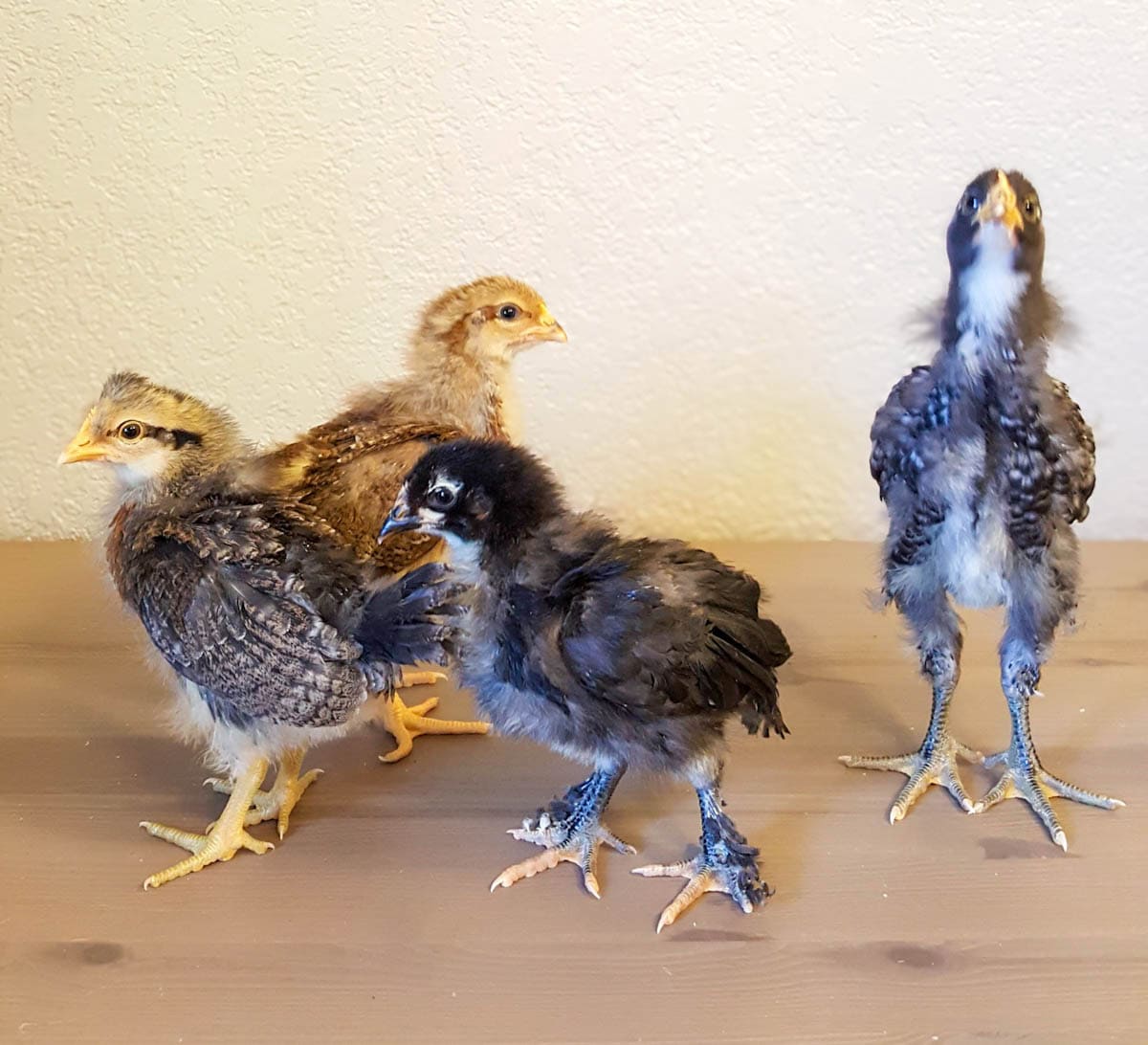
PRO TIP: In my experience, it’s easiest to compare characteristics between chicks of the same breed. Otherwise, there are differences between breeds that may keep you guessing too! For example, Marans chicks tend to grow feathers more slowly than other breeds, and Barred Rock chicks are often bigger than other breeds too.
5 Ways to Sex Chicks
1) Autosexing Breeds
Some chicken breeds are considered “autosexing”, where it’s easy to distinguish male vs female chicks by different physical features (such as color or distinct markings) as early as day one. In the animal kingdom, this is known as sexual dimorphism. Many hatcheries offer autosexing breeds as an easy way to guarantee females without vent sexing.
Reliable autosexing chicken breeds include Dorkings, Crested Cream Legbars, Welsummers, Bielefelders, Rhodebars, and many other less common breeds. Some autosexing chick characteristics are quite obvious: like the distinct dark chipmunk stripes down the back of female Crested Cream Legbars, compared to the lighter body color and yellow head dot found on males.
Other examples of sexual dimorphism are more subtle, and therefore may be more difficult to rely on.
For instance, male Barred Rock chicks usually have larger, scattered or irregular white spots on their head, while female Barred Rock chicks have a smaller, more distinct white head spot. Yet this can be hard to quantify or compare – especially if you only have one Barred Rock chick in your flock! (Our girl Zoey had a very large irregular white spot.) Male Barred Rock chicks also usually have more evenly yellow legs, whereas females have subtle black or gray on the front of their legs instead.

2) Size, Stance, and Legs
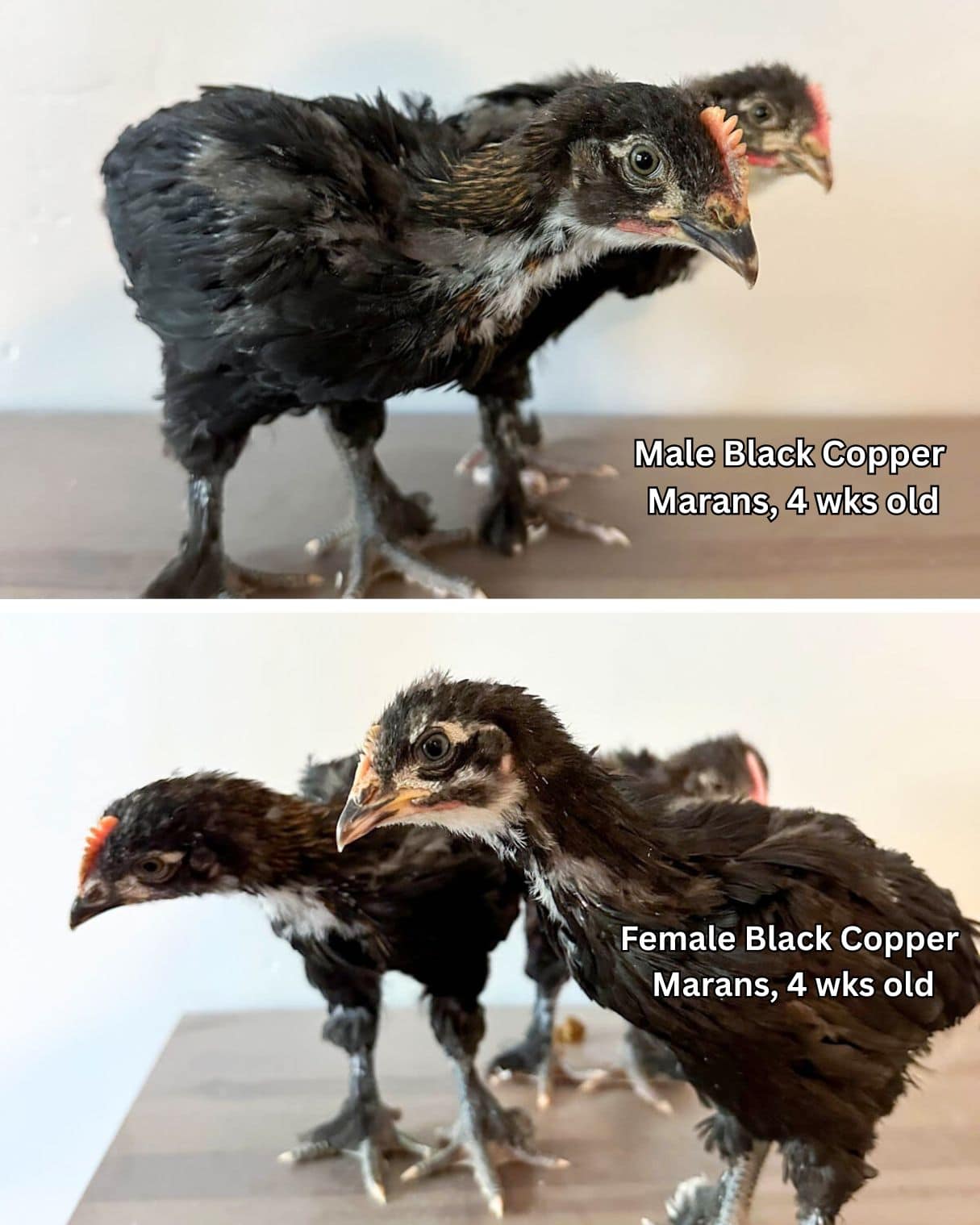
Compared to female chicks of the same age, male chicks tend to grow larger and faster. They often stand up taller than their female counterparts too… you know, practicing puffing out their big impressive chests and all! Male chicks also tend to have thicker legs and feet than female chicks.
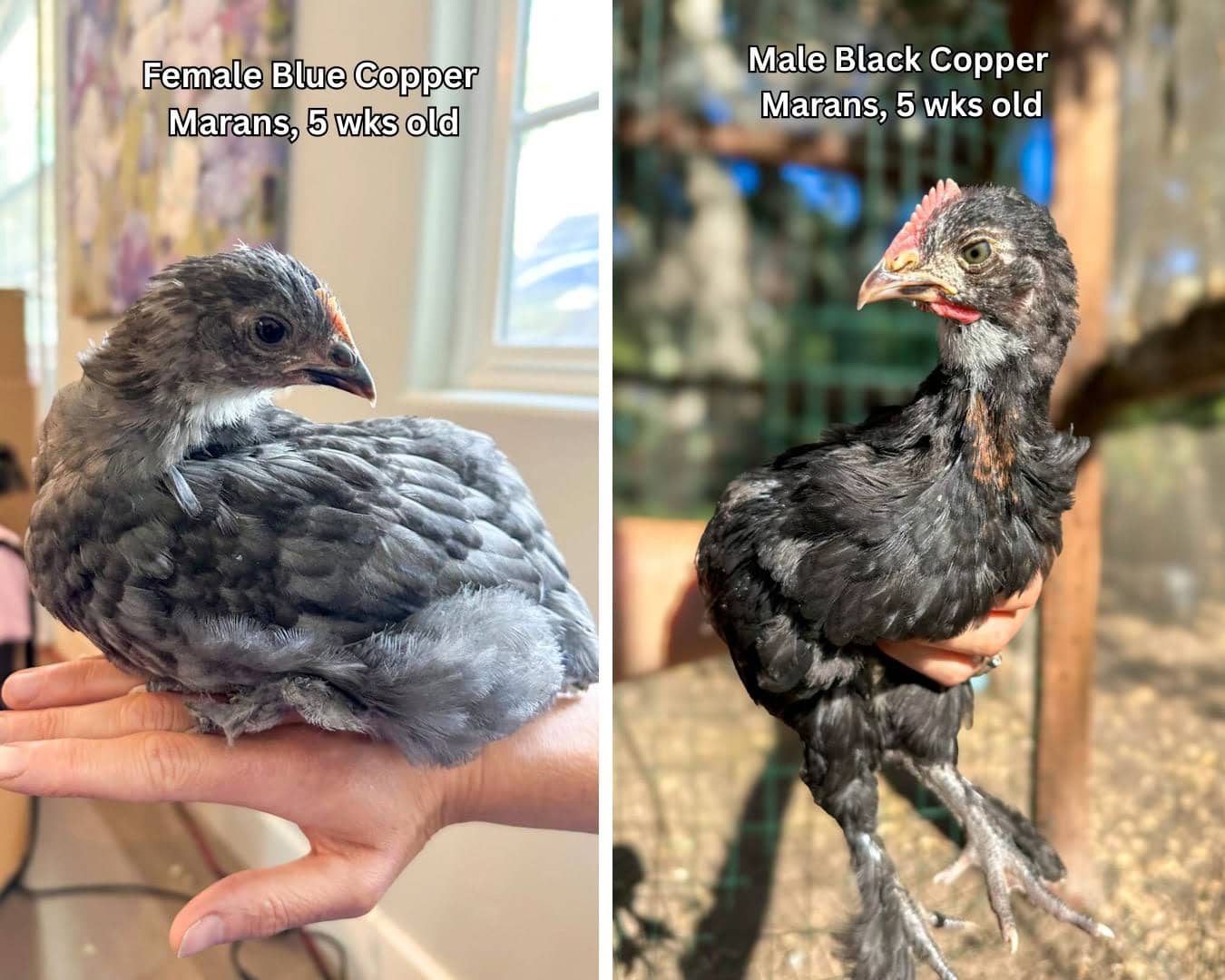
This is especially easy to compare between several chicks of the same breed. We had several Blue and Black Copper Marans in our last group of chicks, and the boys definitely got larger faster! I could tell the difference within just a few weeks, especially combined with their comb development and behavioral differences.
On the other hand, I was once convinced our Barred Rock chick Zoey was a male for many weeks because she was HUGE compared to our other chicks (different breeds)… but she turned out to be a female!

3) Combs and Wattles
Another way to tell the difference between female and male chicks is by watching their combs and wattles develop. Both hens and roosters have combs and wattles. Some hens have impressively large combs, even bigger than roosters! For either sex, a bright red comb is a sign that the chicken is healthy and sexually mature.
The comb and/or wattles on male chicks usually grow sooner and larger, and turns bright red earlier. Most rooster combs will be quite noticeable around 6 to 8 weeks of age, though some of our male chicks had obviously larger combs by 3 weeks old!
In contrast, female chicks combs and wattles usually grow in later (10 weeks or older) and stay lighter pink until they’re 16 to 20 weeks, only turning bright red when they’re about to start laying eggs.
PRO TIP: Remember that comb and wattle size varies greatly depending on breed and comb type. For instance, Ameraucanas and “Easter Egger” hens and roosters both have very small pea combs rather than a classic tall pointed single comb. Pea combs, cushion combs, rose combs, and other petite combs can make sexing chicks more difficult than other comb types.


4) Sexing Chicks by Feathers
Another key difference between male and female chicks is their feathers.
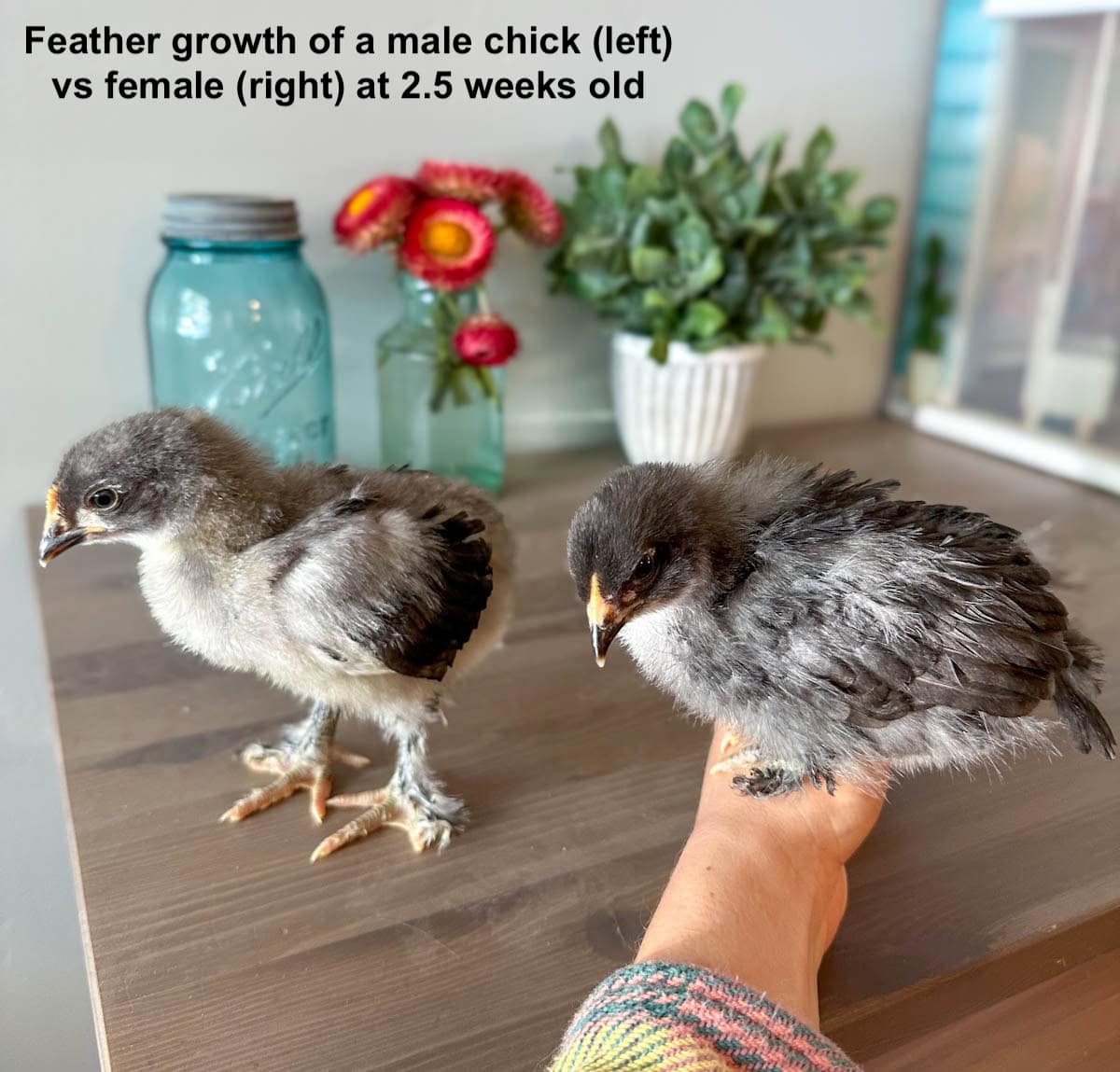
As young chicks (1 to 3 weeks old), female chick feathers often grow in more quickly than males, including faster wing and tail development, so they can appear fully-feathered sooner. See the example photos below.
This was one of the most obvious ways I accurately sexed our last batch of chicks at just one week old! The Marans boys still looked like little fluff balls while the girls already had long wing and tail feathers (though this can vary with breed). Their early comb development confirmed my suspicions a few weeks later.
As they mature, feather differences become even more obvious. Hen feathers stay more uniform, short, and blunt, while full grown roosters have long majestic neck, back, and tail feathers (also known as hackle, saddle, and sickle feathers respectively). Around the age of 9 to 12 weeks old, male chicks will start to show noticeably longer and pointed saddle feathers. Hackle and sickle feathers start to show around 14 weeks or older.



Wing feather sexing
There is another form of feather sexing that allows poultry professionals to distinguish between cockerels and pullets by examining wing feathers just after hatching. With this method, the feathers on male chick wings are even lengths while female chicks have irregular or alternating feather lengths on their wings. See image below.
Some backyard chicken keepers like to try to apply this method to their home flock, but further research reveals that wing feather sexing is only reliable in controlled environments where sex-linked chickens are bred to retain this trait (e.g. as part of a commercial poultry operation) though it can occasionally apply to backyard chickens successfully as well.

5) Behavioral Differences
Rooster behavior
Appearances aside, there are a number of behavioral traits that can give you a clue if a chick is a rooster or hen.
In addition to standing taller, male chicks may get extra rowdy and fight amongst each other more, trying to show off for the ladies or compete for the best roost. With our last batch of chicks, the males started jumping and fighting with one another when they were under two weeks old! (Female chicks will do this a little bit too, but our boys were far more relentless about it.)
Male chicks may also start to practice “tidbitting”: where roosters scratch, dance, and give short, high-pitched clucks near food – a signal that he found some tasty treats and wants to share with his girls. Yes, roosters are quite the gentlemen!
Despite their mean reputation as adults, young cockerels can also be the sweetest birds in the flock. In fact, male chicks are often the most friendly and readily-handled of the group.
And of course, the final and perhaps most obvious sign that a chick is male: he will start to crow. Though a rooster won’t belt out a respectable crow until he’s 4 or 5 months old, young male chicks usually start exercising their vocal cords and start trying to crow as early as 6 to 8 weeks old.

Pullet behavior
One tell-tale behavior of older female chicks is the “submissive squat”. As pullets near maturity and are close to egg-laying age (16 weeks or older), they will often start to squat low and spread their wings as you approach. You can bend down and give them a nice little pet on the back, but it’s not pets they’re after… Female chickens squat as a sign they’re ready to mate with a rooster, and lay eggs! Check out this post about when do chickens start laying eggs: 5 signs to watch for.
Interestingly, pullets or hens may also exhibit “masculine” tendencies in the absence of a rooster, including tidbitting, issuing predator warning calls, or even crowing (though this usually happens far later than it would for males). Our eldest hen Hennifer has tried to crow on occasion, and our Crested Cream Legbar hen Phoebe grew leg spurs!

What to do with young roosters?
If you end up with a cockerel, consider keeping him if you can! Roosters are excellent flock protectors, keeping watch and alerting the others when predators are around. Roosters are often very friendly with their favorite humans too.
Otherwise, you can re-home your rooster to a nice farm where he can live out his life, or at least provide food for a family. Check your area for local animal or farm sanctuaries, or even “rooster rescues”.
Listing the rooster on Craigslist or Facebook marketplace is another option, but be sure to do research to ensure they’re not going to inhumane situations (like cockfighting operations). We have successfully re-homed several young roosters through a local Facebook chicken group.

And that’s the 411 on sexing chicks.
All in all, I hope this guide gave you plenty of tips to help identify male and female chicks. I also hope you have a blast raising them! I miss having them around so much. Please let us know if you have any questions in the comments below, and consider pinning or sharing this post if you found it useful.
If you’re new to keeping chickens, be sure to check out these important related articles:
- 10 Ways to Keep Chickens Cool During Summer or Heat Waves
- 10 Tips on Caring for Chickens in Cold Winter Weather
- When Do Chickens Start Laying Eggs? 5 Tell-Tale Signs It’s Soon!
- How to Store & Wash Fresh Eggs: Best Practices
- Feeding Eggshells or Oyster Shells for Essential Calcium & Health
- How to Ferment Chicken Feed for Better Hen Health & Eggs


4 Comments
Kendra
My first hatch ever from a blue laced lemon head bantam cochin’s eggs fertilized by a partridge silkie rooster resulted in five cute little chicks. Two of them were slow feathering lavendar based chicks and the other three were fast feathering orange, black, and white chicks. I insisted that the lavendar chicks must be males and the prettier more colorful chicks must be males. I DNA tested the three females to find out they are males. The two slow feathering females took after their silkie daddy’s slow feather pattern. The lavendar turned into blue lace as the girls aged. Now they look like clones of their mom with smaller combs/waddles, dark eyes, five toes, and dark skin. The boys carried their mom’s fast feathering gene without the beautiful lacing pattern. Oddly many of the females with the cochin and silkie cross end up with the laced pattern. The boys show zero lacing.
DeannaCat
Hi Kendra, interesting, thanks for sharing your story and experience.
Olga Sheaffer
Very interesting article. Now I know what to look for next time I buy my chickens.
MaryEtta Palmer
One can assume sex differences in baby chicks I a couple other ways. Gently hold a baby chick upside down:.after a few seconds, the female will calmly hang while the male will try to right itself by lifting its head. Also, there is a difference in the feathers under the wing, near the shoulder but the chick needs to be very young.